Heather Conn Blogs

spoutin’ about by the sea

Sixty attend teens’ hike to save Wilson Creek forest

                                                              — Jack Stein photo

This week, I had the pleasure of watching a five-year-old boy, camera in hand, staring up at Douglas firs, their tall tops reaching past the mist in a Sunshine Coast forest.


He had stretched his head far back, almost parallel to the mossy ground, as if his brain needed space just to take in the sight of these massive trees. I wondered what he was thinking, if this moment would leave a memory of awe that would remain to adulthood. More importantly: Would these trees in Wilson Creek, BC even be here in a year?

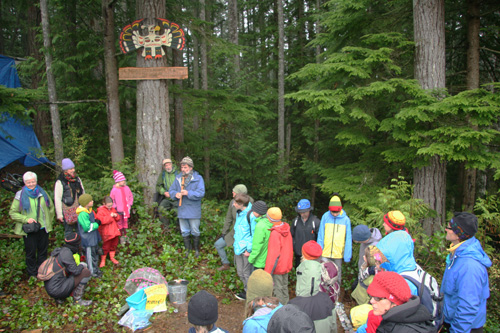
The boy was among dozens of children of all ages, one of 60 local residents who’d come to hike through, and learn about, this remarkable low-elevation forest that’s slated to be logged. Three Coast teens—Jillian Olafson, Kamilla Hindmarch, and Galen Wilson—had organized this educational hike, along with retired teacher Karen Stein, to help save these precious 27 hectares from logging.

Before the hike, at the mouth of the trailhead, we stood in a circle below the wooden sign created by Sechelt First Nations member Willard Joe, which depicts Thunderbird, a powerful protector and mystical figure.

                                                                                                      — Jack Stein photo


We were each invited to choose a small smooth rock, from a pile of 100 brought for this purpose, and write one word that these woods inspired in us. Soon, several rows of rocks appeared, bearing words like “Peace,” “Preserve,” and “Love.”

Jillian Olafson, young friend, Kamilla Hindmarch, Galen Wilson

“One beautiful possibility is for this part of the forest to be left as a park for us all to enjoy,” Stein told the group. “This is our community forest. You are the next generation. Today, you represent all the children who live on our coast.” When asked for one word to describe this forest, Olafson replied: “Magnificent.”

The government of B.C., which owns this land, has issued a licence to enable the District of Sechelt, as shareholder of the Sunshine Coast Community Forest, to log this forest, known as cutblock EW002. It is one of the last intact, natural forests left in the Wilson Creek watershed. Its largest tree, a Douglas fir, measures 2.31 metres across.

“This forest is much more valuable alive than clear-cut,” Hans Penner of the conservation group Elphinstone Logging Focus (ELF) told the gathering. He said he hopes that local residents of all ages who want to save this forest tell the District of Sechelt: “You’re a public body. We expect you to listen to the public.”


Several of the event’s teen organizers plan to meet with District of Sechelt representatives on Nov. 23 to discuss alternatives to logging this forest. “It’s a beautiful place to be,” said co-organizer Wilson. “We can’t let it (logging) happen. It would destroy everything.”


Some local teachers have taken students through this forest to learn about the forest’s biodiversity, thanks to informational trail signs provided by volunteers. The event’s organizers planned the hike as part of a home-schooling peace project.


ELF member Bill Legg told the children: “You guys really have a voice.” He reaffirmed the land as traditional territory of the Sechelt (shíshálh) First Nations, who have used this forest for centuries for hunting and gathering.

ELF member Ross Muirhead speaks to the group

Meanwhile, about 100 Sunshine Coast residents, including Sechelt nation members, held a rally Nov. 15 outside the District of Sechelt office, hoping to tell mayor John Henderson and city council members that these 27 hectares of forest should be protected as parkland. Although no such representatives appeared, people at the gathering, including many who had attended the forest hike in Wilson Creek, openly shared their opposition to logging this area.


Sunshine Coast residents who want to save this forest are urged to write letters to the local media and to the District of Sechelt. Click here to find out more through the ELF website.

, , , , ,
November 18, 2012 at 8:14 pm Comments (4)

Seek peace on Remembrance Day — and always

On Remembrance Day, I woke up at about 4:30 a.m., unable to sleep. Oddly, I was thinking of the life expectancy of a tail-gunner in the Second World War. These men, who operated machine guns while cramped into a highly visible plexiglass bubble in the rear belly of a plane, were exceptionally vulnerable to enemy fire. I had heard that they rarely survived a week of such work. Other sources say seven weeks or two flights. Twenty thousand of such allied gunners died during the war.


I can’t imagine what it would be like to take on such a high-risk task, knowing with complete certainty that you would be dead within weeks. Flying so exposed at high altitudes, these men often suffered frostbite. As lookouts, if they relaxed their guard for a moment and missed seeing an enemy plane, they and their crew mates could be dead within seconds.


Yet so many young men willingly undertook this dangerous role. I would like to honour the courage of such men and the thousands of others at battle on land and sea, who died for the cause of freedom against fascism and Nazi power from 1939-1945. But ultimately, is any war justified?


Remembrance Day always brings me conflict. I admit that I enjoy freedoms now because of those who gave their lives in the past. My heart aches for those whose young sons and daughters have died in a global conflict, for the veterans who have returned, suffering from post-traumatic stress disorder and receiving little government aid.


Yet, I don’t support the hype around labeling dead soldiers “heroes” when they were exploited as pawns in a war for oil interests under the guise of “liberation,” as in Iraq, Afghanistan, and the Persian Gulf. I am a pacifist, committed to nonviolence. I don’t even like using the term “enemy.” I praise the nonviolent resistance movements of Martin Luther King, Jr. and Gandhi. I support the notion of ahimsa, which yoga master Kripalu describes in the following way:


Ahimsa is the state that exists when all violence in the heart and mind have subsided. It is not something we have to acquire; it is always present and only needs to be uncovered. When one practices ahimsa, or nonviolence, one refrains from causing distress—in thought, word or deed—to any living creature, including oneself.


Many people might think that this state is unattainable. Yet, we can all become more conscious of the conflict within ourselves, which we project onto others. Peace begins within. Would I be willing to take up arms in self-defence? Probably. Does that make me a hypocrite? I don’t know.


On Remembrance Day this year, Yoga by the Sea offered a peace meditation at the same time as the memorial ceremony held at the Legion in Roberts Creek. Dozens of people gathered to meditate, in silence, for about 40 minutes. I think that such events are a wonderful counterpoint to the honoring and continuing of war. Peace rhetoric is easy; living it is a daily challenge. Let’s all strive for peace within our hearts and share this every day, as best we can, in forms both big and small.

, , , , ,
November 13, 2012 at 12:13 pm Comments (2)

It’s not too late to stop ratification of the Canada-China Investment Treaty

Two days past its ratification deadline, Prime minister Stephen Harper’s Canada-China Investment Treaty (FIPPA) remains unsigned. That’s good for Canadians.

Harper will soon arrive in India, touted as the largest democracy in the world, to wrangle more business deals. While there, maybe he can pick up some democratic principles of his own, rather than ignoring parliamentary procedure in his home country and the views of thousands of Canadians in how he handles Chinese investment.

As Canada’s Green Party leader Elizabeth May has stated on her website, 32,000 Canadians signed her party’s petition against this treaty. Her office received more than 75,000 emails against the deal and 5,000 used her website to send their MP letters to warn of the danger posed by dealing with the Communist government in Beijing. And the organizations Leadnow.ca and Someofus.org had more than 70,000 signatures on their petition against FIPPA.

I won’t recap here the many dangers related to this treaty, from security threats to China’s non-reciprocal powers and legal clout, because they’re amply covered across the Internet. Instead, I’ll quote from journalist Terry Glavin’s recent commentary in The National Post: “It’s the sudden emergence of the most powerful criminal enterprise in world history suddenly establishing itself as the most powerful capitalist entity in Canada by securing its place as the critical and irreplaceable component of Prime Minister Stephen Harper’s sole economic strategy, which is to transform Canada into an ‘energy superpower.’”

Glavin points out that China’s National Offshore Oil Corporation (CNOOC)’s $15.1 billion pending bid for Calgary’s Nexen Inc. is the biggest-ever overseas acquisition move by a Chinese state-owned enterprise. Petro-China, meanwhile, pumps more oil than Exxon-Mobil. And the annual revenues of the China Petroleum & Chemical Corporation, known as Sinopec, exceed the entire sum of the annual federal tax revenues of the Government of Canada.

Surprisingly, for a deal that gives the Chinese sweeping control over key Canadian resources and the right to sue any level of government that doesn’t go along with its business ventures, the NDP has done little to condemn this agreement. So far, Elizabeth May is the only politician to take a strong vocal stance against this treaty.

Canadians have made it clear that they don’t want their federal leader handing unprecedented powers to a corrupt, foreign country that will gain massive control over this country’s resources. At the very least, this issue needs to be debated in Parliament in a process that includes provinces, territories and First Nations. Let’s stop FIPPA now.

Click here to read Terry Glavin’s opinion piece. To receive updates on this issue, join the Facebook page of SomeofUs and LeadNow.

, , , , ,
November 3, 2012 at 12:22 pm Comments (0)

MLA tells Defend Our Coast supporters: “You’ve done the Sunshine Coast proud”

— Heather Conn photos

Sunshine Coast MLA Nicholas Simons with Sechelt band elder Theresa Jeffries

This was no Sesame Street public spelling bee. And Big Bird and Elmo were nowhere to be seen. Instead, dozens of local people lined Highway 101 yesterday in Davis Bay, BC., each holding a white sign with a different single letter, which collectively spelled out the phrases: “No Tankers,” “No Pipelines,” and “Defend Our Coast.”


These were some of the 500+ Sunshine Coast residents who gathered along both sides of the highway as a public, collective voice to reinforce that most British Columbians are against the Northern Gateway pipeline, proposed by Enbridge, and do not want supertankers off their coast.

Local school trustee Lori Dixon

As a symbolic gesture, the line of protesters extended roughly 235 metres, to represent the length of a supertanker along the Sunshine Coast. Event organizers placed two hand-painted white sandwich boards next to the highway to indicate where the tanker’s bow and stern, respectively, would appear.

“They [tankers] can’t turn, they can’t stop and they’d take eight kilometres to stop for an emergency,” Jef Keighley of Alliance 4 Democracy, one of the main organizers, told protesters. They gathered in the Beach Buoy parking lot at 1 p.m. after their one-and-a-half-hour public action. “And that’s in open waters with no navigational hazards.”

At least 90 percent of drivers who passed the demonstrators honked their horns in support, according to one of the letter-card holders, who did not want to be identified. This included drivers of commercial heavy-duty trucks, dump truck operators, people in luxury vehicles, and not surprisingly, Smart cars.

One irate male senior stopped his grey van on the highway, rolled down his window and hollered at protesters: “Did you drive to this event? How did you get here?” (He presumably found it hypocritical to burn gasoline to get to an event protesting oiltankers and pipelines.) Increasingly enraged, he repeated his questions until driving off.


The protest, which featured homemade signs by people of all ages, was peaceful. It included members of the Sechelt First Nations band, such as elder Theresa Jeffries and local school trustee Lori Dixon, plus teachers from the region, and representatives from the Sunshine Coast Conservation Association. Local RCMP officers were on hand to ensure the safety of participants and asked them to move back farther onto the shoulder, away from the highway.

After the event, demonstrators heard rousing roadside comments, via megaphone, from Keighley, local activist George Smith, and Nicholas Simons, NDP MLA for Powell River-Sunshine Coast. Keighley pointed out that unlike Norway, which captures about 70 percent of the value of its oil, Canada (via Alberta) receives only one per cent in royalties from the gross (not net) value of its bitumen. (Bitumen is the heaviest, thickest form of oil, which Alberta wants to transport from the tar sands via the Enbridge pipeline to Kitimat for initial processing. Then supertankers would take it through the fragile coastal B.C. coast waters and to China for final refining.)

After all of the related capital cost improvements are made, such as building the Enbridge pipeline, tanker terminal etc, Canada would receive only 25 percent of the net value, which will amount to less than one percent in royalties, said Keighley.

“We’re paying the cost to the environment and in jobs,” he said. “This is bad for B.C., bad for Alberta and for the Canadian economy.”

Smith, who has been active in the fight to stop the Site C dam in northeastern British Columbia, outlined the connection between that megaproject and the Enbridge pipeline and tar sands. The provincial government wants to use water power from the proposed new dam for fracking, in the search for natural gas, and for Shell Canada’s liquid natural gas project in northern B.C., he said. The gas would be shipped to the tar sands, then the oil sent to the coast via the pipeline. This, in turn, would enable oil and gas companies to export their product more cheaply to Asia.

“B.C. gives $300 million a year in royalty and tax breaks to oil and gas companies,” Smith said. “They [the B.C. government] are planning to eliminate 83 kilometres of rivers and 13,000 acres of class one farmland [to build Site C].”

Standing on a picnic table not far from his local constituency office, Simons acknowledged that the gathering was on traditional Salish territory. He told the group: “You’ve done the Sunshine Coast proud. Our voices are not solo voices. They are a choir of voices in the right key for the right people to hear.”

The Davis Bay protest was one of dozens of Defend Our Coast actions held yesterday across the province, including demonstrators linking arms outside MLA offices. Defend Our Coast told local organizers that the Davis Bay event was likely the biggest one of the 65 related events around British Columbia. Many thanks to all who participated and helped plan and organize the Sunshine Coast action, including the flyover pilot and photographer (you know who you are).

, , , , , , , ,
October 25, 2012 at 12:36 pm Comments (0)

Defend Our Coast rally in Victoria: Are you listening, Harper and Clark?

— photos by Heather Conn

Beyond the crowd’s cries of “No pipelines, No tankers,” one woman’s tears and anguished tale exemplified the heart and spirit of yesterday’s Defend Our Coast rally in Victoria, BC.

Melina Laboucan-Massimo (with paper); Clayton Thomas-Muller (r) 

“Our way of life is being replaced by industrialized landscapes,” Melina Laboucan-Massimo, a member of the Lubicon Cree First Nation in Alberta, told a crowd of about 3,500 in front of the Parliament buildings. “We are surrounded by mines the size of cities.”

Laboucan-Massimo, a Greenpeace campaigner, cried as she described the impact of a May 2011 oil spill, which leaked five million litres into her traditional territory in Alberta’s tar sands region. (The territory, which comprises 10,000 square kilometres in northern Alberta east of the Peace River, contains more than 2,600 oil and gas wells.)

People in her community, of all ages, were suffering burning eyes, nausea, and headaches but didn’t know why, because the federal government did not notify them of the spill until five days after it occurred, which just happened to be the day after the federal election. “They [the federal government] tried so hard to deny that there was a problem. They put my community at risk.”

At this demonstration led by Coastal First Nations, Laboucan-Massimo described how members of her extended family are now afraid to fish or hunt in their territory because they think that eating what they catch, if contaminated as a result of oil extraction, could make them sick. Moose, their traditional food staple, is disappearing due to tar sands’ activity.

Almost 70 percent of Lubicon territory has been leased for future oil development without consent by the Lubicon people and in direct violation of their treaty. “The land and people will never be the same. I continue to carry that grief,” Laboucan-Massimo said, through tears, to extended applause. “We need to stop the tar sands at the source.”

But First Nations groups are fighting back. Laboucan-Massimo said that today, the Athabasca Chipewyan First Nation will present a constitutional challenge, which they filed earlier this month, in the joint review process against Shell Oil Canada’s application for the expansion of their Jackpine Mine tar sands project.

And a variety of First Nations chiefs and hereditary chiefs from western Canada, clad in ceremonial attire, all declared at yesterday’s rally that they oppose the Enbridge pipeline and will not allow its construction in their territory. Aboriginal singers and drummers repeated this message through their rousing musical beat as the sweet aroma of burning sage wafted into the front of the crowd.

Dave Cole, national president of Communications, Energy and Paperworks Union, challenged the standard rhetoric that pipelines build jobs and the economy. “These pipelines are job killers,” he said to cheers. “These pipelines are bad for the environment. They destroy the economy of Canada.” He added: “First Nations and labour . . . we’re all united in ‘No’ to this pipeline. If they come after one of us, they come after all of us.”

Maude Barlow, national chair of the Council of Canadians, urged attendees to view Canada’s pipelines as part of a broader “carbon corridor,” which includes liquid national gas, fracking, and TransCanada’s Keystone pipeline, currently under construction in Texas. She asked the crowd to join in solidarity with the individuals and organizations opposing such mega energy projects. “This [opposition to oil and gas extraction and expansion] is the most important fight that we could have right now,” she said. “Pipelines are the artery, the blood lines of the tar sands. Harper is selling out our environment and heritage for money.” Barlow was heading up to Fort McMurray last night to provide added vocal support to the constitutional challenge by the Athabasca Chipewyan First Nation.

Green Party leader Elizabeth May, meanwhile, warned that the people of B.C. have to send a message to premier Christy Clark to stop FIPA, the Canada-China Foreign Investment Protection Agreement, before it is slated to come into effect on Nov. 1. This treaty gives Chinese-state-owned businesses considerable rights in Canada without any reciprocity for Canadian companies in China. It sets out obligations for Canada which will become binding for a minimum of 15 years (!). What’s worse, it’s slated to be passed without even a parliamentary vote. (For more info on the treaty, read the post on May’s website.)

May offered this challenge: “Christy Clark, get yourself a lawyer.”

The demonstrators, who included children, Raging Grannies, and concerned B.C. residents of all ages with satirical and strident placards, braved the day’s damp cold and mid-afternoon rain. One young woman standing near me asked if I wanted a muffin and handed me a delicious mini one that she had baked herself.

What a delightful offer from a stranger, an act that typified the day’s atmosphere of camaraderie in unity. Some of the First Nations leaders even thanked Canadian prime minister Stephen Harper for bringing unity to their ranks across the west and nation; many tribes and bands are presenting a solid force against his stance of promoting pipelines and the tar sands.

Nicholas Simons

More than 30 people from the Sunshine Coast attended the rally, joining a host of environmental groups, non-profits, unions, and people from many communities across the province, including Tofino, Kamloops, and Prince George. Nicholas Simons, MLA for Powell River-Sunshine Coast, appeared in the crowd to give his support.

Suzanne Senger (left)

Judith Hammill

Sunshine Coast residents Suzanne Senger and Judith Hammill were among those who participated in the group action of stretching a 235-metre-long black banner around the legislative lawn, then staking it into the ground. The cloth banner symbolized the length of an oil supertanker.

Protesters briefly blocked Belleville Street, but there were no arrests or violent acts associated with the demonstration. Co-emcee Clayton Thomas-Muller, of the Indigenous Environmental Network, gave us a reminder from Gilbert Soloman: “We need to fight this fight with love in our hearts.”

The rally was held to give a broad public message that British Columbians overwhelmingly oppose the proposed Enbridge Northern Gateway pipeline, the planned twinning of the Kinder Morgan oil pipeline from Edmonton to Burnaby, and oil supertankers on Canada’s west coast. The Enbridge pipeline would transport  Alberta oil sands bitumen to Kitimat for export to Asia.


For more info, see Defend Our Coast.

, , , , , , , , , ,
October 23, 2012 at 4:25 pm Comment (1)

Celebrate this week’s Gospel Rock victory

When elected officials bend to the will of the people and vote accordingly on important community issues, it is a rare and beautiful thing. We enjoyed such a momentous event three days ago, when the five-person city council in Gibsons, BC voted unanimously in favour of leaving the Gospel Rock waterfront as undeveloped greenspace. Wow. And council will not consider related issues to the proposed Gospel Rock development, such as density, access, and its impact on the town’s aquifer, for another five years.


What a surprise! This truly unexpected decision brought shocked looks from councillors Lee Ann Johnson and Dan Bouman and tears from Mayor Wayne Rowe and councillor Charlene SanJenko. I can’t interpret councillor Gerry Tretick’s expression because I wasn’t there. I was one of the cynics who had assumed that the full Gospel Rock development was a done deal and wanted to avoid seeing that confirmed at Tuesday’s meeting.


Boy, am I glad that I was wrong. This vote renews my faith in the ability of a small group of committed people to change the minds of decision-makers and create positive change. Some people in our community have been fighting to protect Gospel Rock for decades. We all choose our level of involvement in any issue, and for some, it’s enough to attend meetings, perhaps write the occasional letter to the editor, or speak at a public hearing. That’s all worthy activism. But it always takes people in the trenches with a vision and ideals, who persevere over months and years to plan strategy and meetings, raise funds, send emails, lick envelopes, and keep the message rolling on, and most important of all—to never give up—to make the ultimate difference. That includes both individuals and groups like Friends of Gospel Rock.


Last night, at a victory party at a Gower Point Road home, many people from those trenches and ones who spoke out at last week’s public hearing gathered to celebrate this week’s decision. (At that hearing, only three people from a speaker’s list of about 50, spoke in favour of the bylaw amendment to incorporate the Gospel Rock Neighbourhood Plan into Gibsons’ Official Community Plan bylaw 985, 2005. For more details on that, see my post “Preservationists dominate public hearing for bylaw amendment.”)


Having people from the community of all ages speak out did, indeed, make a difference. Yahoo! This latest decision has given renewed fire to those who want to raise funds to create the Gospel Rock area as a park. Sure, this latest waterfront development issue could be a mere bargaining chip in a larger process, and decisions made to woo voters is always at play, but that doesn’t matter. You will always find people who care and ultimately vote from their heart, even at unexpected times and places. A community rallied, made its views known, and the people’s representatives heard. That’s sweet success.

, , , , , , , ,
October 19, 2012 at 1:19 pm Comment (1)

Preservationists dominate public hearing for bylaw amendment

While the fight to save Gospel Rock in Gibsons, BC has continued for decades, last Thursday’s public hearing at Elphinstone Secondary was the last chance for community members to express their views regarding the related bylaw amendment. (The second reading of the amendment came on July 31.)

When I arrived early and saw many rows of empty seats, I was afraid that the proceedings regarding the amendment (#985-8 2012) to incorporate the Gospel Rock Neighbourhood Plan into Gibsons’ Official Community Plan bylaw 985, 2005 would move ahead with little local feedback.

But by the 6 p.m. start, hundreds of people had already filled seats. Within about 20 minutes, the speaker’s list had more than 40 names. Within the first hour, passionate voices to preserve Gospel Rock, plus those who did not support the neighbourhood plan in its existing form, outnumbered the pro-amendment people by roughly seven to one.

Those in favour of the amendment said that they thought the consultation process had gone on long enough. They acknowledged that the existing plan wasn’t perfect, but felt it was a catalyst for moving forward.

Lorne Lewis, Sunshine Coast Regional District director for Area E (Elphinstone) spoke against the amendment, charging that the current plan for waterfront development was “unsafe and unpalatable,” making access to the proposed area dangerous.
Another speaker recommended creating a nonprofit society and raising money to make Gospel Rock a park, in the same way that the region’s Francis Pt. Peninsula Provincial Park was created. But political will is needed for such an action, she pointed out.
Here is an overview of the opinions expressed against the bylaw amendment and existing neighbourhood plan:
  •  the waterfront is not preserved
  • a development would threaten Gibsons’ aquifer and the town’s water supply
  • it doesn’t follow the policies of the OCP, especially regarding densities
  • it lacks smart-growth policies
  • it doesn’t save forest for community use or protect biodiversity
  • it removes the existing wildlife corridor
  • there is no mention of geothermal energy
  • it threatens Seaward Creek
  • the east part of the proposed waterfront area is an unstable geotechnical zone
  • it doesn’t take into consideration the impact of global warming
  • it doesn’t consider the impact of additional traffic onto Chaster and Pratt Roads
  • the proposed access does not meet fire regulations and requirements by provincial government’s transportation ministry
  • it ignores the area’s designation as sensitive ecological inventory, as defined by the province.

Gibsons Council will vote on the bylaw amendment tomorrow, Oct. 16, at its regular meeting, which starts at 7 p.m. The community group Friends of Gospel Rock encourages concerned citizens to attend.


, , , , , ,
October 15, 2012 at 4:36 pm Comments (0)

Bonnie Raitt was great in Vancouver


Forget her sheer talent, voluminous red hair, and soothingly smooth and craggy voice. Bonnie Raitt made her Friday night concert in Vancouver, BC a delight by her inclusive, humble presence. What other lead singer would introduce a roadie, then invite him to play guitar on one of her band’s songs?


Throughout her two-hour show at the Queen Elizabeth Theatre, Raitt readily gave herself over to her bandmates to let each one shine. Keyboardist Mike Finnigan shared amazing lead vocals with throaty blues on two songs. Two of her musicians – James Hutchinson on bass and drummer Ricky Fataar – have played with her for 30 years, displaying obvious abilities to quickly match Raitt’s improvisational choices. Her four-piece group, including guitarist George Marinelli, were clearly having fun with Raitt as a good friend. “I’ve missed you guys,” she told them.


Raitt’s new tunes, from her latest CD Slipstream, included a great reggae version of Gerry Rafferty’s Right Down the Line (I like it better than the original) and Dylan’s heartbreak song Standing in the Doorway. The latter left Raitt choked up; she shared that when that stops happening, she’ll stop playing music. Tears were pouring down the face of the woman seated next to me.


Raitt received numerous standing ovations throughout the night. Her 1989 CD Nick of Time is one of my favorites and she played three songs from it: Thing Called Love; Have a Heart; and I Will Not Be Denied.


I loved that Raitt was so honest and direct with the nearly sold-out audience. Defying society’s age hangups, especially for women, she readily admitted that she was 62. She expressed gratitude for the audience’s respect, stating that she never once saw someone’s cell phone light appear in the darkness. She reapplied lipstick several times throughout the night, sharing that she was too cheap to have someone else do her makeup and was horrified when she saw what she had looked like in a previous video.


I’ve admired Raitt for decades, not just for her powerhouse female presence in a male-dominated business, but for her activism in so many areas, from environmental protection to formerly providing sanctuary for El Salvadoreans during their nation’s war. (I saw her in Seattle at an unadvertised show about 25 years ago to raise money for the Sanctuary movement, which helped El Salvadoreans leave their country safely.) During the Vancouver concert, she asked: “Have you heard that we’re having an auction, an auction for president?”


As an encore, Raitt invited local blues rocker Colin James to join her band onstage for a few songs, along with opening act John Lee Sanders. I found keyboardist Sanders and his band ho-hum, more suited for a small dance club than a large venue like the Queen E., but I did appreciate his soulful sax-playing.


I’m grateful that Raitt now has her own label Redwing Records, which gives her greater power and control over her work within the music industry. I don’t much care that Rolling Stone has made her #89 on its list of 100 greatest guitarists of all time. For me, she embodies a compelling feminine mix of grace, grit, and grassroots generosity. As Will Hermes said four months ago in Rolling Stone: “Bonnie Raitt is such a class act it’s easy to forget she’s kind of badass.”


, , ,
August 12, 2012 at 2:23 pm Comments (0)

What kind of change agent are you?

Awareness. Commitment. Action. One person alone can’t alter an entire economic system, but working with others who are committed to take action to change it can make a difference. That’s one of the messages of The Story of Change, the latest in environmental activist Annie Leonard’s animated video series The Story of Stuff.


In this six-minute short, Leonard blames bad policies and business practices for our current western economy, which values profits over people and the planet, and creates enormous inequities in taxation and income. It’s not enough, she says, to be a smart shopper and stop buying stuff that you don’t need that will end up in a landfill. We need to demand changes from politicians, regulators, and manufacturers.


The movie explores what effective change-making has looked like over time, presenting two world examples of successful mass change: the U.S. civil rights movement under Martin Luther King Jr., and India’s shift to independence, spurred by Mahatma Gandhi. Neither of these pivotal events of social transformation would have happened, Leonard says, if the respective leaders, King and Gandhi, had pursued their quest as loners.

Annie Leonard

She emphasizes that any significant effort to build a better future shares three key factors: a big idea, a commitment to work together, and the ability to turn the big idea and commitment into action.


I wholly agree, and yet the movie fails to acknowledge the value and power of inner growth and change, which often creates the launching pad for external action. The spiritual beliefs of both King and Gandhi were major influences behind their desire for change and their commitment to peaceful resistance. If King and Gandhi were themselves violent people, they could not have inspired and led others towards peace and dramatic social change. Their inner change had to come first.


That’s one reason, in my view, why many collective attempts at change fail. The so-called leaders haven’t done enough inner growth work (whether it’s in aid of maturity, anger management, compassion, forgiveness, love etc) to walk the talk and inspire others without creating emotional meltdowns, hatred, resentments, and disillusionment. The resulting hypocrisy and contradictions between their espoused views and goals and their daily behavior become too discordant for many followers, who often quit in disgust.


As they say: Never underestimate the power of one human being to make a difference. As Gandhi said: “We must be the change we want to see in the world.” Someone’s presence, demeanour, and attitude, even with no words spoken, can alter any atmosphere or group.


I believe in the approach Heal Yourself, Heal the World. Yet, as Leonard points out, it’s not enough to remain isolated after changing yourself for the good. Only when you join with like-minded others for a larger cause can widespread change take place.


What kind of change agent are you — networker or nurturer, builder or resister? Discover your “changemaker personality type” (communicator, builder, networker, nurturer, investigator or resister) in the short quiz following the video.

, , , ,
July 23, 2012 at 8:15 pm Comment (1)

Green your Canada Day — show that you care about our environmental future


Happy Canada Day! This year, I’ve avoided the parades, entertainment, and other public hoopla that normally come with our nation’s birthday. However, I did wear green for our national birthday, as advocated by Nanaimo, BC resident Dana Haggarty.


“I would like to see green added to the celebrations this year, so we can all show that we care about our environment and we don’t support the government’s changes to environmental protection,” says Haggarty, a PhD student at the Biodiversity Research Centre at the University of B.C.


This marine biologist invited all Canadians to wear green on Canada Day as a symbolic gesture against the Conservative Party’s omnibus budget bill, Bill C-38. Sadly, this bill, which eliminates a cutting-edge environmental research centre and decades of environmental regulations, fisheries and species protection, has just passed in the Senate. Its legislative changes will soon be law.


“The stories of cuts and closures to scientific labs have really affected me and my colleagues working on ecological integrity monitoring that have lost their jobs from the cuts,” says Haggarty.


Our prime minister is poised to begin more program cuts, layoffs, and amendments to environmental assessment, including measures that weaken the legal clout of the federal Fisheries Act and Canadian Environmental Assessment Act.


That’s ironic, since Canadians consider the country’s wilderness the best symbol of “what Canada really is,” even beyond hockey and our flag, according to a Canada Day poll by Ipsos Reid. We’ve allowed Stephen Harper to trample on our natural heritage and threaten the very earth and ecosystems that we cherish as a nation and people.


That’s not even mentioning the other unwanted aspects of Bill C-38, like cuts to old-age security benefits, employment insurance, health care, immigration—even stiffer penalties for marijuana use. All will become part of our new reality as Canadians this year.


That’s why I support Haggarty’s Green Canada Day as a collective sign of protest. As she says on her website:


  • I will wear green to send a message that our country’s identity is our environment.


  • I will wear green to protest the dismantling of environmental protection through changes to the Fisheries Act and repeals of the National Round Table Act and the Canadian Environmental Assessment Act.


  • I will wear green to protest what has been dubbed the “environmental devastation” act, bill C-38, and how we have not been consulted.


  • I will wear green to show that I care about our climate and I am ashamed that our government has missed all of their targets and has no adequate plan to cut emissions.


  • I will wear green to protest funding cuts and closures to our important centres of environmental research: the Experimental Lakes, PEARL, the Centre for Plant Health, the Bamfield Marine Science Centre, and others.


  • I will wear green to protest cuts to Ecological Integrity Monitoring in National Parks and cuts to the Contaminants Program Fisheries and Oceans.


  • I will wear green to protest cuts to fish habitat management at the Department of Fisheries and Oceans.


  • I will wear green for my health and the health of my unborn children.


  • I I will wear green for our land, water and air.


  • I will wear green for our climate and environment.


  • I will wear green for our oceans.


  • I will wear green for our wildlife, our trees, our plants, our animals, our fishes.


  • I will wear green for you, for me, for our future.

 “This land is your land, this land is my land . . .”


, , , , , , ,
July 1, 2012 at 5:33 pm Comments (0)

« Older PostsNewer Posts »