Heather Conn Blogs

spoutin’ about by the sea

Occupy Vancouver: 3,000+ bring power to the people


“First they ignore you

Then they laugh at you

Then they fight you

Then you win” – Gandhi

(on a sign at Occupy Vancouver)


“In times of universal deceit,

Telling the truth is a revolutionary act”

— George Orwell

(on a sign at Occupy Vancouver)


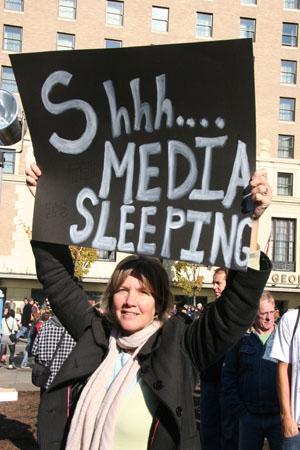
Under the menacing glare of gargoyles perched high on the corners of Hotel Vancouver, across from looming RBC and HSBC buildings, we gathered downtown, 3,000+ strong on Oct. 15. This Occupy Vancouver movement, spawned by weeks of Occupy Wall Street activism in New York City, had set up a sprawling camp of tents, plus tents for food, first aid, public education, and a children’s area, in front of the art gallery.


                                                                                                               — photos by Heather Conn

A handful of friends and I from British Columbia’s Sunshine Coast sat on the edge of the mosaic fountain in front of the Vancouver Art Gallery, surrounded by people of every age, ethnicity, and background: infants, white-haired grandmothers, laid-off workers, disgruntled professionals, business people in suits, women in high heels and fashionable dress, bohemians in masks and costumes . . .They were all a highly visible part of the 99 per cent of western society seeking to be heard and counted as banks, corporations, and governments have gained hugely skewed levels of power, making decisions with little accountability over issues that affect the earth, the public good, and livelihoods. As activist Naomi Klein said a week earlier as part of Occupy Wall Street: “Our system is crashing economically and ecologically.” As one of the dozens and dozens of homemade signs in Vancouver, held high among the throng, said on this day: “Another world is possible.”


I was heartened to see more than a thousand people gathered by 10 a.m., after premier Christy Clark and others had dismissively predicted that few would appear at the event. More and more people kept arriving, until at least 3,000 (some reports claimed 5,000) marched peacefully in a square along four downtown blocks, starting northward at Georgia and Howe. No one smashed windows, threw food at cops, or yelled verbal abuse at passersby. Cars honked in support of the moving crowd. A police officer wore an orange flower in his lapel. The sea of signs gave heart and meaning to what was a living, growing statement (not “a protest”) shared with others who were organizing publicly on the same day in 1,000 cities across the globe:


“One World, One Humanity, Share the World’s Resources”

“Serve the people”

“Close the gap”

“Vancouver wakes up”

“A fair taxation system is overdue”

“We’re the #1 Highest Child Poverty Rate in Canada – Way to go B.C.”

In the first general assembly that morning, various speakers, as part of a moderating team, stood on the art gallery steps and explained the proposed working model for consensus. As defined in the handout provided to the crowd: “A consensus is a decision-making process that attempts to be inclusive and accommodating of the desires and needs of an entire group.” Workers in Venezuela and other Latin American countries have used such models for decision-making in factories and collectives. As one of the moderators pointed out: “It’s not pretty.” It was slow, tedious, and the process bumbling. We were all new at this; our capitalist system had not created models for such forms of decision-making. People would holler out occasionally: “This is what democracy looks like.”


Eager for action and group-based agreements, I grew impatient as different speakers read through the consensus document, word for word, using the mike and then having people within the crowd repeat each phrase in a “human mike” format. Requests went out for translators in a host of languages, from Farsi to Spanish. Hand gestures were given as symbols for how each participant could indicate whether he or she agreed with a proposal, had reservations, would stand aside (“I cannot support this proposal and will not help implement it but do not want to stop the group or block the proposal”) or would block it (“I have a fundamental disagreement with the proposal that must be addressed and has not been resolved”). This repetitive process took an hour and a half.


I was soon growing bored and frustrated. I had to examine my own impatience and desire for a quick outcome, over the inclusion of all questions and requests for something to be repeated. Rather than feeling energized, hopeful, and excited, this process left me feeling deflated and in limbo. But the non-stop stream of informal speakers from the crowd, who took turns at the microphone, helped to draw me back to the power of a group assembly. (The maximum time allotment for each speaker, decided by the group as a whole, was five minutes.) A speaker asked: “Do you trust the system?”

“No,” the crowd roared back. If the group thought that someone was going on too long or the remarks were too self-serving, they hooted or called “Wrap it up” or made the accompanying hand signal. Here is a selection of those who spoke, besides David Eby of the B.C. Civil Liberties Association and Seth Klein (Naomi’s brother) of the Canadian Centre for Policy Alternatives:


  • Bob, a unionized meter reader for BC Hydro, who will be replaced by a smart meter within a year, after receiving only a 1% pay increase in a decade: “Gordo (former premier Gordon Campbell) exempted smart meters from due process”;


  • an artist from Montreal: “We’re losing our neighbourhoods”;


  • Paul Grignon, creator of animated films such as Money as Debt;


  • a representative from Zeitgeist Vancouver, part of the Zeitgeist world movement: “What are the root problems?”


  • Activist and grandmother Betty Krawczyk: “Our environment is going, our wild salmon are going. We won’t tolerate it. Their (government/corporate) power comes with our permission, from our acquiescence. True power is in our hands. The power belongs to us, always and forever.” That brought on loud cheers.


  • The Raging Grannies: “Your right is to be heard.”


Later that day, after meeting a client and some of his medical colleagues for lunch at upscale Shaughnessy Restaurant, I was heartened (again) to hear that one of them, a successful doctor, had wanted to join the Occupy Vancouver events himself. He said that he had felt like going down there and throwing something. I was surprised to hear such a remark in that context from such a professional; you never know where you’ll find someone of like mind.

The day’s events did not topple any existing structures or result in resounding changes. However, the simple act of people coming together in peace in a public space to voice discontent and seek more compassionate and inclusive alternatives was a powerful reminder that the power of the people lies innately with the people and in democratic process. We are the power of the majority and we control how much of that we choose to keep or give up.

After returning home just before the seven p.m. general assembly, my husband and I stopped to watch an astounding natural sight: thousands upon thousands of crows were flying, seemingly without end, through the sky. They kept coming and coming, a sprawling black flap of wings across blue, heading east above the Commercial Drive SkyTrain station. They appeared to be coming from downtown. I thought to myself: “Maybe they had their own gathering.” I had never seen such a massive group of crows in my life. I took it as a sign.


Click here for a Buddhist perspective on Occupy Wall Street, by Buddhist teacher and psychotherapist Michael Stone, author of Awake in the World: Teachings From Yoga and Buddhism for Living an Engaged Life.


Click here to watch U.S. news commentator Keith Olbermann outline what Wall Street protesters want (October 05, 2011)


, , , ,
October 18, 2011 at 12:50 pm Comments (5)

9/11: In One Degree of Separation, a Growing Distance

This week, my guest blogger, again, is Frank McElroy. As I  mentioned in last week’s 9/11-related post, this is his follow-up piece to what he wrote about September 11 a decade ago:


The loss of the Trade Center was deeply personal to me.  My brother and I know the man (Karl Koch) whose family company erected the buildings; for decades, my father, an orthopedic surgeon, treated Karl and he was often in our home.  My brother and I had a wonderful visit with him in October 1968, looking, through the night, over all of New York from the top of one of the towers.  In that view, seemingly of the entire world, it was palpable that there was something about and among us, a sense of shared purpose and identity.  Today, that sense has been drowned by an endless and immeasurable lack of civility, a contrarian and senseless interaction, an absence of concern about our larger family and each other.


It is a mere ten years since the World Trade Center in Manhattan was consigned to its grave.  In that short period, Americans have given up their optimism, their belief that if we work together, good and some measure of prosperity will come.  We have ceded our privacy to dubious authority in favor of asserted needs for endless security, our calm and good will to fear and paranoia.  We have reaped the “neither” and nothing of Ben Franklin’s astute warning: “They that can give up essential liberty to obtain a little temporary safety deserve neither liberty nor safety.”


Now, after a commission’s investigation, countless hours of testimony and seemingly endless documentaries, we are privileged to learn that in this single event, America experienced the greatest string of failures, possibly complicity, in every part of government. This, particularly, applies to our President (George Bush), his Cabinet, the FBI, and the CIA.  Incompetence at the level of the tiniest failure that occurred should have led to firings, indictments, incarceration.  Nobody responsible for the massive failure is on trial, in jail, accountable.


But our nation was glad to wrap itself in the flag as the smoke continued to emanate from the hole in southern Manhattan. This marked a coming together, it seemed, in some ways, to celebrate the heroics and  unending courage of so many who dealt with the mess.  Yet, now, with a bit of distance in time, we ignore the claims for health benefits made by those same heroic and courageous members of our big family.  And we can do that easily because Americans are no longer anything like a family.  Nothing America is about is shared commonly —  any number of charlatans falsely claim the history of the country and claim to have the answers to every problem we face, individually and as a country.  Thrown overboard, the commonweal has sunk to the bottom in favor of the furious drumbeat of fear, pushed by desperate politicians currying favor with business and by the largely spineless and insipid media our Constitution so powerfully protects.


Not long after 9/11, Hurricane Katrina battered New Orleans and many small towns — another event that demonstrated both the failure of our government and our character as Americans.  Seven years later, that disaster continues, but is largely forgotten except by those who continue to exist in its endless wake.


Yesterday, just before Labor Day, I watched footage from Newfane and Jamaica in Vermont, two small towns on Route 30, places I love and mentioned in my piece back in 2001. After 9/11, I was driving north from Marblehead, through a flag-waving America in New England, so desperately wanting to feel like a family, to share something common and comforting after a foreign force had ripped the American fabric to shreds.  Looking now at the roads and bridges lost to Tropical Storm Irene, days after it happened, I didn’t see any flags being waved, any response at all except the sadness and desperation that come when we reflect, in the face of real disaster, that we really are alone, that all is lost.


That has become a mean calculus in America, seized by some to  enhance the division of the country by wealth, race, religion, sex, politics, employment, and every other factor.  The degrees of separation between us might be the same as they were in 2001, but the distance between us has grown dramatically in the last decade.


Anticipate, hope, and work for better days.  Peace.


, , , ,
September 15, 2011 at 7:27 pm Comment (1)

Tenth anniversary of 9/11: one degree of separation

In this past week, marking a decade since the 9/11 disaster, I have watched several powerful documentaries about that horrific day, including “9/11: Heroes of the 88th Floor.” (This focuses on Port Authority workers Frank De Martini and Pablo Ortiz, who saved the lives of dozens of people trapped in the World Trade Center, only to die themselves in the collapse of the towers.) I find such tales of selflessness, and the pay-it-forward response to those rescued by such heroes, truly uplifting, despite the horrendous circumstances.

But my husband, a New Yorker, refuses to watch such shows. He thinks that they over-hype the event, exploiting tragedy, and manipulating sentiment. He finds reminders of 9/11 too upsetting. For two days, following 9/11, he heard the U.S. military jets continue their deafening flight between Boston and New York, circling the skies night and day, and zooming directly overhead his home in Marblehead, Mass., north of Boston. (Who needed such overkill, when all flights were grounded?) He bears his own connection to what happened that September day, which I share below.

To honor his response to 9/11, and those who died that day, their loved ones who remain, the survivors, and those who worked so generously in the clean-up and aftermath, I include my husband’s article, which originally appeared in the Marblehead Reporter. It was later reprinted in The New York Times. This year, the editor of the Reporter asked him to write a follow-up piece, which I will include next week. Stay tuned.

One degree of separation


Frank L. McElroy

Marblehead

On the 11th day after the 11th day of September 2001, I found myself in escape driving through the heart of New England from Marblehead to southwestern Vermont. It couldn’t have been soon enough or more necessary to try to leave behind, even for a moment, the horror of the destruction in southern Manhattan and in Virginia.

Ellen, Mad and I drove along the winding roads of New Hampshire and Vermont, the names of the small towns passing by – Wilton, Peterborough, Dublin, Dummerston, Newfane, Jamaica, Winhall and Peru.

These are tiny places far away from the island of Manhattan, where I was born and where Ellen produced and directed broadcast advertising. Yet people in these places are more closely connected to New York than one might imagine.

The connection was made obvious in the messages which lined our route. There were innumerable flags displayed, beginning in Nashua and continuing the entire route, the greatest density on the roadside likely being in Dublin, N.H. Sign boards related a supportive or conciliatory thought: “Stand Tall America,” “Pray for those who died on Sept. 11,” and “Proud To Be An American/Proud To Be From New York.”

America is a nation of small towns and New York City just happens to be the biggest of all. People in the little towns have always known this – now New Yorkers have learned the same.

I didn’t think I knew anyone who died in the conflagration. My father was safe, as was my niece who lives on Manhattan. A week after the bombing, I connected to the Cornell University Web site. That early list of alumni dead numbered three, and I knew one. Not well, just an occasional acquaintance in the class below me who was a remarkable lacrosse player.

When I saw that name, all courage drained from me. I couldn’t search for any more friends or classmates that day or for days after, because I knew there would be more. And there will be, for everyone.

When the final list is made, many of us will discover that a lover, friend or classmate has been lost. What we won’t directly observe is that this calamity is so awesome and extreme that the six and seven degrees of separation which supposedly connect us all have been pared to one, maybe two.

When we are able to read the final list of the dead, I fear it is safe to say that nearly every one of us will either know someone who died or someone who knew or was related to a victim. In this there is a parallel to the Second World War. Other parallels include extraordinary acts of bravery and heroism, during the attacks and afterwards and continuing.

Driving along New Hampshire 101 and Vermont 9 and 30, I found no relief from the fear and heartache of the earlier 11 days. Looking at the messages, remembering the images, I cried, Ellen cried, Mad, too. We have grown accustomed to our even existence, won and preserved by so many who have come before us and made immeasurable sacrifice.

That existence is forever changed, but I am calmed by the knowledge that the loss occasioned by the brutal attacks is one shared so directly, by so many.

, , ,
September 9, 2011 at 9:38 am Comments (0)

Are you ready to call a minga?

In the last few weeks, I’ve learned a new word: minga. (My husband joked that it must be some version of Mingus, as in Charles, and started doing some free-form jazz on an air trombone.) A Quechan term, it roughly translates to “a community coming together to work for the benefit of all.” I came across it in the book Me to We, by Craig and Marc Kielburger. The authors describe a dilemma they had in Ecuador in a remote, mountain village, where they had come to build a school for local children. Due to delayed transport and delivery of supplies, their rate of construction was lagging far behind their schedule. Reluctantly, they realized that they would have to leave the needy community with the school only half-built.

That’s when they went to the village chief, the oldest woman in the community, for help. Through a translator, she told them: “No problem, I’ll just call a minga.” She took a few steps outside her simple hut and hollered, in Quecha: “Tomorrow . . .there will be a . . . minga.” The next morning, hundreds of people were in the village square. Women had arrived with infants on their backs, men had left their fields at prime harvest time, and young children were standing with eager eyes. They had come to build the school, walking countless kilometres to get there. Many of the kids who showed up lived too far away to even attend the school, but they came anyway. None of these people expected anything in return. They had  brought food and shared it with the authors and their volunteers. The authors state: “In a matter of hours, they did what would have taken us days, if not weeks, to accomplish.” Immediately after the new school was completed, all of these people participated in a lively celebration to honour the new building, then quietly disappeared.

A minga: “Upon hearing the word, people stop everything for individual gain, no matter how important, to come together for the collective good.” The authors tried to think of an equivalent English term, and other than “barn raising”,  the closest they got was “a riot, but for good.” What does this lack of such terminology say about our culture and language?

One reason that I love my community (Roberts Creek on British Columbia’s Sunshine Coast), is its minga-like sensibility. People readily pitch in to benefit others in the area, whether it’s volunteering to paint the local Legion, to host a fundraiser for Japan’s tsunami victims or hold a silent auction to give financial support to a neighbour with cancer.

Yet, the dominant culture in the West still clings to a fierce “Me first” philosophy, valuing getting ahead and competing with one’s neighbour far more than mutual support and cooperation. The reality show The Survivor exemplifies this perfectly; ironically, while in this Ecuadorean village, the authors met one of the participants of the first Survivor show. He was so put off by the hype and papparazzi and image-based associations of the show, that he chose to get as far away from that as possible and flew to live in this remote part of the Andes.

I recommend the book Me to We to everyone. I think that it should be required reading in schools. (The authors co-founded the global activist organizations Free the Children and Me to We.) Their book encourages people to take an issue that they care deeply about, then imagine calling a minga to get people to help. They suggest the following:

“Make a list of how you could call one [a minga] in your community. Ask yourself:

  • Who would help me? Friends? Parents? Coworkers?
  • What tasks would I need help with?
  • How would I call my minga? By sending out a group email? By making a presentation to my faith group? By posting a hand-printed notice in my office?

It’s amazing how many people in our lives are ready to help out . . . all they need is someone to ask them.”

, , , ,
September 5, 2011 at 10:11 am Comments (0)

Open Mind, Open Heart: Finding mindfulfulness every day

From reconciliation to quantum physics to suicide, suffering, and death, the topics recently covered by Zen master Thich Nhat Hanh always returned to four things: mindfulness, love, understanding, and meditation practice. I was one of the lucky people who attended his sold-out talk “Open Mind Open Heart” on Aug. 14, which the inspirational Buddhist offered at Vancouver’s Orpheum Theatre. I’ve long admired this insightful Vietnamese monk for his books of wisdom, his commitment to nonviolence, and his role in urging Martin Luther King Jr. to speak out against the Vietnam war. Hanh is one who truly walks the talk, literally and figuratively, when it comes to bringing full presence and loving speech to life.

He sat onstage, legs folded on a simple cushion, in his floor-length brown gown and characteristic shaved head. About a dozen male monks stood to his left and about 20 Buddhist nuns to his right, all in the same brown gowns, visiting from his Plum Village retreat in France. Hanh spent one-and-a-half hours sharing Buddhism’s “noble truths”, simple stories, and ways to exercise mindful breathing to help handle challenging conflict. He spoke calmly and fluidly, with no notes, and left room for humour despite his serious subject. He laughed after saying: “If you’re suffering when you’re sitting, breathing, and walking, your [meditation] practice is wrong.”

Any summary provided here will barely do justice to the value of his words, which prompted me to begin reading his book on anger, and wanting to meditate more regularly. One reason why I like Hanh’s approach is that he practices “engaged Buddhism,” which  transforms meditation practice into activism.

Manifesto 2000: Six steps to peace

As Hanh pointed out, it’s a lot easier to talk about deep listening, loving speech, and compassionate behavior than to live it. He mentioned Buddha’s Five Precepts embedded in the Manifesto 2000, written by Nobel Peace Prize laureates, which UNESCO circulated and the United Nations accepted. The pledge, aimed to make individuals feel responsible for creating peace at the personal level, includes these responsibilities, in brief:

1.  Respect all life.

2.  Reject violence.

3.  Share with others.

4.  Listen to understand.

5.  Preserve the planet.

6.  Rediscover solidarity.

Sounds simple, right? Obviously, the world at large is not reflecting that. Yet each of us can begin with making our own behaviour, every day, more peaceful and mindful. Hanh outlined regular exercises in mindful breathing, such as recognizing a painful emotion, scanning one’s body for tension, then smiling and releasing the tension. He said that within three months, this practice would generate a feeling of happiness and joy.

“A cloud can never die”

He spoke of suicide, chosen by so many young people who cannot bear painful feelings. Yet, an emotion can last for only a half-hour if we bring our attention down to the level of the abdomen, feel it in our bodies, and release it. This takes ongoing practice. Hanh spoke of common dilemmas in life: “Many of us sacrifice the present for the future” and “Many Buddhists think they will only be happy when they are reborn.” Yet, he reinforced that joy and happiness are available right here, right now by being in deep contact with others and all around us. To love someone, he said, you have to understand your own suffering and theirs, which gives rise to compassion. This requires deep listening and loving speech, and can lead to reconciliation, even between parents and children who have had no contact in many years. He gave several examples of this from people who have attended his retreats.

Hanh reinforced that the concept of something moving into nothing, such as the common societal view of death, is not true. “A cloud can never die,” he said; it simply becomes rain or hail.

The event began with music, song, and interactive exercises, performed by the monk “choir”. It ended with a beautiful, plaintive song, performed in French and English by an elderly nun with a gentle, lined face, which invited listeners not to fear death. Overall, the afternoon was a wonderful communal experience, one for which I feel tremendous gratitude.

, , , , ,
August 25, 2011 at 11:53 am Comments (2)

Do your choices lead to social change?

Have you ever wondered if today’s overwhelming array of choices — whether it’s food products, sex partners, careers or reading material — disempower, rather than serve you? If so, then you’ll enjoy a 10.5-minute animated presentation narrated by sociologist and legal theorist Renata Salecl.

Her premise is that under capitalism, too many choices create anxiety for us. (Raised under Communism in the former Yugoslavia, Salecl challenges that form of ideology too.) As social beings, we’re inclined to choose what others choose, she says, and we worry about how others will regard our choice. Not clear on “What do I really want?”, we become frozen, pacified, and indecisive. (I agree, although many independent thinkers do disregard popular opinion and make choices that seem to serve themselves far better.) We try to make an ideal choice, but there never is one. Therefore, we experience loss (reaction to the choice(s) we didn’t make), which can provoke more anxiety. Sounds cheery, right?

Salecl mentions a lawyer friend of hers who gets anxious when he has to order a bottle of wine. If he gets one that’s too inexpensive, he worries that he’ll look cheap. If he buys something pricey, he figures his fellow diners will think he’s showing off. So, he buys a moderately priced bottle and then feels guilty and anxious for having others’ supposed opinion of him determine his choice.

That makes me think of a food line-up I was in years ago at Capers in Vancouver, BC. A man in a suit in front of me, whom I later learned was a judge, seemed to have untold difficulty deciding which juice to choose from the refrigerated shelves. I watched him, amazed, as he seemed to wrestle for about five minutes with the choice. Later, I thought: How on earth, while on the bench, does he choose people’s fate? Are those choices easier for him because they’re pre-determined, more or less, by the law?

I recognize how quickly I feel overwhelmed when shopping somewhere with too many choices; that’s one reason why I rarely go to Costco or ever shopped at Granville Island Market. Salecl says that too much choice precludes social change because people end up feeling so anxious and powerless, they don’t want to risk more vulnerability. Afraid to lose what they already have, they won’t join others to organize and confront authorities to seek change.

In Salecl’s view, the myriad of choices under capitalism reinforces the myth that “Everyone can make it.” If individuals don’t reach their dreams, they feel guilty for their perceived failures, or shame for being “poor”, however that’s defined. Unfortunately, instead of criticizing society for this, people too often turn their criticism inwards, railing at themselves for not measuring up and never feeling good enough. A variety of malaises can result, from anorexia and bulemia to workaholism and other addictions.

Overall, Salecl’s premise is that the ideology of choice prevents social change. Workers (what she calls “proletarian slaves”) end up believing that they are in charge and have control (as consumers) when someone else (a boss or company) determines their livelihood.

It sounds dismal but too true. Unfortunately, Salecl’s presentation doesn’t present solutions. I think that self-awareness and nurturance of an inner sense of self, beyond the socially created “ego”, is a huge first step. If you are aware of your true desires (not those imposed on you), you can mindfully make more choices that serve your real needs, not those that advertisers and the consumer world say are yours. If we could all internalize the belief “I’m okay exactly the way I am” rather than “I’ll never be good enough,” that would spawn a massive social revolution. External change, inspired by inner growth, makes for the greatest and most meaningful change, in my view.

, , ,
July 9, 2011 at 1:09 pm Comment (1)

2011 Sustainability Congress: one step closer to regional change

Okay, so I learned a lot more than what dematerialization is — and it’s not when someone on Star Trek vaporizes, then reappears in regular form. It is the process of directing more activities “to achieve an improved quality of life that is not based on increased consumption of materials, will allow continued economic growth, and help redress the imbalance in resource consumption between industrialized and industrially less developed countries” (Metro Vancouver definition).

When I first heard about the 2011 Sustainability Congress hosted by Metro Vancouver, BC, I was skeptical. The five featured male panelists were all what I’d call power brokers in mainstream business; I hardly expected them to come up with grassroots solutions that weren’t blinkered by privilege and prosperity. They were David Berge, Vancity’s senior vp of community investment; Tun Chan, director of The Vancouver Foundation; Stephen Owen, vp of external, legal and community relations at UBC; Robin Silvester, president and CEO of Port Metro Vancouver; and Bing Thom of Bing Thom Architects.

Yet, as one of 600 registrants who attended this free event, held June 25 in downtown Vancouver, I came away feeling contentedly surprised. Each speaker revealed far more insights and sensitivity to the needs of the Metro Vancouver region than I had expected. With a focus on three pillars — environment, economy, and society — the first part of the event highlighted these issues:

  • the value of First Nations culture and our need for connectedness and a revitalized sense of community;
  • competing pressures on land; the impact of population; the limitations of the landscape (mountains, waterways, and a delta) that define the area
  • our region’s vulnerability in the event of a widespread catastrophe such as a pandemic
  • a desire to return to small, community-responsive businesses on Vancouver’s Downtown Eastside and elsewhere
  • a need for more cross-cultural sharing of all ages in media, neighbourhoods, and religious practices, beyond token events like an annual Multiculturalism Day. One solution: Build up regional town centres and make them cultural hubs.
  • Over the next five years, women will be the biggest growth economy, double the combined growth of China and India (!)
  • Sustainability takes strategic thinking; leadership; collaboration and dialogue; a change in thinking at the individual level; and participation. Tung said: “Knowledge is nothing unless you put it into action.” (Rather than sustainability, Owen preferred the terms “resilience” and “mitigation.”)

_______________________________________________________

“Sustainability was far more than just a buzz word to these executives”

_______________________________________________________

The panel of “community leaders,” moderated by Vancouver Sun columnist Vaughn Palmer at the Fairmont Waterfront Hotel, began the Saturday event, which ran from 9 to 2:30 p.m. As a whole, the tone of their talk was warm and spirited, yet pointed, with an obvious “Let’s get to it” refrain. These weren’t guys who just ramble along, spouting rhetoric. They’re results-oriented, solutions-based thinkers who function in a context of success (literally, in Chan’s case — he’s former CEO of S.U.C.C.E.S.S.). It was clear that sustainability was far more than just a buzz word to these executives; they were familiar with top thinkers and contemporary authors in the field.

I enjoyed Thom’s comments the best. He was the most outspoken, considering it lunacy to have built Richmond on land so vulnerable to outside forces, from earthquakes to sea-level rise. He noted that it will cost billions to replace the dykes in Richmond as a result, and he called the decision to run the Canada Line to Richmond “insane.” Instead, “We needed it to Coquitlam.” He stressed the need for a clear head when making such large, regional-use decisions: “We need to think strategically.”

As someone immersed in the arts who makes creativity my lifeblood, I loved these remarks by Thom: “Don’t underestimate the power of culture and the arts. The human heart is only twelve inches away [from our head] but it’s the hardest to reach.”

Johnny Carline, Metro Vancouver’s commissioner and chief administrative officer, said that he heard less on energy from the speakers than he had expected, and I agree. I heard very little mention of transportation issues and alternative energy, other than Owen who mentioned that UBC is looking at bio-energy for its heating system. (I was surprised to hear Owen citing Guy Dauncey, a popular author on climate change solutions, and president of the B.C. Sustainable Energy Association. That pleased me.) Within the “society” pillar, I heard nothing about the homeless and creating affordable housing. Similarly, Metro Vancouver’s initiative to use incineration for waste disposal makes a mockery of clean-air concerns and worries about greenhouse gas emissions. 

_______________________________________________________

We were meant to answer: Where do we need to focus time and resources?

Who should lead the charge?

_______________________________________________________

Following the panel event, attendees broke into groups in separate rooms, to discuss responses and possible solutions, and ultimately, to vote on five priority areas defined by Metro Vancouver: food; climate change; energy; security; and dematerialization. (Before the Congress, we had received by email the worksheet Future of the Region: Building a Shared Roadmap.) For each of the five topics, we were meant to answer: Where do we need to focus time and resources? Who should lead the charge?

At my table, our group of nine was a great mix of thinkers and experience, ranging from a PhD student at UBC focusing on food security issues, and a woman from Society Promoting Environmental Conservation to a businessman who does propane conversions on vehicles. A Metro Vancouver employee served as our informal moderator and kept us on task. We shared respectful, open-minded, and passionate talk, discussing whether a certain area would be best handled by Metro Vancouver, local groups, or at the national and international level.

(I found it intriguing that some of the opinions voiced around security issues in post-Canucks-riot Vancouver echoed the same ones I heard that week at a community meeting in rural Roberts Creek on the Sunshine Coast: We don’t need a bigger police presence. People at the community level need to be more watchful of each other.)

After a working lunch and our separate discussions, we reconvened upstairs as a plenary, where we each received a small, portable voting machine to vote electronically. The results were immediately tabulated and displayed on large screens before us, dividing us into our professional groups, ranging from business and government to “other” like me. The majority thought that Metro Vancouver was the best level to address all of the areas, except for security. (Click here to see the results breakdown.)

I applaud Metro Vancouver for seeking public feedback on these important issues and hosting such a well organized, multi-media event. We didn’t revolutionize change in the region or the world in a day, but we did create strong footing and inspiration for future action.

To make sustainability a reality, we need to create connections across, and beyond, many otherwise political, social, and cultural barriers. When it comes to saving our future and our planet, we need a broad vision that requires building new relationships with an open mind. This Congress helped to forge that path.

The Congress was live streamed and a video of the proceedings is available on the Metro Vancouver website. The event will be broadcast on Shaw TV on July 10 at 9pm, repeating at July 16 at 4pm, July 17at 3pm and  July 23 at 9am

(For anyone who thinks that technology hasn’t taken over communication, consider this: When Congress moderator Johnny Carline asked who, in the gathering of hundreds, did not own a cell phone, only about 10 people put up their hand.)

, , , , ,
July 5, 2011 at 12:56 pm Comments (0)

Annie Leonard says: NOPE, We need systemic change

As far as inspirational speakers go, I’d put my friend Annie Leonard among the top. I recently heard her give a talk to several hundred folks on Salt Spring Island, BC in Canada’s Pacific Northwest. After listening to her impressive knowledge of depressing facts regarding pollution levels and how we’re destroying our planet — “We’re in a system in crisis” — you’d think that I’d come away feeling hopeless.

Not at all. Instead, her passion, smarts and insightful perspectives inspired me to take immediate action on an issue I had previously dismissed. Her talk expanded my view of how we can make meaningful and lasting change on a broader scale. I felt invigorated by her enthusiasm.

We’ve all heard the quick ways to help our planet: Ride a bike. Unplug appliances. Buy organic produce. Start a vegetable garden. Yet, when it comes to truly transforming the planet and society, a focus on small, individual actions is ultimately a placebo and mere distraction, says Annie Leonard of The Story of Stuff fame.

“We’re so used to identifying with our consumer role: Shop differently,” she told a crowd of young and old at Salt Spring Island’s Centre for Child Honouring. “We have to start to re-engage as a citizen and engage in our civil society. Our citizen muscle has atrophied.”

She reinforced that individual lifestyle changes are not enough. As a provocative systems thinker, Annie believes that we need deeper, systemic change and to ask tougher questions beyond: Where should I shop? (She promotes the approach of “NOPE” (Not on Planet Earth) rather than the all-too-common NIMBY (Not in my backyard).) She asked a fundamental question: “Why is economy based on growth?” Who says that we need growth? What happened to “Small is beautiful”?

In Annie’s view, we need to rethink our role on the planet to the core, beyond commonly accepted approaches espoused even by many environmentalists. For instance, think in terms of “Waste less” not “Recycle more.”

She says: We need to change the rules of our production methods, to do a life cycle analysis of products. Resist upgrades of electronics. Make them safe. Make them last.

Annie identified our three “simple” problems:

  • We’re trashing the planet
  • We’re trashing each other
  • We’re not having fun.

Besides that, we’re carrying toxic body-burden levels, she says. Annie has had her own body analyzed for harmful chemicals and had 80+ identified. Today’s babies are born pre-polluted with high levels of chemicals found in their umbilical cord, she noted. At the same time, one billion people are chronically hungry.

Amidst North America’s rush for materialist goodies, Annie pointed out four things, according to researchers, that determine happiness:

  • the quality of our social relationships
  • having leisure time
  • a sense of purpose and  meaning in our life
  • coming together with others with shared goals.

Facing an audience that included Green Party leader Elizabeth May in the front row, Annie outlined a few of her solutions for creating a healthier planet of happier people:

  • Build a clean, healthy, green economy.
  • Apply technology to help the planet, whether it’s using zero-waste designers or  biomimicry, whereby scientists study and emulate the processes and systems of nature to solve human problems. For example, how does a peacock make black? (See Biomimicry Institute for more details.)
  • Honour and embrace children as a culture. One way is to have nation-wide, annual testing of breast milk, to monitor what chemicals our vulnerable infants are ingesting. Elizabeth May stood up and told the group: “Nobody can breastfeed without fear on this planet.” Annie expressed her own dismay and worry while breastfeeding: industry has contaminated our most elemental human relationship. (Find out more at Making Our Milk Safe.)

Another way to honour children is to spend more time with them. As  a  single mom who’s on the  road a lot, Annie makes quality time with her daughter Dewi a top priority. When she can, she brings Dewi with her as a combined work trip/holiday. “Children should be first and foremost in our decision-making,” she said.

Our education system offers a great forum for honouring children and offering them ways to serve the planet and society. Annie has worked with teachers to develop curriculum and actions guides for youth around her concepts in The Story of Stuff. (She shared how neocon commentator Glenn Beck raged against her for a week on his previous talk show, telling schools that they should punish any teacher who showed The Story of Stuff in class.)

  • Adopt the same regulatory approach as the European Union. For example, the EU has banned 11,000 chemicals; the United States has banned only 11.
  • “Get corporations out of our democracy.” As event host, Raffi (Annie’s friend, a well-known children’s entertainer and founder of the Centre for Child Honouring) asked: “What choices are you being given by corporations?”

Overall, Annie reinforced that we need to make doing the right thing our default action. In her simplest terms: “hope, love, truth — not fear.” She said: “We need to rebuild community and communication. There is a giant dim sum table of possibilities.” Let’s dig in.

, , , , , , , , ,
June 5, 2011 at 6:03 am Comments (0)

Living in Emergency: survival at its rawest edge

For anybody in western society who thinks that their life is tough, try immersing yourself in the harrowing documentary Living in Emergency. This 2008 hard-to-watch film throws you into the poverty and life-death traumas of  patients in the Congo and Liberia, whom four hardy Medecins San Frontieres (Doctors Without Borders) volunteers — all stressed and challenged to the max — try to save with only the barest of medical resources.

Last month, I saw the Vancouver, BC premiere of this gripping film, a former Oscar contender, at the Vancity TheatreBeyond the doctors’ obvious heroism and exhausting hours, I liked that the movie showed the three men and one woman in less-than-flattering terms. This  movie marked the first-ever insider’s look at Doctors Without Borders volunteers in the field, and director Mark Hopkins told Huffington Post that the organization wasn’t exactly thrilled at the idea.

A French doctor panics when he’s forced to drill a dying man’s skull with the wrong equipment, due to a lack of supplies. One of the doctors, a new-recruit Australian, spews contempt at Unicef while drunk in off-hours, saying he’d tell any of its reps to “Fuck off” if they arrived to “help” at his isolated clinic. The other 20-something recruit rails against the impossibilities of his duties, saying that there’s no way he can continue. The others fear that one of their colleagues  has become too much like Kurtz in Conrad’s Heart of Darkness.

Round-the-clock triage and tension-filled meetings give way to clashing egos, arguments, and also poignant admissions and loving community moments. A  native doctor complains that his western colleagues treat him like a secondary helper and when he demands greater respect, they criticize him. Admitting some gender bias on my part, I was pleased to see that the female doctor appears to handle the stress and demands the best of the four, ultimately choosing to head the emergency program.

Anybody who’s squeamish is guaranteed to look away during some scenes, when the sawing sound of a leg amputation sounds too close, for instance, and a doctor holds an organ in bloodied gloves above an open, throbbing torso. I’m usually pretty good with the sight of blood, but I definitely averted my eyes a few times.

I consider people such as these four doctors, willing to risk their lives to help others in the most extreme circumstances, true heroes. Yet I don’t uphold any sense of them as gods; they have chosen courage and astounding commitment over comfort and wealth, which is still readily accessible to them once they return home.

My main complaint is that the film was too long; it could have been edited more tightly. The interweaving of the four personalities and their stories, as subtext to their demanding medical days, could have been blended together more clearly and seamlessly. But overall, I think  it was an excellent and rare voyeur’s view of life at its rawest edge.

This screening of Living in Emergency was presented by Reel Causes, a great Vancouver-based nonprofit, all volunteer-run,  which screens monthly films on “poverty, disease and humanitarian causes” and donates all proceeds to a related charity. The proceeds from this April 21 show went to support Doctors Without Borders’ emergency fund.

 I applaud Reel Causes’ founder Mohamed Ehab for using film in such a proactive way to support social change, and the Vancity Theatre for creating an ongoing venue and an affiliated partnership.

May 10, 2011 at 5:12 pm Comments (2)

From Kenya to the Creek: it takes courage to save a forest

We might not live in Kenya, but we have something in Roberts Creek, BC unique to the world: 1,000-year-old yellow cedars in ancient coastal rainforest that has never been logged. Like Wangari Maathai, founder of Kenya’s Green Belt Movement, we face a challenge to stop logging of these untouched forests on local Crown land.


For more than 30 years, Maathai endured army-led beatings, police harassment, public humiliation, and condemnation as an enemy of her Kenyan government, all because she led a grassroots movement to plant trees in her native land. Founder of Kenya’s Green Belt Movement and 2004 winner of the Nobel Peace Prize, Maathai is inspirational proof of the impact that one courageous and determined woman can have.


Few people would imagine a link between this East African activist, who has saved Kenya’s dwindling forests and launched the planting there of more than three million trees a year, with a logging issue in upper Roberts Creek, BC. But on Dec. 3, about three dozen locals learned of the disturbing parallels between Maathai’s environmental struggle and our own here on the Sunshine Coast.


We watched the documentary Taking Root — the Vision of Wangari Maathai, thanks to the Green Team at Gibsons United Church. This excellent, award-winning film by Lisa Merton and Alan Dater highlights how Maathai’s efforts to teach Kenyan village women to plant trees grew into a nation-wide force to save the environment, defend democracy, and protect human rights.


In the film, Maathai recalls growing up amidst lush forest and mountains (sound familiar?), where a beloved “spirit tree” nearby, centuries old, is logged. Both the forest and the stream, where Maathai played as a kid, disappear. Decades later, when Kenya’s corrupt president Daniel Arap Moi decides to build a glossy skyscraper and four-storey statue of himself in Nairobi’s only park, Maathai and dozens of women, including many grandmothers, launch a hunger strike and sit-in at the park to prevent destruction of the area’s forest. Democracy activists join them, and soon the military move in with their batons, beating defenceless women.


We see Moi’s public shaming of Maathai and his legacy of brutal rule in a country where the average income is a dollar a day. We discover how the profits from sales of timber, logged on Kenya’s Crown land, go to his political cronies. Maathai and other women confront the loggers to prevent the cutting of forests, and again, Moi calls in soldiers to beat and disperse the group. Eventually, after 24 years in power in a country where he outlawed opposition, Moi leaves the presidency in 2004. In Maathai’s words: “It is the people who  must save the environment. It is the people who must make their leaders change. And we cannot be intimidated.”


By then, some of the same soldiers who had once challenged and beaten Maathai and her supporters are now planting trees on military property. As one soldier says, he sees these seedlings as brothers: the trees protect the environment, while the soldiers protect the people. Maathai, the first woman in East Africa to receive a PhD, becomes Kenya’s deputy minister of the environment. (Maathai’s success and Green Belt movement are cited as sources of tremendous hope in Hope’s Edge, written by Frances Moore Lappe and her daughter Anna. Click here to read my review of the book, published in Alive magazine.)


After the film screening, local activist Hans Penner explained how a British colonial system in both Kenya and our own province adopted the same practices and policies: exploit forests as much as possible for profit, ignore traditional, indigenous uses of the land, and don’t acknowledge the negative impact of logging on groundwater and watersheds. 


BC Timber Sales will soon be advertising to sell off chunks of our rare old-growth trees — 1,000-year-old yellow cedars — on Crown land in upper Roberts Creek to private bidders. They have slated three cutblocks on 44 hectares (109 acres) on Mount Elphinstone; in one of these areas, at least 30 families get their water. This never-logged area stands at about 900 metres (3,000 feet) altitude. Two of the cutblocks are within only about a kilometre of the road access to Dakota Ridge ski area.


“A thousand-year-old tree is a real treasure,” said Penner. “The forest that’s there is an irreplaceable heritage. There’s nothing like it on the planet. In this upper-elevation forest, there’s never been a forest there, it’s never been logged. The forest has been living since the last ice age.” He noted that most people have never even seen a forest like this one, which has no stumps.


Sometimes, forestry companies consider ancient trees a hazard and cut them down without even using the wood, said Penner. “They’re mowing the forest right down to the ground,” he told us.


When he and local Ross Muirhead recently snowshoed through two of the proposed cutblocks, they flagged 30 cedar trees, 300 to 400 years old, deemed “culturally modified” because local First Nations people have used their bark as part of their customs and heritage.


“We’re the closest people in the world to this,” said Penner. “We have a special responsibility. “We’re like witnesses to a crime, where we’re standing there.”


Who will take action and who will remain a silent bystander? Penner recommends writing to the following people in government: B.C.’s forestry deputy minister Dana Hayden forests.deputyministersoffice@gov.bc.ca, who has the authority to stop the timber sale ads, B.C. Minister of Forests Pat Bell (pat.bell.mla@leg.bc.ca), and Don Hudson at BC Timber Sales (don.hudson@gov.bc.ca).

You can also contact the deputy minister to the premier, Allan Sekel.  His phone number is 250-356-2209. The government website does not include his email address — how’s that for open government? — but his address is P.O. Box 9041, Stn. Prov. Gov’t, Victoria, BC V8W 9E1.


If you’re on Facebook, you can join the group Elphinstone Logging Focus and/or contact our MLA Nicholas Simons on Facebook. Nicholas is also available at 250-387-3655 or Nicholas.Simons.MLA@leg.bc.ca. For more information about this issue, you can call Ross Muirhead at 604-740-5654 or Hans Penner at 604-885-5730.

December 5, 2010 at 1:18 pm Comments (0)

« Older PostsNewer Posts »