Heather Conn Blogs

spoutin’ about by the sea

From medieval hospices to today’s memorials, death walks the Camino

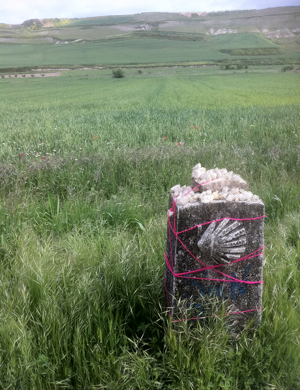
roadside memorial low-res 801

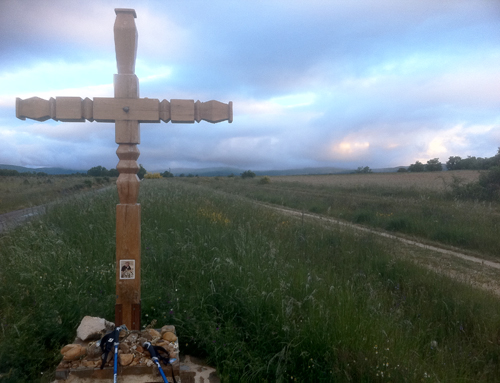
One of dozens of pilgrim memorials along the Camino

For hundreds of years, death has followed some people on the Camino, either literally or figuratively. Many pilgrims walk the path to honour the loss of a recent loved one, leaving a stone to the person’s memory at the Cruz de Fer (Iron Cross), the highest point of the route at 1,504 metres. At this spot, a cross stands on the end of a tall pole, which rises from the top of a large mound of earth and stones that’s several metres high. Each small rock added to this pile represents someone’s life, a pilgrim’s symbolic gesture of letting go or reinforcing a dream, or a way of saying: “I have been here.”


On the first day of our Camino adventure, after crossing the Pyrenees from France into Spain, my husband Frank and I learned that two months earlier, in March, a lone male pilgrim had gotten lost and disoriented in the mountains and had died of exposure. Some said it was a Canadian, others a Brazilian (I find out later he was Italian). We heard that as a result, a tourist office in France was urging all pilgrims to take the lower route, via Valcarlos, rather than the higher one (Route de Napoléon) across the Pyrenees.

memorial low-res with table legs 779

This looks to me like someone used table legs to make this memorial. Whatever works, I guess.

Frank and I had already made that decision ourselves; our guide book recommended using this lower route in poor weather. Since we were experiencing fog, cold, and non-stop rain in late May, we did not want to chance poor visibility at higher elevations. On our second day, before we had walked about 25 kilometres and reached Roncesvalles, it had snowed briefly. Thick mist drifted down from the mountaintops and seemed to shroud the view ahead. We saw only seven people the entire day.


Although initially reluctant to have missed panoramic views available from the higher route, I now felt grateful that we had taken the cautionary path and had arrived safely.


With such weather conditions, it’s not surprising that in medieval days, the Camino route offered many hospitals and hospices to cater to pilgrims’ needs. Back then, people walked the path in sandals, simple shoes or went barefoot. They had no Goretex or specialized waterproof gear. There weren’t over-the-counter medications, tetanus shots, first aid kits or a pharmacy in every town. A simple dog bite, infection, or attack by roving robbers could have resulted in death or serious injury.

memorial 2 low-res 1048

Health wise, these early pilgrims did not enjoy daily hot showers and potable water. They couldn’t walk into a restaurant and order a filling, three-course meal. Many, understandably, got sick and never completed the route. In such cases, they might end up in a hospice bed, tended to by nuns, where they could be carried into a particular church or cathedral and receive the same sacred song or blessing as if they had finished the path.


Back then, kings and queens chartered hospices as a way of currying God’s favour as a shortcut to heaven. In the medieval form of lay charity, specialized religious orders sheltered pilgrims and others to reflect their ideal of holiness as practical and accessible rather than separate and cloistered, according to James William Brodman, author of Charity and Religion in Medieval Europe.


This sounds like the height of practical religious service to me: Come down and be close to the people rather than have them seek you out in hallowed places, especially when they’re ill and near-death. Camino pilgrims, after all, are great symbols of people with their feet to the ground, rather than their head in the clouds.

memorial and Brazilian low-res 303

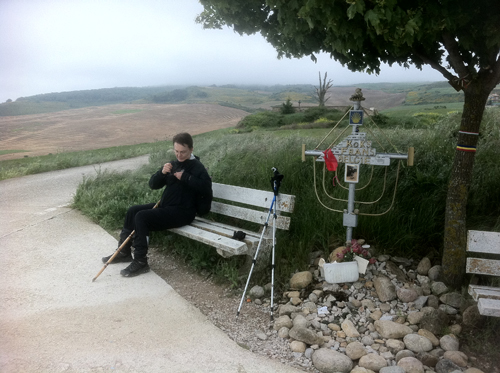
One of my Camino companions, a Brazilian, rests beside an informal memorial.


In these early hospices, pilgrims’ spiritual needs were considered just as, if not more, important than their healing or palliative care. Those tending the sick and dying made the patients’ need for sacraments and religious burial a top priority.


(In the 12th century, although there were no lists of “Ten best places to die on the Camino,” the Codex Calixtinus, widely considered the world’s first travel guide, gave pilgrims basic information about the route. This publication is said to have been available from 1140 on; even then, tourism surrounding the Camino was organized.)


Some of the centuries-old former hospices and hospitals are still standing along today’s route or have been converted to albergues. As a hospice volunteer, I wanted to find out more about these historic structures and services but have uncovered little about them so far.

memorial 3 low-res 1053

While walking the Camino, I saw dozens of memorials that honoured the life of a pilgrim who had died en route. Most were simple stone, wood or concrete structures with a cross. Some bore a photo of the person and a brief summary of his or her life. In one small town, I discovered that a bicycle sculpture I had admired on a steep street was actually a memorial to a pilgrim who had died while cycling downhill.


I don’t know how many pilgrims die on the Camino each year, whether most suffer a heart attack or get hit by a car. Our guidebook warned us in a few places where there had been a traffic-related death. But the handful of deaths in recent years is teeny compared to the 183,366 who walked the route in 2012, for example.

memorial 1 low-res 1039

This niche along the path includes memorial messages and a prayerful plea
from a mother for help with her wayward teenage daughter.

It never saddened me to see one of the memorials. I believe that almost every person who had died along the way was middle-aged; perhaps they were fulfilling a lifelong dream or challenging their physical boundaries. Regardless, they died as part of intentional travel, on an adventure. I felt a kinship with these pilgrims of the past. Their souls live on.

, , , , , , , , ,
November 9, 2013 at 9:00 am Comments (2)

The Camino adopts the scallop and St. James as global brands

shell and walking stick low-res 453

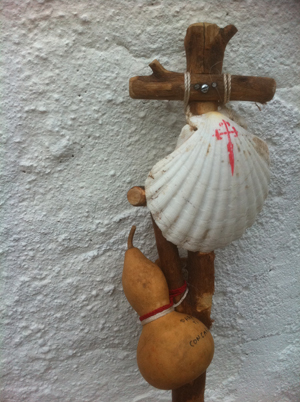
A pilgrim’s walking stick with a gourd
and scallop bearing the St. James cross


Before walking the Camino, I knew nothing of Saint James. Excuse my ignorance, but I now know that he and his brother John were among Jesus’s first apostles; they were the fishermen to whom Jesus said “Come, let me make you fishers of men.”


A pagan at heart, I felt little affinity to this notable Christian, particularly since he tried to convert Druids in Spain. But when I learned of his beheading in Jerusalem by King Herod in 42 or 44 A.D. (official dates vary), he gained greater favour in my eyes; viewed as subversive, he had died for his beliefs, evoking my sympathy for the wronged rebel. He’s now the patron saint of Spain.


It seems fitting that the memory of someone who worked in the sea is now paired with an ocean emblem like the scallop. Different legends explain the origin of this connection. In one popular myth, a ship that transported St. James’ body from Jerusalem to northern Spain smashed on rocks during a storm; when his body was recovered, it was covered in scallop shells.

scallop shell on bridge low-res 869

This scallop image appeared as a repeated symbol on this Camino bridge.

Today, the scallop is to the Camino what the golden arches are to McDonald’s: a global brand and repeat motif that every Spanish village and town displays in myriad forms along the route. Just as in India, where the “Om” symbol graces hats, souvenirs, carved rocks and any meditation-related surface, you’ll find a scallop logo on the Camino embedded in bridges, sidewalks, roads, on manhole covers, in stone waymarkers—anywhere where pilgrims’ eyes and feet will pass.

yarn bombed scallop waymarker low-res 543

A yarn-bombed waymarker bearing a scallop shell


Each urban municipality along The Way presents its own version of a stylized scallop. Seeing such a variety of presentations, I assumed that some lucky graphic designers must have enjoyed healthy contracts to create such distinctive, professional-looking images.

scallop in road low-res 432

A scallop image embedded in a cobblestone street,
next to my bandaged toes


I bought my own souvenir scallop at the albergue in Roncesvalles on day two of my Camino journey. It’s a real shell, about four inches across, with a red St. James cross painted on it. A long loop of red cord makes it easy to attach this to a backpack. This scallop version is the one most commonly seen dangling from pilgrims’ packs. It’s an overt yet silent way of saying: “I’m part of this particular global walking tribe.”


As I walked along, my shell clinked or bobbed. Whenever I rested, I made sure to lean my pack down gently so that the shell wouldn’t smash. Once, just after I had stopped and written something in my journal critical of the Catholic church, the shell fell off my pack. A subtle message in response to my sacreligious sensibilities?

St James iron work low-res 704

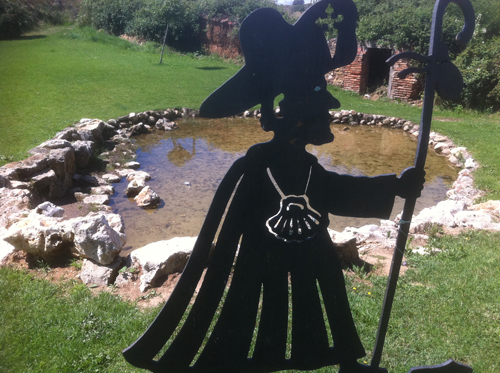
One of the many representations of St. James along the Camino

Some pilgrims will wear an additional scallop, perhaps as a hat or lapel pin. I bought a beautiful one, about two inches wide, hand-carved by a young German from the remains of a church pew. Suspended on a suede cord around my neck, it became part of my daily pilgrim attire, much like a bolo tie.

German carver low-res 848

The German carver who created
my wooden scallop necklace


In medieval times, pilgrims attached a scallop shell to their hats or clothes and used it as a portable bowl or dish. They’d use it as a scoop to receive a scallop’s worth of food donated at churches or other pilgrim-oriented centres along the path.


On day 21 of my journey, in the small village of Reliegos, I met an 82-year-old Dutch man who was walking the Camino for the twentieth time. He told me that the Canadian regiment that had liberated his city in the Second World War had worn scallop shells on their hats. Based on subsequent internet research, this must have been the Lincoln and Welland regiment, based in St. Catharines and Welland, Ont., which liberated Arnhem under the leadership of General Sir Isaac Brock. I had no idea that scallops had been part of this wartime victory.

Dutch man pilgrim low-res

The 82-year-old Dutch man
with U.S. pilgrim Michael Romo and I

Some of today’s European languages still draw a connection between St. James and scallops: in French, a scallop is coquille Saint Jacques and in German, scallops are Jakobsmuscheln (James mussels). In Dutch, Jacobsschelp means “shell of St. James.”


My constant viewing of scallop imagery along the Camino, combined with an assortment of life-size and smaller public statues of St. James, reminded me that walking this path plugged me into an archetypal history, one that valued his selfless service to others and the power of community.


St. James statue low-res 320

A statue of St. James


Although James has become a saint, I like that he was supposed to have been fiery and impetuous, blowing up at those who ran afoul of his visions. This makes him more accessible as a symbol of imperfect humanity rather than some beatific angel basking in the glow of his halo.


His heritage does give him saintly “street cred,” though. His mother Saint Mary Salome was at the foot of Jesus’ cross during his crucifixion and later brought herbs and spices to his tomb to anoint his body.

I had thought that James’ mom was the famous Salome of the dance of the seven veils; a Catholic-educated friend quickly corrected me on this (thanks, David M.). But I still like to think of James—dare I call him Jim?—with a soul of earthy rawness. Just think if he had become linked with oysters, instead of scallops . . .

St. James beheading low-res 1101

A depiction of St. James’ beheading
from a door panel in the cathedral at Santiago


By the time I got to Santiago, I didn’t care if the sacred relics of St. James in the cathedral were real, fake or nonexistent. I had made it—unlike him, with my head intact.


, , , ,
November 5, 2013 at 11:11 am Comments (2)

Art and graffiti on the Camino: How do we create connection?

EL CAMINO mural low-res 457

One example of a pilgrim-themed mural

Like any pathway of self-expression, The Camino is a repository for art and human musings. These range from professional sculptures and murals that depict a modern or ancient pilgrim to silly scribblings, wise reflections, and indulgent graffiti.


As an art devotee and long-time fan of street art, I was curious whether the offerings along The Way of St. James would reflect greater contemplative wisdom or spiritual enquiry than what usually appears in most cities in North America. After all, at least 100,000 people from around the world walk the route each year, many of them on a spiritual or religious quest. Surely, this motivation would produce words and images inspired by reverie, “aha” moments, and a questioning or deepening of faith?

demons low-res 764

Some of the demon art displayed along the Camino

Yes and no. Most people on an inner search are probably less likely to scrawl graffiti across a public space, which I respect. I found that it takes time for many strangers to open up about their deepest reasons for doing the walk. Such revelations require a degree of intimacy, something that a public message can only imply. Graffiti can provide a big-picture view, connecting us in shared sentiment, conveying a sense of community. Yet, because it’s anonymous, we don’t grow any closer to the person who created it. It’s one-way dialogue.


For me, the Camino was very much about two-way communication in one-on-one encounters. However, I still appreciated both the “official” art I saw, publicly funded or in galleries, and found much of the pilgrimage-related graffiti either heartening or entertaining. Sometimes, a simple question spelled out in large capital letters “WHY ARE YOU WALKING?” could prompt some added introspection. Once, the short statement “Keep walking. Don’t give up” was just the extra boost I needed, as if from a silent coach. The suggestion “Open your heart wider,” spray-painted on a cement road barrier, made me smile.

open your heart low-res 885

One high wall featured Spanish verse about the life of a pilgrim and what such a walk means. One pilgrim, an obvious Tom Petty fan, had sprinkled the route with quotes from the musician’s lyrics, written in small letters on the backs or tops of signs. At times, I found the quotations amusing or oddly appropriate. At others, they seemed to irritate me with intrusion.

pilgrim wall low-res 400

The wall of pilgrim-themed verse


Strangely, the quality of graffiti content seemed more puerile the closer I walked towards Santiago; evidently, walking the path produced no guarantee of gains in maturity. One pilgrim wrote on the back of a road sign: “Only pussies walk the last 100 kilometres.” This was a reference to those who walk the minimum distance required to obtain an official pilgrim certificate in Santiago. Ilke, a German pilgrim with whom I walked for the last four days, commented on this graffiti: “Sounds like he should walk the Camino again.”

doorway art low-res 055

Art on a doorway in Chartres,
part of the Chemin de Paris Camino trail


In the final days of the Camino, I was disturbed to see a man’s open letter to a woman (I believe it was “Ann”), painted in about three-inch-high letters on the side of a house that faced the path. Admitting his love for her, he told her how much it meant to him that they had walked together. Her presence had made all the difference, he said.


Admirable sentiments, but why deface someone’s home to advertise your private thoughts? What arrogance and disrespect for others that required, despite an avowed love for one. Perhaps it’s easy to view all graffiti “artists” in this way.


Throughout the Camino, the murals and sculptures of pilgrims reminded me that I was part of a collective historical journey, an archetypal one that reached beyond my own personal trip. These visual reminders appeared on hilltops or town squares as unknown yet familiar faces. Like all meaningful art, they created connection.

pilgrim low-res 739

The most universal symbol or source of art on the Camino is the Christian cross. It appears in every imaginable form, from two crossed sticks stuck in a fence to intricately carved wooden ones and medieval or gothic gilt ones in cathedrals. Regardless of one’s beliefs, it is impossible to ignore the evocative power, as an historical art piece alone, that this symbol carries.


From the Crusades to vampire-slaying, we have recognized across cultures, continents, and centuries that the cross carries significant weight. Whether it instills joy, faith, hatred, disdain, fear, guilt, love, anger or any other emotion, the cross communicates more in silence than a million graffiti artists could ever hope for with their messaging. Like great art, it is a mirror of our own projections, transforming us by how we choose to view it and what meaning we bring to it.

roadside memorial low-res 801

A cross on one of the dozens of memorials that appear along the Camino.

NEXT WEEK: St. James and scallop shells

,
October 25, 2013 at 2:27 pm Comments (4)

Present or absent? The way of friendship on the Camino

When my husband Frank left our Pamplona hotel room at 4 a.m. to catch his flight home, as we had planned, I felt sad but eager to continue on the Camino. It was day six of my pilgrimage, and I knew that a friend was arriving that night, June 1, to accompany me on the rest of The Way.

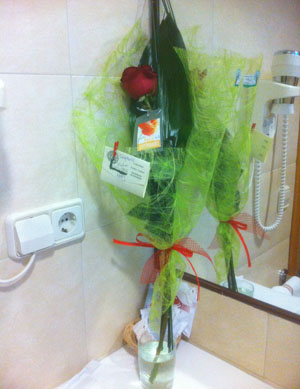
rose low-res 296

a birthday rose for my friend

It was her seventieth birthday and we were going to celebrate that evening; I had bought her a long-stemmed rose and card. To mark her special milestone, we had chosen 2013 to walk the Camino together, after talking about it for years. That spring, she had invited me to join her for a day of informational workshops about the Camino. After attending an excellent event hosted by the Canadian Company of Pilgrims, I felt more inspired than ever to go. Now I looked forward to our reunion and a new phase of my trip.

By late afternoon, when she had not arrived at the hotel, I asked the man at reception if he had any messages for me. No. A few hours later, I asked again. Still nothing. I had received no emails on my iPhone. Assuming that she must have missed her flight, I figured that she would arrive the next morning. I knew that she was travelling without a cell phone, so I could not contact her; unbelievably, I didn’t have her flight information.  Assured that nothing serious was wrong, I felt disappointed that we would not be together on her birthday to celebrate.

The next day, after still not hearing from her, I wondered if she had decided against the trip. Originally, she had wanted to go later in the summer, but I had said it would be too hot and crowded then for me. The previous month, health issues had made her decide not to walk the Camino, but then she had changed her mind. Did she reschedule the trip to her liking, after all, and not tell me, knowing how angry I would be?

Pamplona hotel window low-res 294

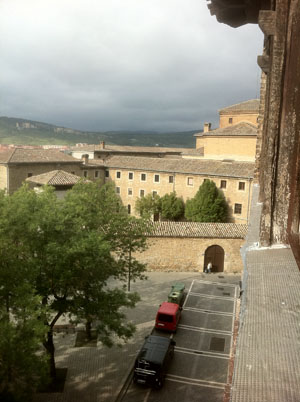
The view from our hotel window in Pamplona

I checked again at hotel reception, my email and phone for messages, but nothing. The next morning, same thing. Not wanting to spend yet another day in Pamplona, I wrote in my journal on June 2: “[It] looks as if this will be a solo trip.” I gave her rose to the man at reception, who looked stunned. “Give it to your wife or mother,” I told him, in Spanish.

Impatient to head out, I left just before 9 a.m., leaving my friend a message at reception in case she arrived after my departure.

Alone, I walked out into heavy winds on my first Camino day without rain. As someone who has always relished solo travel, I felt partly pleased at this surprising change of plans. I like the freedom to move at my own pace, answerable to no one. Because my friend walked much more slowly than me, I had wondered, while still in Canada, if our different paces would cause friction.

On the first few days of the Camino, I had already recognized that walking the route brought out my competitive side; I enjoyed passing people on the trail. I had felt impatient waiting for my husband, who walked much more slowly due to a previous knee injury. Chastizing myself for this perspective, I later paid little attention to the notion of being ahead or behind. We were all on our own path, travelling at our own speed.

me in rain low-res 185

Frank took this photo during the rainy first days of the Camino.

In the following days and weeks, I alternated between anger, compassion, and forgiveness towards my friend. What had happened to her? Why didn’t she contact me? Sometimes I wondered if she was just a few days behind me on the trail. In a notebook for pilgrims provided at one roadside stop, I even wrote to her: “Where are you?”

Some mornings, waking up angry, I focused on releasing my irritation while starting to walk. With each step, it was easier to let go. I realized that in absentia, she had become a spiritual teacher on my path. Her silence and not showing up became external mirrors for my frame of mind each day. Was I going to let her absence control my mood?

As I walked, my mind had endless time and space to imagine an array of scenarios from confrontation and a severing of the friendship to joking about it decades later. I had the power to choose how I would respond to this situation, ranging from self-pity to self-righteous triumph. My mind would determine the quality of my process, both on the Camino and everywhere. I, alone, was responsible for how much light and shadow I brought to my experiences.

As I met and walked with various pilgrims for consecutive days along the way, I realized that if my friend had been there, my connections with these people would likely have been very different. Perhaps I would not even have spent much time with them. I felt grateful for these encounters, realizing that solo travel often provides opportunities for people to reach out when they might not otherwise. Strangely, I felt like thanking my friend, whose absence allowed me to make these new friendships without her.

Yet I still felt annoyed at not hearing from her. Along the way, as different people asked why I was walking the Camino, I explained the story. Many were aghast. The pilgrims in their twenties, in particular, were incredulous that in today’s plugged-in world of social media, my friend and I had not communicated.

me with 50 km left low-res 1020

Only 50 kilometres left to go . . .

On day 30 of my pilgrimage, four days before arriving in Santiago, I finally found out what had happened. In an email, Frank said that my friend had left a phone message at our home, sounding terrible; since he had been away for several weeks, he did not receive it until he got back. She had been found unconscious near downtown Victoria, suffering an adverse reaction to a recent change in medication, and had remained hospitalized for days.

I felt grateful to know, at last, that she was okay and why she hadn’t come. For almost my entire Camino journey, her fate had symbolized the unknown for me. Her absence, indirectly, was my gift, to help me deal with the unexpected.

Upon my return, we reconciled by phone. Our friendship continues.

October 18, 2013 at 2:39 pm Comments (3)

Sacred space needs no official designation

“Anywhere can be a sacred site—it only requires us to see our land as special and we will learn to tread more gently upon it.”
Alliance of Religions and Conservation website


A short, squat man in dark clothes and peaked cap, whom I thought was a priest, was about to lock the front door—a thick, dark, wooden one—of the Santa Maria La Virgen Blanca church in Villalcázar de Sirga.


My guidebook recommended seeing the interior of this Knights Templar church, a national monument, which housed the tombs of royalty and nobles. From the twelfth century onwards, one task of the Templar knights was to protect pilgrims on their journey to sacred Christian sites.

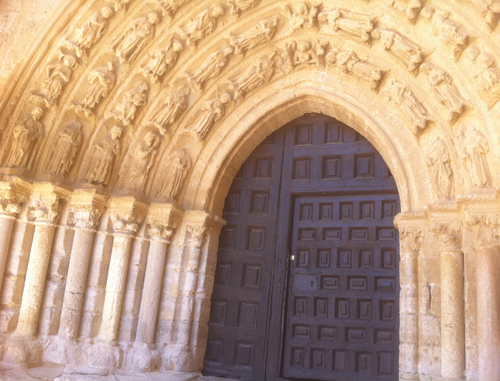
church door low-res 634

The entrance to Santa Maria La Virgen Blanca church in Villalcázar de Sirga

Curious, I ran up the front stairs and got inside, just before the man turned the deadbolt. Leaving my friend Dieter at a café across the street, where he was enjoying a cool drink in the shade, I figured a 10-minute visit would be enough; then we’d continue on The Way.


After the short man made sure that I had paid the 1 EU entrance fee for pilgrims or peregrinos, he began a tour inside the church for a busload of middle-aged Spanish women. Previously, when they had spilled onto the lazy town square, I had called them “chickens” for their noisy, non-stop squawks and talk.

church entrance low-res 635

The view above the front entrance of the church

Wandering around the church, I sat on a dark wooden pew, trying to meditate briefly in the semi-darkness. Soon, the coolness of the church’s stone floor and walls became too cold for me, and I wanted to leave. The inside of the front door, separated from the rest of the church behind a small entrance, stood in solid darkness. With the help of my pocket flashlight, I tried to jiggle the dead bolt and piston lock, which was embedded into the ground. Nothing moved.

church interior 2 641

Part of the church interior


We were locked in. Approaching the guide during a brief break in his narration, I asked him, in basic Spanish: “May I have the key to open the door? I have to leave.”


“No,” he replied. In Spanish: “You’ll have to wait until the tour is over.”


Frustrated, I tried to accept the situation, but irritation soon won over. I was prisoner of a church! About a half-hour later, some of the Spanish women were also cold and wanted to get out. The man wouldn’t let them. “We could get sick and end up in the hospital,” one muttered in Spanish. Three of us huddled around the door but despite our attempts to escape, it remained locked.


After about 15 minutes, we approached the guide together and demanded to be let out. With about two dozen female Spanish tourists thronged around him, he thrust out his arm and pointed at me, wagging his finger while saying something in Spanish to the effect of “It’s her fault that your tour is ending now.”

church low-res 639

A view inside the church

Feeling like a marked woman, I laughed, but was pleased to see him get out his circle of skeleton keys and head for the door.

Once outside, back into 23-degree-C sunshine, I felt grateful to see Dieter again, sorry that I had kept him waiting. “I was ready to come looking for you,” he said, adding with a chuckle: “I thought you must be doing thirty years’ worth of confessions.”


I thought it ironic that a public building like a church, which is supposed to be sacred space and a comforting sanctuary, had kept me trapped. I wondered: To what else am I held prisoner? The list is long: expectations, ambition, judgments, comparisons, envy . . .


This was day 19 of my pilgrimage. Before walking the Camino, I had expected that each albergue would offer group spiritual activities from shared meditation to facilitated discussions. But less than a handful did. By week two of the Camino, I realized that rather than seek out groups of spiritual community, which I ultimately found anyway, I needed to create my own versions of sacred space.


So, at times, I made myself stop along the route, lean against a tree, close my eyes, and silently absorb my surroundings. For me, this usually proved more meditative than constantly moving through an environment.

sacred space low-res 950

What makes space sacred? With Pam and Elke of Langley, BC

At one albergue in Belarodo, the hospitaleros, a thirty-something European couple, had hosted a brief, evening session of informal song and meditation, using the organ as accompaniment upstairs in the church next door to the hostel.


A handful of us had gathered in the bone-cold church under blankets, singing a few lines of a Latin song as a round. It was one that Camino pilgrims sang in medieval times, the male hospitalero told us, and translates roughly to the following:


Every morning we take the Camino,
Every morning we go farther,
Day after day the route calls us,
It’s the voice of [Santiago de] Compostela


Way of earth and way of faith,
Ancient road of Europe,
The Milky Way of Charlemagne,
It’s the Chemin of all the Santiago pilgrims,
and so on . . .


The chorus “Ultreia, ultreia, Et sus eia, Deus adjuva nos” is “Onward, onward, and upward, God helps us.” I appreciated the historical link that these words made to pilgrims who had walked the same path centuries earlier.


Before walking the Camino, I had read that it was customary for Spanish residents along the route to call out “Ultreia” (also spelled “Ultreya”) to pilgrims as a sign of support and encouragement. Yet, I heard no one say that word once during my pilgrimage. Instead, today’s common greeting is “Buen Camino” (Have a good Camino.) Along the way, I saw “Ultreya” written in only a few places. Otherwise, the term seemed obliterated.


For me, discovering and singing the word “Ultreia” on the Camino was a significant thread, a form of creating sacred space over time. It invited union, commonality, between pilgrims and non-pilgrims, and those who had walked The Way now and in the past.

sacred space low-res 156

A view along the Camino

In the small town of Manjarin, on day 26, I heard beautiful Gregorian chant next to a restaurant and noticed the word “convento,” in large letters, on the side of a nearby building. Thinking that perhaps live monks were singing or I could hear sacred harmonies in a nunnery, I headed towards the source of the music. Looking up, I saw a loudspeaker mounted above patio tables and umbrellas. This was the source of the music. It was a recording.


Feeling like Pavlov’s dog, I laughed aloud. Some savvy business person sure knew what would draw pilgrims’ attention. Even my guidebook mentioned the music in this specific place: “Perhaps Gregorian chant (from a well-worn tape out of the Cluny sanctuary of Taizé) will call you to stop.”


Sacred space on the Camino or anywhere certainly doesn’t need to be within a church or cathedral or some form of monument collectively deemed powerfully poignant, such as the Cruz de Ferro at Puerta Irago. At this highest point on the Camino, at 1,505 metres, a giant cross stands atop a high pile of stones, each one left by a pilgrim to honor a dream or loved one or trait that someone wants to release.


Sacred space needs no official designation. It is created through ritual and recognition that all life is sacred; we are the ones who bring meaning to what touches us. We decide what words, acts, ceremonies create sacred sharing. Yet the earth is innately sacred; if we do not see it as such, does its sacredness disappear?


Every encounter upon The Way, whether at a drinking fountain in a village plaza or in the flat plains of the Meseta, can become sacred. Over the years, dozens of pilgrims have broken off two branches to form a cross and added them to different fences along the way. Each one can represent the life of a loved one lost or a symbol of someone’s faith.

crosses low-res 787

Some of the informal crosses that pilgrims leave along the route

Even my encounter with the tour guide and the locked church was sacred, although not one I appreciated at the time. It was an opportunity for me to learn patience and to join in a common goal with women I had previously judged and deemed separate from myself.


A meeting of two kindred hearts and spirits, in itself, creates sacred space. What lies within each of us—a lush, tended garden or withered barren land? How well we cultivate our inner space determines how much we have to give to others and ourselves.

NEXT WEEK: Hemingway and the Camino

, , , , , , , , , , , ,
October 4, 2013 at 1:20 pm Comments (2)
In what form does a spiritual community appear?

How many times, as a non-Catholic, do you get the chance to participate in a small mass, seated next to a woman who defines herself as an atheist from Alaska?


That’s how impromptu spiritual community unfolds on the Camino. In Santa Domingo, on day 12 of my pilgrimage, I participated in a eucharist mass, not even knowing what that term meant. As someone who nearly winces at the terms “God” and “Lord” and rejects patriarchal organized religion, I wondered what I was doing there. But a deeper part of me, longing for some form of collective spiritual connection or divine validation, felt in the right place.


Eleven pilgrims—a jocular late-forties Irish priest who was questioning his loyalty to the church; me; two twenty-something Catholic men from Philadelphia and two from Hawaii; a self-professed atheist; a middle-aged male Irish Protestant; a middle-aged female Irish Catholic; a 50ish Lutheran minister from Saskatchewan; and one man I never spoke to—gathered in an upstairs room at an albergue.

informal mass low-res

Part of an impromptu mass on the Camino

I had met the presiding priest earlier on The Way and admired his playful approach to life, his commitment to grassroots social reform and his growing sense of alienation from his church hierarchy. In my view, he was an anarchist at heart. I knew that his willingness to perform this mass to a mixed group of believers and non-Catholics was verboten by his church’s traditional regulations. The Lutheran minister later warned me not to even mention the priest’s name in any subsequent public writings since he could be ex-communicated for such a supposedly treasonous act.


Ah, a cabal of rebels: my kind of crowd. The priest acknowledged the diversity of our group and gave us all the option of either taking mass or asking for a blessing. As we sat in a circle, holding hands and singing a hymn, I found myself crying, feeling goose bumps and chills, my own form of soulful recognition of something beyond description.

The priest had asked me to read Corinthians 1 verses 1-7. I hadn’t read a Bible in decades. Grace and peace to you from God our Father and the Lord Jesus Christ. I told myself: Keep an open mind. Ignore the holy trinity language. Connect to the spirit of the words. I enjoyed reading aloud; it reminded me of old Sunday-school sessions and school performances. Yet I still felt disconnected from these phrases. What relationship did they bear to my life?

communal breakfast low-res 456

A typical communal breakfast at a Camino albergue

My chattering mind continued. It’s just another form of saying a connection to All That Is. Don’t be so judgmental. Stay open to whatever form you might receive a teaching. Why do you continue to promote a sense of separation? We are all One.


“The eucharist relates to the washing of feet,” the priest told us. As pilgrims, we could all relate to a focus on our weary soles. Along the Camino, monks and nuns at some albergues even wash the feet of pilgrims. Our holy host spoke of our common link as people walking The Way. I felt blessed, grateful to be part of this loose-knit yet intentional gathering.


Immediately afterwards, one of the young German men was openly crying. A lapsed Catholic, this was his first mass in many decades. Something had reached him. I read somewhere that everyone who walks the Camino cries at least once along the way.


Later, some of us went for dinner at a restaurant, relishing a Pilgrim’s Menu that included red wine. This was not the Last Supper, which the eucharist commemorates, yet it reinforced a different form of fellowship, a sharing of bread and wine between global souls.

communal dinner low-res 835

An international communal dinner at the Apostol Santiago albergue

Communal meals on the Camino are their own form of sacred gathering, like the one I experienced on day 26 at the parochial albergue, Apostol Santiago, in Acebo. By the time I arrived, I felt as if my feet and ankles had been beaten with wooden paddles. But the two matronly hospitaleros, full of laughter and kindness, welcomed me warmly and after much-appreciated rest on my dorm bed, I felt more invigorated.


By 8 pm that night, I joined about a dozen pilgrims from France, Germany, Spain, Portugal, Belgium, Hungary, and the U.S. for a dinner of salad, lentil soup, and watermelon slices for dessert. Before eating, we all read a sheet provided by the albergue, which spoke about the Camino as both an inner and outer journey, how it becomes part of you, you become part of a community and so on.

communal dinner low-res 2 834

Each of us read aloud a translation, in our own language, of the same message; there were at least eight versions and we listened to each one consecutively. The Hungarian man was last to read; the hungry Belgian beside me grumbled about having to hear the same thing so many times, but I shushed him. To me, the ritual was a wonderful validation of our separate, yet unified journey.


Eleven days earlier (three days after the mass), the same priest had hosted another spiritual gathering. This time, it was an ecumenical circle in an empty room on the 4th floor of the downtown albergue La Casa del Cubo in Burgos. In a facility that housed 150 beds, I had expected a large turnout but only about a dozen participated, most of them the same people from the previous mass.


We sat in a circle on the floor, a backpack and pillow in the centre representing our collective pilgrim spirit and passage. Since we had all seen herds of sheep fenced in along the path that morning, the priest used sheep and the Lord as a shepherd as a metaphor in his informal talk. He sang a hymn while the two Catholic guys from Philadelphia, both in the seminary, sang beautiful harmonies.

sheep 1 low-res 478

Sheep on the path en route to Burgos

Although moved by the sound and shared connection, I still missed my more familiar reference points, the Sanskrit chants from my yoga class, and the eastern-based sensibilities that resonate more profoundly with me. Yet, in that time and place, otherwise alone, I still felt a part of something far larger than myself, regardless of what name I or others chose to call it.

NEXT WEEK: Creating sacred space on the Camino

, , , , , , , , , ,
September 28, 2013 at 3:36 pm Comments (4)

What thresholds have you crossed or missed?

low-res outdoor fence landscape 831

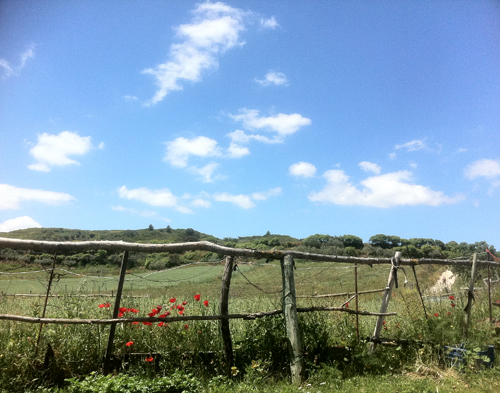
The Camino offers many forms of portals and thresholds.


After walking almost 27 kilometres, I arrived in the hot, dusty town of Sahagún in mid-afternoon, looking forward to rest and an albergue bed. In mid-June, the town of about 170,000 was poised for a night of bullfights.


In preparation for a small running of the bulls before the indoor event, temporary fencing of horizontal boards blocked off sections of the street surrounding the municipal albergue downtown. A youthful marching band, wearing light blue shirts and red scarves, was already playing rousing music. The young men’s brass instruments and pounding bass drum added to the loud, throbbing songs piped through a loudspeaker across the street.

the band low-res 654

The marching band in Sahagun. I snapped this as they were posing for an official group photo.


I needed to escape the sun, noise and crowds. After searching for an opening amidst the fencing, I walked up to what looked like the main doors of the municipal albergue, an imposing former church made of brick. I tried the knob and pounded on the thick wooden doors, but they were locked. No one came.


Damn siesta time, I thought. Can’t I just come in and lie down? Instead, I had several lemon sodas at the bar-restaurant across the street, hoping to quench my seemingly endless thirst. Ah, the shade and cold liquid felt good.

cow low-res  939

After more than an hour, I walked towards the albergue doors again, hoping that they would now be open. A young female pilgrim, sprawled on a bench to the right of the doors in beating sun, pointed past the doors to the corner of the building. I wasn’t sure what she meant. She continued to point.


I followed the direction of her finger, and found myself around the corner of the same brick building, which turned out to be the front of the albergue. It was open, and people were coming in and out. I had been trying to get into the side door!

stone doorway los-res 460

The Camino is full of intriguing wooden doors
in stone buildings.


An unwelcome sense of déjà vu hit me. That same day, thirteen kilometres earlier in the tiny village of Terradillos do Los Templarios (population 80), I had found a square white stucco building of several storeys that bore the sign for the Jacques de Molay albergue, my desired destination. I tried a main door covered with vertical wrought iron. Locked. I knocked and rang the buzzer. No one came. Walking around the building, I tried another door. Locked. More knocks produced no one.

Frustrated, I looked around for some shade. This was the only albergue in the village. How could it be closed at 1 p.m.? Feeling too tired to walk to the next town of Moratinos, more than three kilometres away, I joined several pilgrims in the shade who were waiting for a bus. I told them that the albergue was closed.

“That’s strange,” said one of them. “We were just there and it was open.” After chatting for about a half-hour, with no sign of a bus, they headed to the albergue and I joined them. We turned the corner of the building, perpendicular to where I had stopped previously. About a half-block down, an open doorway led into the albergue’s large grassy courtyard. Dozens of pilgrims sat at tables, drinking beer and relaxing. After enquiring, I found out that this welcoming spot, although now full, had been open all day. How could I have completely missed this entrance?

bales of hay low-res

On day one of the Camino, bales of hay in southern France
formed the gateway to the route to Valcarlos in Spain.


After experiencing this form of omission twice in one day, I began, as always, to ponder its symbolic ramifications. What else in life have I passed over or not seen, thinking it was not there or unavailable, when it was indeed?

I recognize that my impatience or fear often makes me give up too soon. Usually, if I can’t readily find what I’m looking for, I stop the search. When challenged or beyond my comfort zone, whether it’s due to fatigue, frustration or downright orneriness, I normally grumble about waylaid plans. I stop trying.

church door low-res 634

One of many church doorways found along The Way


This is different from the spiritual concept of surrender. In that case, I can recognize, with some humility and grace, that my desired answer or solution might not be immediately visible. I can choose to trust that it will come later, perhaps in an unexpected form.

low-res church interior 619

What makes me let go, trust, and persevere in some cases, and give up in others? If my goal is clear and deeply felt, such as a creative project, I will pursue it relentlessly.

Like life, the Camino is a series of portals and thresholds. The most obvious ones are physical access points: doorways, gates, and windows or stairs leading into an enclosed space, perhaps a church or sanctuary. The mental and emotional thresholds, whether it’s leaving an unsatisfactory relationship or changing an attitude that no longer serves us, are more difficult to face.

vertical portal low-res 1043


I love the notion, both literally and symbolically, of crossing a threshold. The hero’s journey, exemplified by Joseph Campbell, is a great archetypal example. Stories and cultural tales of all kinds, whether it’s a knight slaying dragons or Rosa Parks refusing to give up her bus seat to a white man, feature people who cross thresholds.


Crossing thresholds, big and small, determines who we are and aren’t. When we face a fear and overcome it, that’s huge. I’ll share the story of an Irish pilgrim named Anne, whom I spent time with along The Way. Ever since a dog bit her when she was a child, she had a tremendous fear of these animals. While walking alone on the Camino, three dogs approached her. But as they got closer, she didn’t run or skulk. Instead, she raised her walking sticks, yelled, and ran towards them. The dogs ran away.

low-res church and gate 1016

I give myself credit  for  having crossed many big thresholds, from a mountain climb to the Camino Frances itself, but my response to the little ones still needs work.

NEXT WEEK: Little miracles


, , , , , ,
September 15, 2013 at 11:38 am Comments (4)

Sharing the path with “all creatures great and small”

cats low-res 872

Cats on the Camino, gathering under a window, waiting to be fed

horse low-res 321

A pilgrim from Spain feeds his horse before starting another day on the Camino

“I will cease to live as a self and will take as my self [sic] my fellow creatures.”

—   Shantideva, an 8th-century Indian Buddhist scholar and yogi

On a windy, cold day, walking through forest past the town of San Martin del Camino, I watched two pilgrims ahead of me scoop up things from the path and put them in a white plastic bag. The twenty-something couple, travelling with an older man, bent down at least a dozen times and continued to fill the bag.

When I approached them, they said, in English: “We’re going to have them for dinner.” Snails. Escargots. The pilgrims were French. A typical delicacy for them, right?

snails low-res 656

I felt sorry for the poor little snails. This was day 24 of my pilgrimage. By then, I had shared The Way with many snails, ones with black-and-brown striped shells that looked at least twice the size of our snails at home. I thought of them with fondness as my fellow travelers, along with the slugs, ants, beetles, lizards, and bigger creatures—dogs, cats, horses, sheep, and cows—that shared brief portions of my journey.

For me, these tiny sentient beings were as much a part of the trail as human pilgrims. In my busy life back home, they often went unnoticed or ignored. On the path, they had become visual focal points for me. After all, my eyes were constantly looking down, surveying the terrain for the most level surface, trying to avoid any potential footfalls. Amidst stones and other stationary features, insects added a spark of movement that invited more attention.

beetle and poppy low-res 594

I began to see them as a symbol of life’s interconnectedness. At times, while hiking alone on the  Camino, my mind and body, with no conscious effort, entered a sense of profound oneness with my surroundings. Physically, I felt as if I was no longer separate from what I could see and feel. Everything—my moving legs, shadows and bugs on the ground, birdsong in the air, waving tufts of wheat—were linked energetically as one fluid form of life. Insects weren’t just little dots beneath me: they were part of my own soul and being.

This sensation was so palpable I wondered why I didn’t feel it all the time.  I wrote in my journal: “I truly felt as if I had reached a state of grace while hiking alone today. . . It felt as if all life was sacred, including the flies, splats of cowshit—everything.”

Beyond  visual sensations, the Camino offers frequent reminders of bird and animal presence: the clang of cow bells, cuckoo calls, seemingly nonstop birdsong, and rooster crowing, even in the evening. Along the route, storks build thick, high nests of large branches on the flat eaves of many stone churches. The migratory paths of many birds follow The Way.

orange beetle low-res 769

The bright colour of this beetle, on a white path, drew my interest

We are never alone if we are willing to let all of nature into our hearts. Perhaps that is why I revel in solitude when in the outdoors.

beetle pile low-res 822

A cluster of beetles in the shadows

In hills with radiant rows of heather, thick and tall, on the highest part of the Camino (1,505 metres), while walking from Santa Catalina to Acebo, I noticed individual beetles, shiny and iridescent, along the path. Then I came across a cluster of them, later writing in my journal: “They’re startling in their mundane beauty.”

While contemplating these wee beings, I was surprised that the words from a hymn, which I sang in church as a child, came back to me:

All things bright and beautiful,
All creatures great and small,
All things wise and wonderful:
The Lord God made them all.

heather low-res 815

some of the gorgeous hills of heather on the Camino

Had the Christian roots of the El Camino reached me? I had not thought in terms of “Lord” or “God” in many years. I believe in Soul and Spirit and divine essence, a unifying link of Oneness, rather than an externalized God or Saviour. Yet the phrase “all creatures great and small” stayed with me as I walked, almost as a mantra.

swallows low-res 837

swallows amidst pilgrims’ laundry

On day 27, while walking from Acebo to Cacabelos, I saw what looked like a large chickadee, with dark orange on its throat, alight on a low branch of a shrub. I remained only about a metre away and it did not fly away. Two days later, a yellow finch with some orange in its tail feathers hopped along the dusty path just in front of me.

cows and dogs low-res 934

These direct encounters with nature occurred while I was solitary and had seen no other pilgrims for at least an hour. They reminded me that any notion of separateness, viewing someone or something as The Other, or better or less than, is ultimately an illusion. All living beings share a heart that beats. That is enough to unite us all, big or small.

Then why did I inwardly condemn the pilgrims who repeatedly got drunk or treated the Camino like any regular two-week vacation? I resented the brashness of some bicyclists who hurtled downhill, loud and sometimes with little warning, expecting those on foot to make way for them. My mind eagerly put them in a category separate from me.

sheep low-res

On the Roman Road with U.S. pilgrim Michael Romo

With humans, I feel the need to maintain the illusion of my own identity, making others somehow wrong so that I can feel righteous or more evolved. With insects and animals, no such filter is necessary; with them, it is easier to connect from pure spirit.

NEXT WEEK: La Casa de los Dioses


, , , , , , , , ,
August 16, 2013 at 1:38 pm Comments (4)

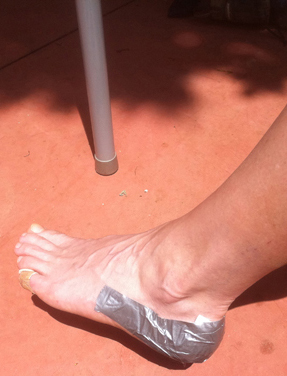
Duct tape dharma: what feet can teach

 “When in doubt about where you are meant to be, look down at your feet.”

—    A Buddhist saying

duct tape low-res 1  Elke's duct taped foot low-res 986


“Stick a sanitary napkin in the bottom of your boot—it will soak up the sweat. It works!”


“Slather your foot in Vaseline, then put on your sock.”


“Put a few tufts of sheep’s wool inside your boot. That’ll keep you dry.”

heel blister low-res 402

One of my heel blisters


Blister remedies—El Camino style. These are just a few I heard while walking with sore blisters for the first three weeks of my pilgrimage in France and Spain. Who knew that tiny blisters on the top and side of your little toe could produce such agony? I also had big ones on my heels, my instep, and under my toes. Blisters on blisters.


For a few days, I wore my Teva sandals because it was too painful for my heel blisters to rub against my Vasque hiking boots. Then I got new blisters from the sandals.


I pondered the symbolic ramifications of my condition. What was I supposed to learn from this? I decided that it was a way to slow me down, to invite me to bring a greater sense of presence to my journey. Too often, I live in my head, speeding along and missing so much around me.


My blisters were a silent reminder: Stay grounded. They forced me to stop earlier or more frequently to rest and ease my discomfort. In turn, I could use this time to admire a cluster of wild poppies against a sprawl of green fields or to chat with a fellow pilgrim whom I might otherwise just pass by and never get to know.


At times, I raged inwardly against the pain. Other times, I tried to push through it with my will, until stabbing jolts made me realize: I need to listen to my body and stop for the day.


I learned to make the pain part of my walking meditation. My blisters became my teachers, inviting me to feel every step and bring more mindfulness to the stony paths, curbs, and uneven surfaces that I encountered. They brought me greater compassion for those with similar afflictions.


blister expert low-res

Receiving expert blister treatment

Through my blisters, I became part of a community of fellow sufferers, both first-time and repeat pilgrims, swapping jokes and stories and comparing remedies. Favourite solutions were to use duct tape or Compeed, a brand of blister treatments found in European pharmacies. Moleskin was a great preventative measure, as long as you covered every potential blister spot, which was tough to do. (I still wonder what happened to the feet of two pilgrims on The Way who were wearing plastic Croc shoes.)


After walking almost 200 kilometres, I paid a Spanish volunteer at an albergue in Santa Domingo, a self-described blister expert, to drain my blisters using a needle and iodine and wrap them in gauze and medical tape. Thankfully, I overcame my reluctance to pay someone else to do a version of what I was already doing on my own. Maybe he could teach me something.


When he peeled off the dressings on my left heel, the inch-wide blister was a disturbing caramel brown. The pus that drained from it was the same colour. The guy shook his head.


“It’s infected,” he said. Obviously, I didn’t know as much about my feet as I thought.


“Don’t use Compeed,” he told me. “Once you’ve got a blister, it seals it off and doesn’t let it breathe.” I’d been using Compeed-like blister packs recommended by a Swiss-German friend.


blotchy foot low-res 381

some of the red blotches on my feet:
allergic reaction or heat rash?

“Change the dressings every two days and change your socks every two hours,” he said. “And don’t put cream on your feet in the morning—do it in the evening.” His advice about the cream treatment contradicted what I’d read and seen other people doing.


He told me that the itchy red splotches on my feet and ankles, which I assured him were heat rash, were an allergic reaction to the chemicals in sweat. “It’s a common thing. I’ve seen a lot of that.”


After my visit with the expert, on day 12 of my pilgrimage, I started to take my boots and socks off about every two hours and air out my feet. That helped. I added gauze to my first-aid repertoire, which included antibiotic cream. And I never put cream on my feet in the morning, only at night.

I tried the sanitary napkin treatment—but can’t tell if it made a difference. The daily Vaseline-in-the-sock option sounded too yucky to me; besides, how would the guck come out every night with hand-washing?


In preparation for the Camino, I had bought two pair of expensive Merino wool socks, recommended by outfitters and guidebooks. But after the itching and rashes started, I switched to cotton socks.


Before arriving in France and Spain, I had taken time to break in my new, super-comfortable waterproof boots, wearing them continuously for days and with a loaded pack. But on the first four days of The Way, in almost solid downpour and mud, my feet had gotten wet, which I learned is the worst breeding ground for blisters.

shelves of hiking boots low-res 403

A common sight at every albergue:
pilgrims’ boots stored en masse


By week three of the Camino, I joked to pilgrims that my fantasy was to arrive at Santiago Cathedral free of blisters, like a leper miraculously cured. And it happened. My blisters dried up and I was walking pain free for the last week. Yahoo!


And while blister free, I didn’t speed up. I slowed down even more, to appreciate the mountains, vineyards, and orchards that made me think of B.C. My feet, literally, showed me The Way: I’ve never maintained such a prolonged, intimate relationship with them or with ground surfaces.

NEXT WEEK: All Creatures Great and Small

August 9, 2013 at 4:17 pm Comments (4)

The Camino: Blisters and bliss on The Way

me with group and cathedral low-res

With Camino friends in front of the cathedral in Santiago, Spain (I’m the one on the left)


“The law of love could be best understood and learned through little children.”

—    Mahatma Gandhi


This is the first in a series of weekly blog posts that will address my journey on the Camino de Santiago route in May and June this year. I welcome your comments.


Seated on a narrow wooden pew in the cathedral of Santiago, Spain, I was one of hundreds of global visitors attending a daily “pilgrim’s mass” at noon. A non-Catholic, I felt little affinity to the Judeo-Christian symbology around me. Crosses and sculptures of a suffering Jesus? They barely seemed to touch my heart. So, why was I sitting here listening to a bishop talk about God, the Saviour, and so on, in Spanish? And I was crying!

The day before, I had arrived in Santiago, my final destination after completing the 800-kilometre Camino de Santiago pilgrimage, which had begun in France 34 days earlier. After this demanding walk of blisters and bliss, I felt both proud and exhausted. Although I embrace eastern philosophy and mysticism, feeling more drawn to Taoist and Tibetan Buddhist concepts than Christian beliefs, I had joined in an archetypal journey, one that required faith in one’s body and soul to succeed. This Way of St. James might be Christian-based, but “The Way” is also a translation for the Tao, or “middle way” of living in harmony with the flow of life.

cathedral interior low-res

The interior of Santiago Cathedral with the St. James cross, a symbol seen throughout the El Camino route, visible in the upper right

For 2,000 years, millions of people have walked this path called the Camino Frances, from the Romans who constructed early portions of the route to Christian pilgrims who have come to this cathedral for 13 centuries to see the remains of the Camino’s honoured patron, Saint James.

A Catholic friend wanted to know how my Camino journey compared to my seven months of solo spiritual exploration in India more than two decades ago. The biggest difference was the overriding sense of community on the France-Spain route. In India, spiritual seekers for centuries have chosen a path like mine, but I was not sharing it daily with others. Alone, I had no defined route. With periods of extended meditation in India, I was choosing stillness and solitude, rather than constant movement and companionship.

On the Camino, the path’s two ever-present way markers—the scallop shell symbol of St. James and a yellow arrow—link all pilgrims on the route in a powerful, unifying goal: to keep moving forward on the path. It’s a global village on the go, so to speak, and that’s a heady force to draw from.

On the Camino, I usually walked between 20 to 30 kilometres a day. This provided form, structure, and a logical sequence for each day. In India, I had no such limits except those I imposed myself. In this Asian nation, I felt closer to timelessness; I could wake up and go to sleep as I chose. The Camino fits closer to a routine; the albergues or pilgrim hostels require all visitors to be gone by 8 a.m. and most close by 10 p.m., requiring silence and lights-out by then. Normally, I’m one who disdains routine but on the Camino, I welcomed it. The albergue life provides sanctuary, a bed of relief from exhaustion, and a global community of potential friends.

For me, the Camino trip was more externally based than my India questing; it required more attention to physical needs. Although each journey required keen awareness of my footing to avoid accident or injury, the Camino walk prompted more physical pain and suffering. This ranged from shooting pain caused by a blister to sore joints that sometimes delayed walking. While in India, my pain was more internal; I was troubled and confused about many things and trying to let go of negative habits. On the Camino, I often felt at peace, providing a listening ear and support to others.

waymarker low-res photo 372

An example of the Camino’s many waymarkers bearing the scallop shell icon and yellow arrow

Any spiritual growth often requires some level of suffering, especially when progressing to a less-reactive self. How will I choose to respond to any challenge? What can I learn from this encounter? How can my level of awareness deepen my connection with my surroundings and those who I meet along the way?

Both my time in India and on the Camino allowed me to immerse myself in nature, finding moments of profound oneness in the sprawling beauty of landscapes.

In Santiago, I was delighted to see a live sculpture in one of the busy tourist plazas near the cathedral: a bald man with glasses, wearing sandals and a draped cloth, painted head to toe in white, stood motionless on a platform, looking like a Mahatma Gandhi mannequin. This appearance of an Indian icon, one whom I admire tremendously, felt like a validating touch of eastern welcome amidst this city of Catholic gatherers.

When I dropped some coins in the young man’s small bucket, he reached into a pocket and asked me if I preferred Spanish or English. He pulled out a tiny scroll of white paper, less than an inch wide, tied with a fuschia-coloured piece of wool.

“A small piece of wisdom from Mahatma Gandhi,” he said, handing me the scroll. Later, I unrolled it, and read the quotation about children that appears at the top of this post.

gandhi statute low-res

Every day, we can find blessings anywhere—not just on the Camino. We need only to keep our hearts open to receive and to overcome biases about what form these tiny miracles might take.


NEXT WEEK: Trust and the Camino


July 29, 2013 at 9:25 am Comments (14)

« Older PostsNewer Posts »