Heather Conn Blogs

spoutin’ about by the sea

Tenth anniversary of 9/11: one degree of separation

In this past week, marking a decade since the 9/11 disaster, I have watched several powerful documentaries about that horrific day, including “9/11: Heroes of the 88th Floor.” (This focuses on Port Authority workers Frank De Martini and Pablo Ortiz, who saved the lives of dozens of people trapped in the World Trade Center, only to die themselves in the collapse of the towers.) I find such tales of selflessness, and the pay-it-forward response to those rescued by such heroes, truly uplifting, despite the horrendous circumstances.

But my husband, a New Yorker, refuses to watch such shows. He thinks that they over-hype the event, exploiting tragedy, and manipulating sentiment. He finds reminders of 9/11 too upsetting. For two days, following 9/11, he heard the U.S. military jets continue their deafening flight between Boston and New York, circling the skies night and day, and zooming directly overhead his home in Marblehead, Mass., north of Boston. (Who needed such overkill, when all flights were grounded?) He bears his own connection to what happened that September day, which I share below.

To honor his response to 9/11, and those who died that day, their loved ones who remain, the survivors, and those who worked so generously in the clean-up and aftermath, I include my husband’s article, which originally appeared in the Marblehead Reporter. It was later reprinted in The New York Times. This year, the editor of the Reporter asked him to write a follow-up piece, which I will include next week. Stay tuned.

One degree of separation


Frank L. McElroy

Marblehead

On the 11th day after the 11th day of September 2001, I found myself in escape driving through the heart of New England from Marblehead to southwestern Vermont. It couldn’t have been soon enough or more necessary to try to leave behind, even for a moment, the horror of the destruction in southern Manhattan and in Virginia.

Ellen, Mad and I drove along the winding roads of New Hampshire and Vermont, the names of the small towns passing by – Wilton, Peterborough, Dublin, Dummerston, Newfane, Jamaica, Winhall and Peru.

These are tiny places far away from the island of Manhattan, where I was born and where Ellen produced and directed broadcast advertising. Yet people in these places are more closely connected to New York than one might imagine.

The connection was made obvious in the messages which lined our route. There were innumerable flags displayed, beginning in Nashua and continuing the entire route, the greatest density on the roadside likely being in Dublin, N.H. Sign boards related a supportive or conciliatory thought: “Stand Tall America,” “Pray for those who died on Sept. 11,” and “Proud To Be An American/Proud To Be From New York.”

America is a nation of small towns and New York City just happens to be the biggest of all. People in the little towns have always known this – now New Yorkers have learned the same.

I didn’t think I knew anyone who died in the conflagration. My father was safe, as was my niece who lives on Manhattan. A week after the bombing, I connected to the Cornell University Web site. That early list of alumni dead numbered three, and I knew one. Not well, just an occasional acquaintance in the class below me who was a remarkable lacrosse player.

When I saw that name, all courage drained from me. I couldn’t search for any more friends or classmates that day or for days after, because I knew there would be more. And there will be, for everyone.

When the final list is made, many of us will discover that a lover, friend or classmate has been lost. What we won’t directly observe is that this calamity is so awesome and extreme that the six and seven degrees of separation which supposedly connect us all have been pared to one, maybe two.

When we are able to read the final list of the dead, I fear it is safe to say that nearly every one of us will either know someone who died or someone who knew or was related to a victim. In this there is a parallel to the Second World War. Other parallels include extraordinary acts of bravery and heroism, during the attacks and afterwards and continuing.

Driving along New Hampshire 101 and Vermont 9 and 30, I found no relief from the fear and heartache of the earlier 11 days. Looking at the messages, remembering the images, I cried, Ellen cried, Mad, too. We have grown accustomed to our even existence, won and preserved by so many who have come before us and made immeasurable sacrifice.

That existence is forever changed, but I am calmed by the knowledge that the loss occasioned by the brutal attacks is one shared so directly, by so many.

, , ,
September 9, 2011 at 9:38 am Comments (0)

The fear of risk: Eagles wait to soar


In the wide, stick nest across the street from us, two “baby” bald eagles (they’re now almost the size of their parents) are getting ready to fly. Only one appears at a time, a high brown hulk, sitting on the edge of the nest, repeatedly opening and closing its wings, as if testing out the equipment. It will hop from one side of the nest to the other, flap its wings some more, then stop.


These short-distance hops and the wing fluttering have gone on for weeks. Sometimes, one will bend down from the side of the nest, look below, then sit up again. A few moments later, it will peer over the side of the nest again. To me, it’s thinking: Gee, that’s a long way down. The nest is about 100 feet up in a thin Douglas fir.


Yesterday, one of the babies sat perched on a branch to the right of the nest. This was progress – for the first time, it had ventured beyond the nest itself. But, ever the impatient one, I’ve been wondering: What are they waiting for? Are they trying to get the courage to jump off? Why don’t they just go for it?


Too ready to judge them for cowardice, I remind myself of my own fears about jumping off into new creative work or a different career path. It feels risky to leap when you don’t know what’s waiting for you. It takes time to build resolve. The eagles remind me of the courage required to let go and surrender to flight in all of its forms.


As for the height itself, I’ve had my own surprises. Normally, I love being in high places; I’ve climbed to 20,000 feet and feel exhilarated when I’m on a mountain or looking down at some astounding panoramic view. Yet, last year, when I tried the zip line set up in downtown Vancouver for the Winter Olympics, I felt petrified just walking up the few flights of stairs to the launch site, then stepping down three small steps to take off. It was only about three stories up, for heaven’s sake. I couldn’t believe that my legs were wobbling. I was teamed up with a construction worker, who’s used to spending weeks at least 30 floors up on high-storey buildings, and he had the same reaction. This surprised us both.


Years ago, while up in a hot-air balloon in Langley, BC, I was too afraid to let go of the vertical supports to take photos. We were only about 1,500 feet off the ground. This mystified me. I told myself it was because we were moving around in the air, not resting on something solid.


Next month, the CN Tower in Toronto will open its Edge Walk, letting harnessed people walk on, and hang out from, a platform that has no guardrail and is 1,168 feet up. I doubt that humans will ever stop pushing for new high-level thrills. Yet, fear is always there, waiting.


I’m feeling more compassion for these young eagles now and their probable fear. Let them take more time before they fly. Maybe they’re just exercising what I need more of: patience.


, , ,
July 30, 2011 at 12:32 pm Comments (0)

Goo-goo, ga-ga: Raptors make great neighbours

             My husband likes to watch – bald eagles, that is. Every day, he has a telescope trained on the white-capped couple who live in the penthouse — a large nest of uneven sticks — in a Douglas fir across the street in Roberts Creek. Before moving to Canada’s west coast from the eastern U.S., he had never even seen a bald eagle. He’s enthralled by every screech and movement they make and always tries to get me to come to the telescope to watch them.


            Sometimes I do, but most of the time, I’m thinking: I’ve seen bald eagles for over thirty years. I’ve seen a pair join talons in the sky. I’ve seen one dive for a salmon and fly off. I’ve seen dozens of bald eagles of all ages in Brackendale, BC. While sleeping near the sea, I’ve been shaken awake by one when it landed on the tree that supported my hammock. I love hearing them cry and squeak and watching them soar while I’m working at my desk, but mostly, I’ve been a bit jaded when it comes to bald eagles.


            Until last week. My husband urged me, more emphatically than usual, to look through the scope. I did, and this time, saw a small fuzzy head rise slightly above the top of the nest. A baby! I felt like an auntie. My husband christened the youngster Chester. Today, my hubby made another discovery – Chester has a sibling. Hester. We’re thrilled. Who needs a 24-hour eaglecam? We’ve got our own vicarious family in the ‘hood.

June 19, 2011 at 10:20 pm Comment (1)

Car maintenance 101: How not to keep the windshield clean

A few weeks ago, after adding power steering fluid to my old Honda Accord, I noticed the plastic receptable under the hood where the windshield wiper fluid goes. I thought: “Might as well fill that up too while I’m at it.”


I went into our garage and looked to the open shelves on the right, where my husband and I keep various containers of liquids that cars require. I grabbed the large one on the ground that said “windshield wiper fluid,” took it to the car, opened the cap, and poured it into the open plastic container.


Within seconds, I abruptly stopped pouring. The liquid coming out of the container was thick and brown — nothing like windshield wiper fluid. Omigod. I realized: It must be spent oil. My husband obviously must have used that plastic container for storing used oil and never disposed of it.


Lucky for him, he was working thousands of miles away at the time. When we discussed this mishap on the phone, he said: “Didn’t you look at the colour of the liquid in the container?” No, I didn’t. I read the label, took it on face value, and poured. I suggested: “Can you please label it next time?”


“How much did you pour in?” he asked. “A quarter cup, half a cup . . .?”


“I don’t know.” I truly didn’t, and don’t. I’m guessing that it was not even a half-cup.


My husband emailed me me a detailed, step-by-step description of how I could try and get the oil out. Fill the receptable with water and wait for the oil to rise, like my own BP oil spill disaster. Then use paper towels to try and soak it up, and put some dish soap in afterwards. Make sure that you’ve got newspapers spread out on the ground underneath. To save myself the hassle, he recommended that I take the car to the garage and let them remedy the matter.


I’m too embarrassed to do that. I’ll try the soak-it-up-yourself method first.

August 31, 2010 at 6:41 pm Comments (0)

Congrats, Mike, for Special Olympics writing success & ribbons

mike-oswald-resized1
                                                       — Heather Conn photo

I feel honoured to give recognition to one of my writing clients, Micheal Oswald, 28, who recently won a 2010 Writers Award and trophy from the Special Olympics on the Sunshine Coast (SOSC).


Michael, a Special Olympics athlete and volunteer,  received the trophy at a Special Olympics awards banquet held June 26 at the Gibsons Legion.  The budding reporter won acclaim for his fundraising efforts and coverage of the Sunshine Coast Special Olympics in Amateur Sports News, an Edmonton, AB-based publication that has operated since 1979.


This marks Michael’s first published article and byline and he has since written a second feature in the same newspaper.


“I didn’t expect this [award],” says Michael, a resident of Roberts Creek, BC. “I felt happy to have something published. It’s pretty darn inspiring and has inspired me to keep going.”


In his article in the spring 2010 issue of Amateur Sports News, Michael explains how vital an organization like SOSC is for people like him who have developmental disabilities. (Michael has a developmental disability caused by Fetal Alcohol Spectrum Disorder.) He writes:


Had it not been for Special O., I might have never done any sports at all. School could not provide the right environment fo me to take part in athletics. No one could understand my needs. I felt that I was ostracized and out of place in the gym.

In Special O., the coaches and volunteers are trained to work with people who have special needs. . . When I find difficulty with certain aspects of the game, they demonstrate and teach me in a way that I can understand. They are always calm, encouraging, and warm.  


In the same feature, Michael writes that his practices are the highlight of his day. He adds: “The love and friendship is more rewarding than any wage in any professional association. . .[T]hrough this wonderful organization, we can complete any goal and attain any dream.”


Besides his writing achievements, Michael took home a third-place medal and two second-place medals at SOSC swim meets last winter in Vancouver and Powell River. Special Olympics on the Sunshine Coast comprises eight sports: basketball; softball; swimming; track and field; soccer; curling; rhythmic gymnastics; and golf. Forty local athletes and 50+ coaches and volunteers participated this year.


Congratulations, Michael. You deserve it. It’s been a delight to work with you on your young adult story that addresses self-esteem, the love of family, and the impact of bullying. I look forward to seeing it in print. I have enjoyed teaching you over the years and hearing your poems and spontaneous abilities with words. Here’s to continued success with your writing.

August 8, 2010 at 4:10 pm Comments (2)

Nine Creeker readers; nine jailed journalists

reading-night-resized

Author Gillian Kydd (right) and yours truly at the July 17 Gumboot Cafe readings

                                                                                                                          — George Smith photo

From the traffic mayhem of eyelash mites to erotic prose and historical fiction, nine Roberts Creek writers read an eclectic mix of creative prose July 17 at a fun launch/benefit.


Think globally. Read locally!, a special evening organized at the Gumboot Cafe by Jane Covernton, was a wonderful opportunity for an overflow crowd (about 60) to hear the voices and visions of these local writers:

  • Joanne Bennison: journalist, screenwriter, and young adult novelist
  •  Myself: “who likes to write true stuff best and is working on a scandalous family story”
  • Jane Covernton: self-published fiction writer who launched her third novel, The Modern Age, that evening
  • Rebecca Hendry: author of the novel Grace River, who has published short fiction in numerous Canadian literary magazines
  • Caitlin Hicks: an international playwright and performer and writer of fiction, nonfiction, drama, and comedy; her film Singing the Bones, produced on the Sunshine Coast, is celebrating its 10th anniversary
  • Gillian Kydd: author of Secrets of the Creek, a mystery set in Roberts Creek
  • George Payerle: author of two novels and two books of poetry
  • David Roche: an international performer and author of The Church of 80% Sincerity
  • Robin Wheeler: author of fiction and nonfiction books such as Gardening for the Faint of Heart

Each of us had 10 minutes to read, after drawing numbers from a hat to determine our order of appearance. (George was kind enough to swap with me so that I became #3 instead of #8.) It felt great to share in such a community-minded event with fellow writers and hear what each of us is working on. A number of writers stretched beyond their familiar genres and read new material. Some shared local content, from Gillian’s Secrets of the Creek to George’s comical account of a night at the Roberts Creek Legion.


Donations at the door raised $211.25 for PEN, the international organization that supports writers jailed for their published material. The event honored Dawit Isaak, co-owner of an independent newspaper in Eritrea and one of nine journalists imprisoned since 2001. Four of the reporters have since died in jail. As a symbolic gesture, Jane displayed an empty chair, bearing Isaak’s photo, next to the speaker’s platform.


Many thanks to Jane for organizing this event as a grassroots local occasion with a global rights-to-writers action, and for providing a book-sales table, sound equipment, stage, advertising materials, etc. Thank you to all the writers who participated, to Joe for allowing us to hold this event at the Gumboot, and to all the friends, family, and community members who attended. I hope that this becomes an annual event.


July 25, 2010 at 11:25 am Comments (3)

Woolly public art: better than tea cozies

resiized-yarn-shot

                                                                                                                       — Heather Conn photos

I was delighted last week to spot two offbeat, local examples of public street art, otherwise known as “yarn bombing.” While walking down Cowrie Street, the main drag in Sechelt, BC, I saw a different hand-knit woolly cover stretched over two brown-and-yellow metal posts. These fuzzy, striped sleeves covered unsightly chipped paint and added a jaunty, colourful spirit to an otherwise drab street scene. Hurray for fun and creative self-expression in public spaces.


Yarn bombing is a cool, new form of craft-making, whereby mostly urban women fit knitted or crocheted concoctions over public structures. A parking meter gets its own snug sweater. A tree branch gains a crazy-coloured, woollen branch. Pink, knitted pom-poms dangle from a red fire hydrant. Done anonymously, this donated art  adopts the stealth-application style of graffiti artists.

 resiized-yarn-shot-2

I first discovered this quirky form of street art at a BC Book Prizes reception in Vancouver, where I saw the book Yarn Bombing: the Art of Crochet and Knit Graffiti by Vancouverites Mandy Moore and Leanne Prain. I loved the concept and marvelled at the prankster-style patterns included in the book for knit and crochet installations. (Prain co-founded a “stitch-and-bitch” group called Knitting and Beer.)

 resiized-yarn-shot-3

I’ve since learned that there’s an international “guerrilla” knitting movement called Knitta. which began in Houston, TX in 2005 — hardly the hotbed of radicalism.


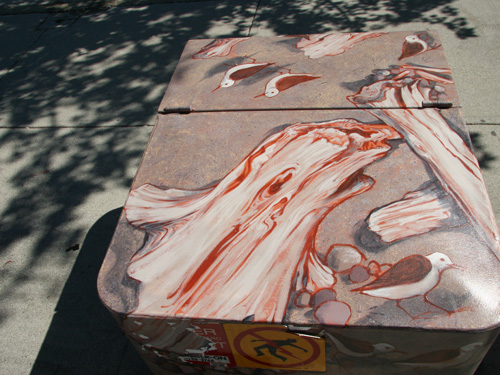
It was great to see some whimsical soul add a local angle to the movement here on the Sunshine Coast. Besides, the posts were right next to several other wonderful examples of art in public spaces: artist Jan Poynter’s hand-painted images on BC Hydro’s otherwise-boring  transformer or relay boxes.

resized-street-art-1

resized-street-art-2

I admire the prolific pranksters in yarn and wool, especially since knitting and crocheting never caught on with me. As a teen, I crocheted a blue granny-square afghan, but it took me ages to transform my initial efforts from too-big circles into evenly sized squares. As for knitting, I think I produced one of those boring, de rigeuer scarves for a home economics class and that was it. I don’t think such activities are designed for impatient people like me. 


I just found out who created the Cowrie Street yarn additions and it’s someone I know. What fun. I’m not telling.  This year’s Gibsons Landing Fibre Arts Festival is hosting its own version of yarn storming. The festival is inviting people to decorate Gibsons with their own knit or crocheted creation. Participants are encouraged to make something functional such as hats or scarves that can later go to those in need. Otherwise, people can feel free to “liberate” the fuzzy public art creations after the festival.


For more information and guidelines, contact festival co-sponsor Unwind Knit and Fibre Lounge at 886-1418 or email info@unwindknitandfibre.ca, using  “Yarn Storming'” in the subject line. There will be related photos in the entrance of the festival and a people’s choice award.


Sadly, this might be the last year of the Fibre Arts Festival due to a current lack of committed volunteers. Festival organizers have announced that they won’t hold the annual event next year. Be sure to enjoy this year’s festival, held August 19-21.

July 21, 2010 at 7:37 pm Comment (1)

Gumboot Nation a soft touch on violations

Sometimes you just have to take the law into your own hands, with tongue firmly planted in cheek. Here in Roberts Creek, BC, aka Gumboot Nation, we’re known as cheeky eco-activists who care about clean air and our community. Therefore, if someone leaves a car idling, we figure they’re disturbing the peace, so to speak. If they park in a bike lane, they’re risking the safety of a cyclist who has to swerve onto the road into traffic to get by the offending vehicle.


That’s when a fun but fervent citizen’s action comes into play. The offender will receive one of two tickets indicating a violation notice against the Nation of Roberts Creek, issued by the Department of Good Vehicle Operation. Each comes complete with a gumboot image and notification of the infraction: “You have left your car idling” or “You have parked in the bike lane.”


The ticket for idling reminds the motorist that this action

  • “increases greenhouse gases
  • shortens the life of your vehicle
  • irritates people
  • costs you money.”

The ticket for the parking infraction provides a cautionary note: “Failure to change our habits may subject us all to a grim future” and offers this call-to-action: “Do your part! Help make Roberts Creek pedestrian and cyclist friendly. Walk, ride a bike, take public transit.”

“I have found that people who are ‘bad’ do not have a sense of humour about it,” says Donna Shugar, chair of the Sunshine Coast Regional District and a Roberts Creek resident. “They are quite affronted. Perhaps that is brought on by guilt!”


I love that residents have chosen education and soft censure in response to these violators rather than resort to angry words or revenge. As a form of direct action, these tickets harm nobody and can actually make people healthier through smiles and laughter. Who says you need to get tough on crime? The soft touch works.

July 9, 2010 at 12:49 am Comments (2)

Hands Across The Sands: A Jedediah adventure

hands-across-sands-low-res-1
                                                                                                                      — Heather Conn photos

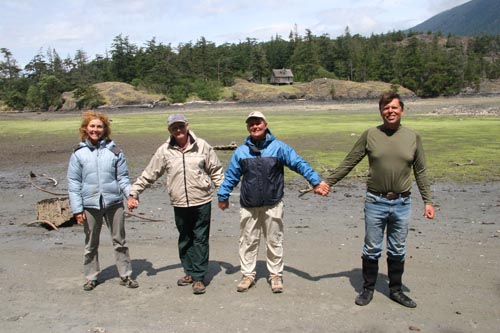
Four kayaking companions and I, camped on Jedediah Island on British Columbia’s Sunshine Coast,  joined the June 26 global event Hands Across the Sand  to protest offshore oil drilling. From our low-tide beach at Home Bay, we gathered around noon and stretched our hands across a shoreline to support clean energy choices. Like thousands of others around the world, we took this symbolic gesture to draw a line in the sand against the threat that oil drilling poses to coastal economies and the marine environment.


The Hands Across the Sand movement, founded by U.S. resident Dave Rauschkolb, began in Florida on Feb. 13 this year. Thousands of residents across the state, representing 60 towns and cities and more than 90 beaches, joined hands to protest attempts by the Florida and the U.S. governments to lift the ban on oil drilling near and off the state’s shores. The movement created partnerships with major environmental organizations such as the Sierra Club, Greenpeace, and Audubon.


The impetus for the June Hands Across the Sand event, which involved 860 locations, came from the environmental devastation of the ongoing British Petroleum oil spill. The mission of Hands Across the Sand is to draw attention to our global dependence on fossil fuels and adopt policies that encourage renewable energy sources.

our-camp-1-low-res

 At our  idyllic location on Jedediah, a marine provincial park, tiny crabs scrabbled in the shallows while dozens of live sand dollars wafted in low waters. By the thousands, oysters and periwinkles covered the sea bed, surrounded by thick clusters of mussels and barnacles on nearby rocks. At low tide, three raccoons hunted for food in the mud while red-footed oyster catchers flew past,  screeching like banshees. Ever-present seagulls dropped shellfish onto the beach to break open their food.


With such natural richness hinged to the sea, it was disturbing to imagine how an oil spill in these waters could easily destroy this abundance. While hundreds of thousands of barrels of BP oil continue to pour into the Gulf of Mexico,  Chevron is drilling underwater off Newfoundland at almost twice the depth as BP’s rig that blew out.

our-camp-2-low-res

 Meanwhile, B.C. Premier Gordon Campbell wants to drill oil off the northwest coast of the province, by the Queen Charlotte Islands. Along with the federal government and Enbridge, he’s poised to create an oil pipeline from Alberta’s Tar Sands to Kitimat, B.C. This would result in oil tankers traversing the province every day through fragile ecosystems and challenging waters in central and northern B.C. (For more details, see my archived feature “No oil tankers on the B.C. coast” posted Dec. 1, 2009 under “Environment.”)

hands-across-sands-low-res-2

On a more upbeat note, the abandoned wooden building in the background of this photo is the old homestead on Jedediah that once belonged to the Palmers. Mary and Al Palmer bought the island as a summer holiday destination in 1949, then became full-time residents in 1972. They both farmed the land and cherished the island’s 600 acres, which includes cedar, old-growth fir and arbutus, peaceful bays, and stunning views. Mary was determined to prevent any  development. (Palmer describes life on the island, complete with historic family photos, in her book Jedediah Days, a B.C. bestseller published by Harbour Publishing.)

homestead-low-res

The Palmers worked hard to preserve the island, helped by a province-wide fundraising campaign, started by the late Dan Culver’s Follow Your Dream Foundation. Many groups rallied to raise money to create a park, including Friends of Jedediah, the Marine Parks Forever Society, and the Nature Trust of B.C. Countless individuals and organizations provided financial support, which included $1.1 million from Culver’s estate. The B.C. government donated millions more and the Palmers agreed to sell the island for $4.2 million, far less than its market value. Thanks to their generosity and the dedication of so many donors and volunteer fundraisers, Jedediah Island became a provincial park in 1995.

scenic-low-res

Now thousands of people can enjoy this unsullied spot every year. A flock of wild sheep still roams the island and several dozen mountain goats, said to be descendants of those left by Spanish explorers, can peer down at you from rocky bluffs. The island has four registered archaeological sites, including a First Nations fish weir.

gibraltar-low-res1

 I took the photo above from Gibraltar, a rocky viewpoint towards the north-central part of the island. A cairn of stones marks the spot with a heavy plastic tube that contains scribbled notes from hikers over the years. Of course, I added a message from our group. Towards the centre of the island, we wandered through forests pastoral and open, without tangles of thick underbrush. We saw the grave of the Palmers’ beloved horse Will, which bears visitors’ strange offerings and detritus from the sea, from a toy car and flattened soccer ball to a plastic marine float. Elsewhere, the island’s open meadows, pungent with mint-like scent, are still home to neglected fruit trees.

moss-low-res

 Jedediah has frequent patches of startling green moss and clusters of yellow wild flowers. It was wonderful to explore this island and see only a handful of people over several days. Thanks to the Palmers’ vision and commitment to conservation, this quiet wilderness sanctuary will never see development . . .and hopefully, oil will never tarnish its shores.

sunset-low-res

June 29, 2010 at 2:28 pm Comment (1)

A bear in the back seat

A ggggrrrrrr in the glove compartment. A bear in bucket seats.  What would you do if momma bear hunkered down in your car’s front seat and decided: Hmmm, this one feels just right?


In my nearby town of Gibsons, BC, Canada, a mother bear recently found herself locked inside a resident’s car. Somehow, she figured out how to open the unlocked vehicle with her teeth and decided to get in for a sniff. Trapped with the door shut, she couldn’t get out but faced another, more serious problem: her cub was left alone outside, terrified.


The mother bear proceeded to tear up the interior of the car, probably frantic in her attempts to get to her cub. The publisher of one of our weeklies, The Local, wrote about the incident: “The bear was gingerly released from the car and joined her cub up the nearest tree.” I am not sure how to interpret that statement, although I can easily picture some cowering driver slowly opening the car door and hiding behind its glass and metal for protection.


I guess squatter’s rights don’t apply here. No one was hurt and the displaced momma was reunited with her treed offspring. However, the same bear apparently entered two other vehicles after this event. That’ll teach the owners to keep their car doors unlocked.


I’ve always been a huge bear fan and have photographed the rare kermode bear and grizzly bears in the wild in British Columbia. A bear has crashed through our wooden fence, knocked out the vertical slats in our gate, taken down our bird feeders, gotten into our garbage, and torn a slit in our soft-top Mazda convertible, but I still love the big critters. They’re so wrongly maligned and misrepresented, especially the grizzly.


Humans need to stay bear aware and follow simple rules:

  • Keep your garbage in bear-safe containers. If your trash contains meat, don’t put it out until the last minute.
  • Pick fruit readily from your trees so that it doesn’t entice bears.
  • Keep your bird feeders high and out of reach of bears. Use feeders only in the winter, when bears are hibernating.
  • Respect bears as smart creatures. Once they’ve discovered a food source, they will return to the same spot for years.


To read and see photos about a truly remarkable bond between a human and bear, click here.

June 22, 2010 at 4:48 pm Comments (0)

« Older PostsNewer Posts »