Heather Conn Blogs

spoutin’ about by the sea

Woolly public art: better than tea cozies

resiized-yarn-shot

                                                                                                                       — Heather Conn photos

I was delighted last week to spot two offbeat, local examples of public street art, otherwise known as “yarn bombing.” While walking down Cowrie Street, the main drag in Sechelt, BC, I saw a different hand-knit woolly cover stretched over two brown-and-yellow metal posts. These fuzzy, striped sleeves covered unsightly chipped paint and added a jaunty, colourful spirit to an otherwise drab street scene. Hurray for fun and creative self-expression in public spaces.


Yarn bombing is a cool, new form of craft-making, whereby mostly urban women fit knitted or crocheted concoctions over public structures. A parking meter gets its own snug sweater. A tree branch gains a crazy-coloured, woollen branch. Pink, knitted pom-poms dangle from a red fire hydrant. Done anonymously, this donated art  adopts the stealth-application style of graffiti artists.

 resiized-yarn-shot-2

I first discovered this quirky form of street art at a BC Book Prizes reception in Vancouver, where I saw the book Yarn Bombing: the Art of Crochet and Knit Graffiti by Vancouverites Mandy Moore and Leanne Prain. I loved the concept and marvelled at the prankster-style patterns included in the book for knit and crochet installations. (Prain co-founded a “stitch-and-bitch” group called Knitting and Beer.)

 resiized-yarn-shot-3

I’ve since learned that there’s an international “guerrilla” knitting movement called Knitta. which began in Houston, TX in 2005 — hardly the hotbed of radicalism.


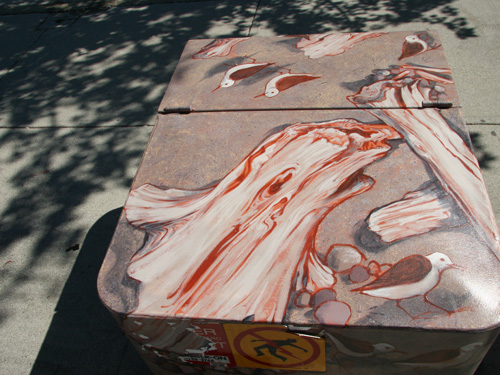
It was great to see some whimsical soul add a local angle to the movement here on the Sunshine Coast. Besides, the posts were right next to several other wonderful examples of art in public spaces: artist Jan Poynter’s hand-painted images on BC Hydro’s otherwise-boring  transformer or relay boxes.
resized-street-art-1

resized-street-art-2

I admire the prolific pranksters in yarn and wool, especially since knitting and crocheting never caught on with me. As a teen, I crocheted a blue granny-square afghan, but it took me ages to transform my initial efforts from too-big circles into evenly sized squares. As for knitting, I think I produced one of those boring, de rigeuer scarves for a home economics class and that was it. I don’t think such activities are designed for impatient people like me. 


I just found out who created the Cowrie Street yarn additions and it’s someone I know. What fun. I’m not telling.  This year’s Gibsons Landing Fibre Arts Festival is hosting its own version of yarn storming. The festival is inviting people to decorate Gibsons with their own knit or crocheted creation. Participants are encouraged to make something functional such as hats or scarves that can later go to those in need. Otherwise, people can feel free to “liberate” the fuzzy public art creations after the festival.


For more information and guidelines, contact festival co-sponsor Unwind Knit and Fibre Lounge at 886-1418 or email info@unwindknitandfibre.ca, using  “Yarn Storming'” in the subject line. There will be related photos in the entrance of the festival and a people’s choice award.


Sadly, this might be the last year of the Fibre Arts Festival due to a current lack of committed volunteers. Festival organizers have announced that they won’t hold the annual event next year. Be sure to enjoy this year’s festival, held August 19-21.

July 21, 2010 at 7:37 pm Comment (1)

Trinidad, Cuba: a post-9/11 view

Photo used with permission from Adam-m.ca


Under a backlit street of penetrating sun, residents in Trinidad, Cuba appear and disappear within the shadows of open doorways in a silent prelude to darkness.


It is mid-October 2001, barely a month after 9/11. At this seemingly post-apocalyptic time, most world travelers are too afraid to fly here. In this south-central town of 50,000, my friends and I see almost no other tourists. We feel grateful for this reprieve: no belching tour buses, no jarring crowds, no kamikaze camera hounds.


The town’s languid feel, in the steamy heat of hurricane season, is a welcome sanctuary from the fear and frenzy of CNN. The television news, available here via satellite at our oceanfront hotel, has positioned the United States on a metaphorical abyss, following the fiery demise of the World Trade Center and its 3,000 dead. Engulfed in the search for Osama bin laden, Wolf Blitzer warns of the impending anthrax crisis. His tiny image and impassioned coverage on my hotel-room screen appear oddly surreal in this land of smiles and siestas.  


Yet, beneath its perfect-holiday atmosphere, Cuba bears a collective pain of its own. Sure, this island nation, rich with salsa and jazz, offers the calendar gloss of white-sand beaches, delectable mojitos, Hemingway nostalgia, and photo-pretty 1950s sedans in gleaming colours. But the first Spanish invaders brutalized and enslaved Cuban people, even feeding some live to their dogs.


Cuba continues to suffer under the U.S. embargo imposed in 1962, resulting in a lack of medical, educational, and mundane supplies like soap, notebooks, and guitar strings. The country bears the highest suicide rate in the Western Hemisphere, and inaccessibility to food at various periods has resulted in needless deaths, bringing many past urban residents to near-starvation. (Our informal group received government permission to import and transport medical supplies for distribution in remote clinics.)


Understandably, with few tourists present, the locals in Trinidad are desperate for our business. In Trinidad’s main town square, a genteel enclave of colonial homes and palm trees, street vendors display homemade wares: toy cameras and planes made of pop and beer cans, open-weaved tops and tablecloths of lace, lively street scenes painted in a flourish of colour.


Declared a World Heritage Site by UNESCO in 1988, Trinidad remains a living museum of its heyday in the mid-1800s, when the surrounding area produced a third of the country’s sugar. Founded in 1514 by Cuba’s first governor, Diego Velasquez, Trinidad was the third settlement ever formed in this fiercely independent Caribbean nation. An early haven for smugglers, the town and its region later became a focus for the importation of slaves and goods, shifting to cattle ranching and tobacco-growing for its wealth. When 50 small sugar mills started northeast of the downtown core in the early 19th century, sugar cane became the area’s crop of prosperity.


The 2000 Lonely Planet edition of Cuba describes modern Trinidad this way: “Its baroque church towers, Carrera marble floors, wrought-iron grills, red-tile roofs, and cobblestone streets have changed little in a century and a half.”


The must-see building off the town’s main plaza is Museo Historico Municipal, a mansion that wound up in the hands of a German sugar plantation owner in the 19th century. He reportedly gained control of huge sugar estates by poisoning an old slave trader and marrying his widow, who also died mysteriously. The building’s neoclassical décor and its outstanding view of Trinidad readily evoke the power and privilege of Cuba’s former ruling class. Today, in Castro’s economy of agrarian collectives and nationalized companies, this refurbished symbol of colonial grandeur remains an antiquated testament to comparative wealth.

Click here for a published account of my Cuba trip.


Here are a few travel books on Cuba:

Cuba (Lonely Planet Guide), by David Stanley, 2000

Cuba: A Concise History for Travellers by Alan Twigg 2000

The Reader’s Companion to Cuba, edited by Alan Ryan, 1997

The Rough Guide to Cuban Music by Philip Sweeney, 2001

Travelers’ Tales Cuba, edited by Tom Miller, 2001

July 21, 2010 at 12:01 pm Comment (1)