Heather Conn Blogs

spoutin’ about by the sea

Art and graffiti on the Camino: How do we create connection?

EL CAMINO mural low-res 457

One example of a pilgrim-themed mural

Like any pathway of self-expression, The Camino is a repository for art and human musings. These range from professional sculptures and murals that depict a modern or ancient pilgrim to silly scribblings, wise reflections, and indulgent graffiti.


As an art devotee and long-time fan of street art, I was curious whether the offerings along The Way of St. James would reflect greater contemplative wisdom or spiritual enquiry than what usually appears in most cities in North America. After all, at least 100,000 people from around the world walk the route each year, many of them on a spiritual or religious quest. Surely, this motivation would produce words and images inspired by reverie, “aha” moments, and a questioning or deepening of faith?

demons low-res 764

Some of the demon art displayed along the Camino

Yes and no. Most people on an inner search are probably less likely to scrawl graffiti across a public space, which I respect. I found that it takes time for many strangers to open up about their deepest reasons for doing the walk. Such revelations require a degree of intimacy, something that a public message can only imply. Graffiti can provide a big-picture view, connecting us in shared sentiment, conveying a sense of community. Yet, because it’s anonymous, we don’t grow any closer to the person who created it. It’s one-way dialogue.


For me, the Camino was very much about two-way communication in one-on-one encounters. However, I still appreciated both the “official” art I saw, publicly funded or in galleries, and found much of the pilgrimage-related graffiti either heartening or entertaining. Sometimes, a simple question spelled out in large capital letters “WHY ARE YOU WALKING?” could prompt some added introspection. Once, the short statement “Keep walking. Don’t give up” was just the extra boost I needed, as if from a silent coach. The suggestion “Open your heart wider,” spray-painted on a cement road barrier, made me smile.

open your heart low-res 885

One high wall featured Spanish verse about the life of a pilgrim and what such a walk means. One pilgrim, an obvious Tom Petty fan, had sprinkled the route with quotes from the musician’s lyrics, written in small letters on the backs or tops of signs. At times, I found the quotations amusing or oddly appropriate. At others, they seemed to irritate me with intrusion.

pilgrim wall low-res 400

The wall of pilgrim-themed verse


Strangely, the quality of graffiti content seemed more puerile the closer I walked towards Santiago; evidently, walking the path produced no guarantee of gains in maturity. One pilgrim wrote on the back of a road sign: “Only pussies walk the last 100 kilometres.” This was a reference to those who walk the minimum distance required to obtain an official pilgrim certificate in Santiago. Ilke, a German pilgrim with whom I walked for the last four days, commented on this graffiti: “Sounds like he should walk the Camino again.”

doorway art low-res 055

Art on a doorway in Chartres,
part of the Chemin de Paris Camino trail


In the final days of the Camino, I was disturbed to see a man’s open letter to a woman (I believe it was “Ann”), painted in about three-inch-high letters on the side of a house that faced the path. Admitting his love for her, he told her how much it meant to him that they had walked together. Her presence had made all the difference, he said.


Admirable sentiments, but why deface someone’s home to advertise your private thoughts? What arrogance and disrespect for others that required, despite an avowed love for one. Perhaps it’s easy to view all graffiti “artists” in this way.


Throughout the Camino, the murals and sculptures of pilgrims reminded me that I was part of a collective historical journey, an archetypal one that reached beyond my own personal trip. These visual reminders appeared on hilltops or town squares as unknown yet familiar faces. Like all meaningful art, they created connection.

pilgrim low-res 739

The most universal symbol or source of art on the Camino is the Christian cross. It appears in every imaginable form, from two crossed sticks stuck in a fence to intricately carved wooden ones and medieval or gothic gilt ones in cathedrals. Regardless of one’s beliefs, it is impossible to ignore the evocative power, as an historical art piece alone, that this symbol carries.


From the Crusades to vampire-slaying, we have recognized across cultures, continents, and centuries that the cross carries significant weight. Whether it instills joy, faith, hatred, disdain, fear, guilt, love, anger or any other emotion, the cross communicates more in silence than a million graffiti artists could ever hope for with their messaging. Like great art, it is a mirror of our own projections, transforming us by how we choose to view it and what meaning we bring to it.

roadside memorial low-res 801

A cross on one of the dozens of memorials that appear along the Camino.

NEXT WEEK: St. James and scallop shells

,
October 25, 2013 at 2:27 pm Comments (4)
Present or absent? The way of friendship on the Camino

When my husband Frank left our Pamplona hotel room at 4 a.m. to catch his flight home, as we had planned, I felt sad but eager to continue on the Camino. It was day six of my pilgrimage, and I knew that a friend was arriving that night, June 1, to accompany me on the rest of The Way.

rose low-res 296

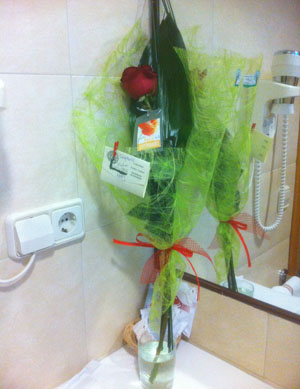
a birthday rose for my friend

It was her seventieth birthday and we were going to celebrate that evening; I had bought her a long-stemmed rose and card. To mark her special milestone, we had chosen 2013 to walk the Camino together, after talking about it for years. That spring, she had invited me to join her for a day of informational workshops about the Camino. After attending an excellent event hosted by the Canadian Company of Pilgrims, I felt more inspired than ever to go. Now I looked forward to our reunion and a new phase of my trip.

By late afternoon, when she had not arrived at the hotel, I asked the man at reception if he had any messages for me. No. A few hours later, I asked again. Still nothing. I had received no emails on my iPhone. Assuming that she must have missed her flight, I figured that she would arrive the next morning. I knew that she was travelling without a cell phone, so I could not contact her; unbelievably, I didn’t have her flight information.  Assured that nothing serious was wrong, I felt disappointed that we would not be together on her birthday to celebrate.

The next day, after still not hearing from her, I wondered if she had decided against the trip. Originally, she had wanted to go later in the summer, but I had said it would be too hot and crowded then for me. The previous month, health issues had made her decide not to walk the Camino, but then she had changed her mind. Did she reschedule the trip to her liking, after all, and not tell me, knowing how angry I would be?

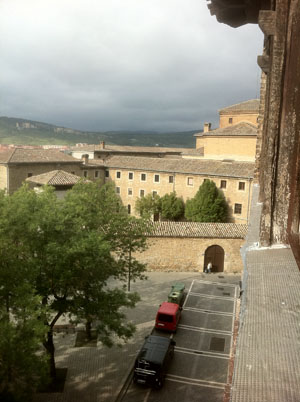
Pamplona hotel window low-res 294

The view from our hotel window in Pamplona

I checked again at hotel reception, my email and phone for messages, but nothing. The next morning, same thing. Not wanting to spend yet another day in Pamplona, I wrote in my journal on June 2: “[It] looks as if this will be a solo trip.” I gave her rose to the man at reception, who looked stunned. “Give it to your wife or mother,” I told him, in Spanish.

Impatient to head out, I left just before 9 a.m., leaving my friend a message at reception in case she arrived after my departure.

Alone, I walked out into heavy winds on my first Camino day without rain. As someone who has always relished solo travel, I felt partly pleased at this surprising change of plans. I like the freedom to move at my own pace, answerable to no one. Because my friend walked much more slowly than me, I had wondered, while still in Canada, if our different paces would cause friction.

On the first few days of the Camino, I had already recognized that walking the route brought out my competitive side; I enjoyed passing people on the trail. I had felt impatient waiting for my husband, who walked much more slowly due to a previous knee injury. Chastizing myself for this perspective, I later paid little attention to the notion of being ahead or behind. We were all on our own path, travelling at our own speed.

me in rain low-res 185

Frank took this photo during the rainy first days of the Camino.

In the following days and weeks, I alternated between anger, compassion, and forgiveness towards my friend. What had happened to her? Why didn’t she contact me? Sometimes I wondered if she was just a few days behind me on the trail. In a notebook for pilgrims provided at one roadside stop, I even wrote to her: “Where are you?”

Some mornings, waking up angry, I focused on releasing my irritation while starting to walk. With each step, it was easier to let go. I realized that in absentia, she had become a spiritual teacher on my path. Her silence and not showing up became external mirrors for my frame of mind each day. Was I going to let her absence control my mood?

As I walked, my mind had endless time and space to imagine an array of scenarios from confrontation and a severing of the friendship to joking about it decades later. I had the power to choose how I would respond to this situation, ranging from self-pity to self-righteous triumph. My mind would determine the quality of my process, both on the Camino and everywhere. I, alone, was responsible for how much light and shadow I brought to my experiences.

As I met and walked with various pilgrims for consecutive days along the way, I realized that if my friend had been there, my connections with these people would likely have been very different. Perhaps I would not even have spent much time with them. I felt grateful for these encounters, realizing that solo travel often provides opportunities for people to reach out when they might not otherwise. Strangely, I felt like thanking my friend, whose absence allowed me to make these new friendships without her.

Yet I still felt annoyed at not hearing from her. Along the way, as different people asked why I was walking the Camino, I explained the story. Many were aghast. The pilgrims in their twenties, in particular, were incredulous that in today’s plugged-in world of social media, my friend and I had not communicated.

me with 50 km left low-res 1020

Only 50 kilometres left to go . . .

On day 30 of my pilgrimage, four days before arriving in Santiago, I finally found out what had happened. In an email, Frank said that my friend had left a phone message at our home, sounding terrible; since he had been away for several weeks, he did not receive it until he got back. She had been found unconscious near downtown Victoria, suffering an adverse reaction to a recent change in medication, and had remained hospitalized for days.

I felt grateful to know, at last, that she was okay and why she hadn’t come. For almost my entire Camino journey, her fate had symbolized the unknown for me. Her absence, indirectly, was my gift, to help me deal with the unexpected.

Upon my return, we reconciled by phone. Our friendship continues.

October 18, 2013 at 2:39 pm Comments (3)

Not just bars and bravado: retracing Hemingway’s past in Pamplona

Hemingway statue low-res 225

Statue of Hemingway by the Plaza del Toros

While seeking out Ernest Hemingway’s favourite haunts in Pamplona, I admit to feeling like a groupie. The Camino is a spiritual journey, I told myself, so why do I care where a famous alcoholic author, who was macho, petty, and self-absorbed, liked to hang out?

I know these labels don’t cover all of who he was. Besides his chiseled writing style and literary wonders, I admire his willingness to support the International Brigades, risking his life to fight fascism in Spain’s civil war as an ambulance driver. In daily life, he mucked about equally with illiterate fishermen and Hollywood stars, never wallowing in his celebrity status. From his home in Cuba, he tutored young boys in boxing and kept young baseball teams afloat by providing uniforms and equipment.

And Hemingway made a significant pilgrimage of his own to a basilica near a different Santiago, in southwest Cuba. Was it superstition or humility that motivated him to leave his home near Havana and deposit his 1954 Nobel Prize in Literature, a medallion, at the shrine of the Virgin of Charity (La Virgen de la Caridad), Cuba’s patron saint?


Sure, having read Hemingway’s Women, I know about his four wives, and how he never left one until he had lined up another. Yes, he could be a drunken, brutal bastard and for most of my life, I’ve condemned him. Yet, recently, I have felt more compassion for him after learning that he, at age 19, was sent onto the battlefield after an explosion to sweep up the body parts. That would traumatize anyone.

He seemed unable to forgive his talented third wife, journalist Martha Gellhorn, for scooping him on a deluxe Second World War assignment; she was the sole foreign correspondent to gain coveted access to a certain allied aircraft carrier to report on the war first-hand.

fun with Hem low-res 259

Having fun with Hem in the bar at Cafe Iruna

And what’s with his fixation with having a large rod in his hands while fishing or hunting?

Yet under his bluster and bravado, a cowering little boy lurked. The 1976 autobiography How it Was, by his fourth wife Mary, reveals not only Hemingway’s meanness and spite but his tenderness and vulnerable need for loving reassurance. She documents his later descent into paranoia and struggle with mental illness. How could a man, formerly at home in vast landscapes, free on the roiling ocean and African plains, stay sane and contained within a locked, isolated room in an institution? While reading that book, I felt compassion for the suffering of his soul.

The writer in me felt drawn not only to the places he frequented in Spain, but to his rebel soul that disdained mundane journalism for a passion-filled life of irreverent adventure.

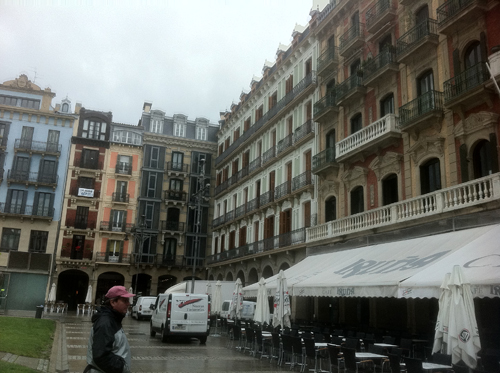
plaza with Cafe Iruna low-res 218

My husband Frank on a dreary day in Pamplona’s near-deserted Plaza del Castillo. The white awning of Cafe Iruna appears in the right foreground.

Hemingway’s great literature, skillfully created, added grit and guts to the otherwise snooty veneer of the land of American letters. His bylines came with a lot of sweat, swearing, and swagger; he was a man of the seas and the street—no starched white lapels for him. Although I don’t condone bullfights and his enjoyment of them, I recognize his love of Spanish people and culture and how his view of both expanded North American sensibilities.

Hemingway's cafe low-res 240

Inside the popular Cafe Iruna in Pamplona

When I strode across Pamplona’s Plaza del Castillo, the large square that housed Hemingway’s favourite hotel and café, it was easy to imagine the expatriate writer arm-wrestling over one of the many patio tables or downing too many absinthes or whiskeys in fading Spanish light. The wicker seats that once filled his haunt Café Iruña (Basque) are gone, but the large, high-ceiling place with overhead fans and polished lights feels like a touch of Paris. In the adjoining bar stands a near-life-size statue of him. Many framed black-and-white photos in the bar show him in informal poses. In one, he’s in the midst of making a cocktail; in another, he’s laughing with friends.  

I wasn’t surprised to discover that Pamplona’s tourist office supplies a free map of Hemingway-related sites. At Plaza de Toros, the bullfighting arena, there’s a Paseo or street named after him. Next to it, a sculpture in his honour — a bust atop a stone shoulders and folded arms — stands as a solemn monument.

Besides notable folk like Charlie Chaplin and Orson Welles, Hemingway used to stay at the tall, elegant Hotel La Perla, where a small bust of him rests on a table in the lobby. Although this five-star “perfect combination of tradition, history, and comfort” offers discounts for Camino pilgrims, I found the atmosphere impersonal and uninviting.

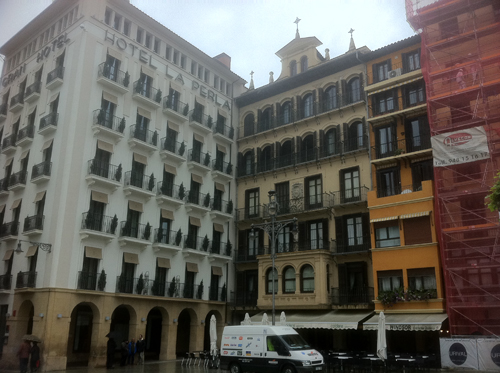
hotel la perla low-res 237

Hemingway’s five-star accommodations, Hotel La Perla,
appears to the left in this image of Plaza del Castillo.

One of Hemingway’s favourite hangouts, Bar Txoko, was empty when I first looked in. Dominated by a wide counter that runs the full length of the establishment, it has a photo mural at one end. When my husband Frank and I popped in later, the cozy joint was full of Spaniards drinking and talking after work, standing in huddles. Hem would have easily fit into this laid-back, intimate bar.

Heminway's bar low-res 223

Bar Txoko, one of Hemingway’s favourite hangouts in Pamplona

I have toured Hemingway’s home in Key West, Florida, with its tropical garden, mangy crew of five-toed cats, and the salt-water pool that his wife Pauline built for him and he never used. The image of his writing room there, with a typewriter, chaise lounge, and mounted animal heads, has remained with me as a symbol of inspiration. I look forward to seeing his house in Cuba and some of the island’s local places that Mary writes of fondly in her book.

Hem cocktail photo low-res 256

A photo in the Cafe Iruna bar
shows Hemingway preparing a drink

After walking the Camino, I reread Hemingway’s The Sun Also Rises, appreciating his description of the same areas and towns where I had walked. But while still in Pamplona, after seeing the token spots that had attracted Hemingway’s boozy interest, I began to feel restless.  After spending two days in Pamplona — days five and six of my Camino pilgrimage — I was ready to leave the city and return to the open, rural paths of The Way. Like this far more famous writer, I craved untamed space and the lure of the unknown.

NEXT WEEK: The gift of little miracles on the Camino

, , , , , , , , , , , , , , , ,
October 12, 2013 at 11:46 am Comments (2)

Sacred space needs no official designation

“Anywhere can be a sacred site—it only requires us to see our land as special and we will learn to tread more gently upon it.”
Alliance of Religions and Conservation website


A short, squat man in dark clothes and peaked cap, whom I thought was a priest, was about to lock the front door—a thick, dark, wooden one—of the Santa Maria La Virgen Blanca church in Villalcázar de Sirga.


My guidebook recommended seeing the interior of this Knights Templar church, a national monument, which housed the tombs of royalty and nobles. From the twelfth century onwards, one task of the Templar knights was to protect pilgrims on their journey to sacred Christian sites.

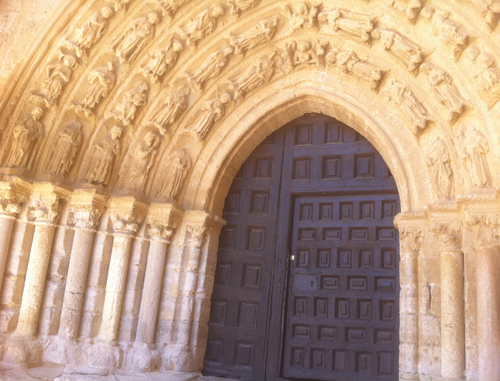
church door low-res 634

The entrance to Santa Maria La Virgen Blanca church in Villalcázar de Sirga

Curious, I ran up the front stairs and got inside, just before the man turned the deadbolt. Leaving my friend Dieter at a café across the street, where he was enjoying a cool drink in the shade, I figured a 10-minute visit would be enough; then we’d continue on The Way.


After the short man made sure that I had paid the 1 EU entrance fee for pilgrims or peregrinos, he began a tour inside the church for a busload of middle-aged Spanish women. Previously, when they had spilled onto the lazy town square, I had called them “chickens” for their noisy, non-stop squawks and talk.

church entrance low-res 635

The view above the front entrance of the church

Wandering around the church, I sat on a dark wooden pew, trying to meditate briefly in the semi-darkness. Soon, the coolness of the church’s stone floor and walls became too cold for me, and I wanted to leave. The inside of the front door, separated from the rest of the church behind a small entrance, stood in solid darkness. With the help of my pocket flashlight, I tried to jiggle the dead bolt and piston lock, which was embedded into the ground. Nothing moved.

church interior 2 641

Part of the church interior


We were locked in. Approaching the guide during a brief break in his narration, I asked him, in basic Spanish: “May I have the key to open the door? I have to leave.”


“No,” he replied. In Spanish: “You’ll have to wait until the tour is over.”


Frustrated, I tried to accept the situation, but irritation soon won over. I was prisoner of a church! About a half-hour later, some of the Spanish women were also cold and wanted to get out. The man wouldn’t let them. “We could get sick and end up in the hospital,” one muttered in Spanish. Three of us huddled around the door but despite our attempts to escape, it remained locked.


After about 15 minutes, we approached the guide together and demanded to be let out. With about two dozen female Spanish tourists thronged around him, he thrust out his arm and pointed at me, wagging his finger while saying something in Spanish to the effect of “It’s her fault that your tour is ending now.”

church low-res 639

A view inside the church

Feeling like a marked woman, I laughed, but was pleased to see him get out his circle of skeleton keys and head for the door.

Once outside, back into 23-degree-C sunshine, I felt grateful to see Dieter again, sorry that I had kept him waiting. “I was ready to come looking for you,” he said, adding with a chuckle: “I thought you must be doing thirty years’ worth of confessions.”


I thought it ironic that a public building like a church, which is supposed to be sacred space and a comforting sanctuary, had kept me trapped. I wondered: To what else am I held prisoner? The list is long: expectations, ambition, judgments, comparisons, envy . . .


This was day 19 of my pilgrimage. Before walking the Camino, I had expected that each albergue would offer group spiritual activities from shared meditation to facilitated discussions. But less than a handful did. By week two of the Camino, I realized that rather than seek out groups of spiritual community, which I ultimately found anyway, I needed to create my own versions of sacred space.


So, at times, I made myself stop along the route, lean against a tree, close my eyes, and silently absorb my surroundings. For me, this usually proved more meditative than constantly moving through an environment.

sacred space low-res 950

What makes space sacred? With Pam and Elke of Langley, BC

At one albergue in Belarodo, the hospitaleros, a thirty-something European couple, had hosted a brief, evening session of informal song and meditation, using the organ as accompaniment upstairs in the church next door to the hostel.


A handful of us had gathered in the bone-cold church under blankets, singing a few lines of a Latin song as a round. It was one that Camino pilgrims sang in medieval times, the male hospitalero told us, and translates roughly to the following:


Every morning we take the Camino,
Every morning we go farther,
Day after day the route calls us,
It’s the voice of [Santiago de] Compostela


Way of earth and way of faith,
Ancient road of Europe,
The Milky Way of Charlemagne,
It’s the Chemin of all the Santiago pilgrims,
and so on . . .


The chorus “Ultreia, ultreia, Et sus eia, Deus adjuva nos” is “Onward, onward, and upward, God helps us.” I appreciated the historical link that these words made to pilgrims who had walked the same path centuries earlier.


Before walking the Camino, I had read that it was customary for Spanish residents along the route to call out “Ultreia” (also spelled “Ultreya”) to pilgrims as a sign of support and encouragement. Yet, I heard no one say that word once during my pilgrimage. Instead, today’s common greeting is “Buen Camino” (Have a good Camino.) Along the way, I saw “Ultreya” written in only a few places. Otherwise, the term seemed obliterated.


For me, discovering and singing the word “Ultreia” on the Camino was a significant thread, a form of creating sacred space over time. It invited union, commonality, between pilgrims and non-pilgrims, and those who had walked The Way now and in the past.

sacred space low-res 156

A view along the Camino

In the small town of Manjarin, on day 26, I heard beautiful Gregorian chant next to a restaurant and noticed the word “convento,” in large letters, on the side of a nearby building. Thinking that perhaps live monks were singing or I could hear sacred harmonies in a nunnery, I headed towards the source of the music. Looking up, I saw a loudspeaker mounted above patio tables and umbrellas. This was the source of the music. It was a recording.


Feeling like Pavlov’s dog, I laughed aloud. Some savvy business person sure knew what would draw pilgrims’ attention. Even my guidebook mentioned the music in this specific place: “Perhaps Gregorian chant (from a well-worn tape out of the Cluny sanctuary of Taizé) will call you to stop.”


Sacred space on the Camino or anywhere certainly doesn’t need to be within a church or cathedral or some form of monument collectively deemed powerfully poignant, such as the Cruz de Ferro at Puerta Irago. At this highest point on the Camino, at 1,505 metres, a giant cross stands atop a high pile of stones, each one left by a pilgrim to honor a dream or loved one or trait that someone wants to release.


Sacred space needs no official designation. It is created through ritual and recognition that all life is sacred; we are the ones who bring meaning to what touches us. We decide what words, acts, ceremonies create sacred sharing. Yet the earth is innately sacred; if we do not see it as such, does its sacredness disappear?


Every encounter upon The Way, whether at a drinking fountain in a village plaza or in the flat plains of the Meseta, can become sacred. Over the years, dozens of pilgrims have broken off two branches to form a cross and added them to different fences along the way. Each one can represent the life of a loved one lost or a symbol of someone’s faith.

crosses low-res 787

Some of the informal crosses that pilgrims leave along the route

Even my encounter with the tour guide and the locked church was sacred, although not one I appreciated at the time. It was an opportunity for me to learn patience and to join in a common goal with women I had previously judged and deemed separate from myself.


A meeting of two kindred hearts and spirits, in itself, creates sacred space. What lies within each of us—a lush, tended garden or withered barren land? How well we cultivate our inner space determines how much we have to give to others and ourselves.

NEXT WEEK: Hemingway and the Camino

, , , , , , , , , , , ,
October 4, 2013 at 1:20 pm Comments (2)

In what form does a spiritual community appear?

How many times, as a non-Catholic, do you get the chance to participate in a small mass, seated next to a woman who defines herself as an atheist from Alaska?


That’s how impromptu spiritual community unfolds on the Camino. In Santa Domingo, on day 12 of my pilgrimage, I participated in a eucharist mass, not even knowing what that term meant. As someone who nearly winces at the terms “God” and “Lord” and rejects patriarchal organized religion, I wondered what I was doing there. But a deeper part of me, longing for some form of collective spiritual connection or divine validation, felt in the right place.


Eleven pilgrims—a jocular late-forties Irish priest who was questioning his loyalty to the church; me; two twenty-something Catholic men from Philadelphia and two from Hawaii; a self-professed atheist; a middle-aged male Irish Protestant; a middle-aged female Irish Catholic; a 50ish Lutheran minister from Saskatchewan; and one man I never spoke to—gathered in an upstairs room at an albergue.

informal mass low-res

Part of an impromptu mass on the Camino

I had met the presiding priest earlier on The Way and admired his playful approach to life, his commitment to grassroots social reform and his growing sense of alienation from his church hierarchy. In my view, he was an anarchist at heart. I knew that his willingness to perform this mass to a mixed group of believers and non-Catholics was verboten by his church’s traditional regulations. The Lutheran minister later warned me not to even mention the priest’s name in any subsequent public writings since he could be ex-communicated for such a supposedly treasonous act.


Ah, a cabal of rebels: my kind of crowd. The priest acknowledged the diversity of our group and gave us all the option of either taking mass or asking for a blessing. As we sat in a circle, holding hands and singing a hymn, I found myself crying, feeling goose bumps and chills, my own form of soulful recognition of something beyond description.

The priest had asked me to read Corinthians 1 verses 1-7. I hadn’t read a Bible in decades. Grace and peace to you from God our Father and the Lord Jesus Christ. I told myself: Keep an open mind. Ignore the holy trinity language. Connect to the spirit of the words. I enjoyed reading aloud; it reminded me of old Sunday-school sessions and school performances. Yet I still felt disconnected from these phrases. What relationship did they bear to my life?

communal breakfast low-res 456

A typical communal breakfast at a Camino albergue

My chattering mind continued. It’s just another form of saying a connection to All That Is. Don’t be so judgmental. Stay open to whatever form you might receive a teaching. Why do you continue to promote a sense of separation? We are all One.


“The eucharist relates to the washing of feet,” the priest told us. As pilgrims, we could all relate to a focus on our weary soles. Along the Camino, monks and nuns at some albergues even wash the feet of pilgrims. Our holy host spoke of our common link as people walking The Way. I felt blessed, grateful to be part of this loose-knit yet intentional gathering.


Immediately afterwards, one of the young German men was openly crying. A lapsed Catholic, this was his first mass in many decades. Something had reached him. I read somewhere that everyone who walks the Camino cries at least once along the way.


Later, some of us went for dinner at a restaurant, relishing a Pilgrim’s Menu that included red wine. This was not the Last Supper, which the eucharist commemorates, yet it reinforced a different form of fellowship, a sharing of bread and wine between global souls.

communal dinner low-res 835

An international communal dinner at the Apostol Santiago albergue

Communal meals on the Camino are their own form of sacred gathering, like the one I experienced on day 26 at the parochial albergue, Apostol Santiago, in Acebo. By the time I arrived, I felt as if my feet and ankles had been beaten with wooden paddles. But the two matronly hospitaleros, full of laughter and kindness, welcomed me warmly and after much-appreciated rest on my dorm bed, I felt more invigorated.


By 8 pm that night, I joined about a dozen pilgrims from France, Germany, Spain, Portugal, Belgium, Hungary, and the U.S. for a dinner of salad, lentil soup, and watermelon slices for dessert. Before eating, we all read a sheet provided by the albergue, which spoke about the Camino as both an inner and outer journey, how it becomes part of you, you become part of a community and so on.

communal dinner low-res 2 834

Each of us read aloud a translation, in our own language, of the same message; there were at least eight versions and we listened to each one consecutively. The Hungarian man was last to read; the hungry Belgian beside me grumbled about having to hear the same thing so many times, but I shushed him. To me, the ritual was a wonderful validation of our separate, yet unified journey.


Eleven days earlier (three days after the mass), the same priest had hosted another spiritual gathering. This time, it was an ecumenical circle in an empty room on the 4th floor of the downtown albergue La Casa del Cubo in Burgos. In a facility that housed 150 beds, I had expected a large turnout but only about a dozen participated, most of them the same people from the previous mass.


We sat in a circle on the floor, a backpack and pillow in the centre representing our collective pilgrim spirit and passage. Since we had all seen herds of sheep fenced in along the path that morning, the priest used sheep and the Lord as a shepherd as a metaphor in his informal talk. He sang a hymn while the two Catholic guys from Philadelphia, both in the seminary, sang beautiful harmonies.

sheep 1 low-res 478

Sheep on the path en route to Burgos

Although moved by the sound and shared connection, I still missed my more familiar reference points, the Sanskrit chants from my yoga class, and the eastern-based sensibilities that resonate more profoundly with me. Yet, in that time and place, otherwise alone, I still felt a part of something far larger than myself, regardless of what name I or others chose to call it.

NEXT WEEK: Creating sacred space on the Camino

, , , , , , , , , ,
September 28, 2013 at 3:36 pm Comments (4)

Witches on The Way: Remember the Camino’s tarnished halo

While tromping through mud and rain near Burguete on day three of the Camino, I came across an official-looking historical sign near an old stone cross. Expecting to read something about a local church or landmark, I was surprised to learn that there had once been a witch’s coven in the area in the sixteenth century. The surrounding forested region, part of the province of Navarre, was known as the Wood of Sorginaritzaga or Oak Grove of the Witches.


The historical marker, one of the few along The Way that included an English translation, said that medieval people had believed that the presence of a white cross would save them from such evil.

white crosses low-res

White crosses in a church cemetery on the Camino


When I looked at the stone cross beside the sign, it gave me no sense of reassurance or protection at all. Instead, I thought of the many innocent women who had died brutally at the hands of Christians simply because God-fearing people viewed their practices of natural healing and using herbs as the devil’s work. I knew which side my modern sensibilities favoured.


My guidebook made no mention of Spain’s regional witch history. Once back in Canada, I learned that Spain had repressed witchcraft in this Auritz-Burguete area and eastward around Roncesvalles more fiercely than anywhere else in the country. Long before the Spanish Inquisition began in 1478, a major raid against witches took place here in 1329. This resulted in the burning of five alleged witches in a village square.


Then, in the sixteenth century, a Spanish grand inquisitor named Licenciado Balanza started his investigation into alleged devil worship in this same region. As a result, at least nine people were persecuted and burned at the stake. That’s when the Catholic church erected a white cross or cruz blanca, as symbolic divine protection, near where today’s historical sign stands.


About five hours after reading the sign about the oak grove, I discovered a witch figurine on top of a bathroom shelf in my fifth-floor accommodations in a private building in Zubiri. When I tried, in Spanish, to ask our kind, middle-aged female host about it, she thought I wanted to use a hair dryer or there was something wrong with the plumbing. Only when I finally showed her the figure did I learn the word for “witch”: bruja.

with ad in pamplona store low-res 290

This ad for some type of alcohol appeared in a shop window in Pamplona, complete with a dead fly. A mandragora is the plant mandrake from the deadly nightshade family, which is supposed to have hallucinogenic qualities. It’s known as “Satan’s apple” in Arab culture. Because the plant’s tubers can look human, it was associated with witchcraft.


In Spanish, the woman told me about the witch museum in Zugarramurdi in the Pyrenees and its nearby cave. Until the seventeenth century, this area is where witches’ pagan rituals occurred, along with “wild parties, dancing around bonfires and holding orgies by moonlight,” according to the Kingdom of Navarre government tourism website. Sounds like juicy Burning Man material to me. Today, people still gather every year in the cave at summer solstice, with tall, flaming torches as their only light.


But as in the Oak Grove of the Witches, women did not fare well, historically, in the Zugarramurdi region. In 1611, the Spanish Inquisition received instructions to go to this cave and neighbouring countryside to hunt down so-called witches and heretics. During this rash of persecution, 2,000 people in the area confessed under torture; of these, more than 1,300 were aged seven to fourteen.


This demonization of women and children is an important, not-to-be-forgotten shadow side of today’s Camino de Santiago. The churches and cathedrals along the route easily herald the Madonna in statues, paintings, and prayer as the embodiment of divine, sacred woman. But beneath that glowing halo of Christianity lies unimaginable darkness: the horrific deaths of “lesser” females, branded as witches, whose lives did not conform to official holy doctrine. This signifies, in extreme form, what Simone de Beauvoir called the long-held cultural view of “women as Other” in her insightful book The Second Sex.

witch trash can low-res 918

This creative garbage can, designed to look like a witch’s hut, appeared in O’Cebreiro.


It is difficult to find accurate figures for how many women died as witches in Spain and elsewhere in Europe. Numbers range from tens of thousands in some countries to millions as a whole. One Internet source says that the last legal witch-burning in Spain occurred in Galicia in 1936, but I can’t find any further verification of this.


Nowadays, residents in some communities in Spain honour the powers of benevolent women known as “white witches.” They are believed to have the ability to cure ailments from sunstroke, eczema, and stomach aches and to remove the mal de ojo or “evil eye.”

A common form of protection against the evil eye is to wear a cruz de Caravaca or double cross, one with two horizontal, parallel bars.


Today, like so many aspects of the Camino, witches have become commodities, sold as cute or comical souvenirs in tourist shops; I confess to buying a few myself. Spain’s Navarre tourist board even offers three separate “Witch Routes” in the areas where the most persecution and murder of witches occurred centuries ago. As a historian, I am grateful that such activities in Spain draw public attention to what medieval and pre-medieval abuses occurred in that nation, but I would prefer to see witches treated as honoured symbols of female wisdom rather than trivialized baubles.

NEXT WEEK: Creating community on the Camino

, , , , , , , , , , , , , , , ,
September 21, 2013 at 11:52 am Comments (3)

What thresholds have you crossed or missed?

low-res outdoor fence landscape 831

The Camino offers many forms of portals and thresholds.


After walking almost 27 kilometres, I arrived in the hot, dusty town of Sahagún in mid-afternoon, looking forward to rest and an albergue bed. In mid-June, the town of about 170,000 was poised for a night of bullfights.


In preparation for a small running of the bulls before the indoor event, temporary fencing of horizontal boards blocked off sections of the street surrounding the municipal albergue downtown. A youthful marching band, wearing light blue shirts and red scarves, was already playing rousing music. The young men’s brass instruments and pounding bass drum added to the loud, throbbing songs piped through a loudspeaker across the street.

the band low-res 654

The marching band in Sahagun. I snapped this as they were posing for an official group photo.


I needed to escape the sun, noise and crowds. After searching for an opening amidst the fencing, I walked up to what looked like the main doors of the municipal albergue, an imposing former church made of brick. I tried the knob and pounded on the thick wooden doors, but they were locked. No one came.


Damn siesta time, I thought. Can’t I just come in and lie down? Instead, I had several lemon sodas at the bar-restaurant across the street, hoping to quench my seemingly endless thirst. Ah, the shade and cold liquid felt good.

cow low-res  939

After more than an hour, I walked towards the albergue doors again, hoping that they would now be open. A young female pilgrim, sprawled on a bench to the right of the doors in beating sun, pointed past the doors to the corner of the building. I wasn’t sure what she meant. She continued to point.


I followed the direction of her finger, and found myself around the corner of the same brick building, which turned out to be the front of the albergue. It was open, and people were coming in and out. I had been trying to get into the side door!

stone doorway los-res 460

The Camino is full of intriguing wooden doors
in stone buildings.


An unwelcome sense of déjà vu hit me. That same day, thirteen kilometres earlier in the tiny village of Terradillos do Los Templarios (population 80), I had found a square white stucco building of several storeys that bore the sign for the Jacques de Molay albergue, my desired destination. I tried a main door covered with vertical wrought iron. Locked. I knocked and rang the buzzer. No one came. Walking around the building, I tried another door. Locked. More knocks produced no one.

Frustrated, I looked around for some shade. This was the only albergue in the village. How could it be closed at 1 p.m.? Feeling too tired to walk to the next town of Moratinos, more than three kilometres away, I joined several pilgrims in the shade who were waiting for a bus. I told them that the albergue was closed.

“That’s strange,” said one of them. “We were just there and it was open.” After chatting for about a half-hour, with no sign of a bus, they headed to the albergue and I joined them. We turned the corner of the building, perpendicular to where I had stopped previously. About a half-block down, an open doorway led into the albergue’s large grassy courtyard. Dozens of pilgrims sat at tables, drinking beer and relaxing. After enquiring, I found out that this welcoming spot, although now full, had been open all day. How could I have completely missed this entrance?

bales of hay low-res

On day one of the Camino, bales of hay in southern France
formed the gateway to the route to Valcarlos in Spain.


After experiencing this form of omission twice in one day, I began, as always, to ponder its symbolic ramifications. What else in life have I passed over or not seen, thinking it was not there or unavailable, when it was indeed?

I recognize that my impatience or fear often makes me give up too soon. Usually, if I can’t readily find what I’m looking for, I stop the search. When challenged or beyond my comfort zone, whether it’s due to fatigue, frustration or downright orneriness, I normally grumble about waylaid plans. I stop trying.

church door low-res 634

One of many church doorways found along The Way


This is different from the spiritual concept of surrender. In that case, I can recognize, with some humility and grace, that my desired answer or solution might not be immediately visible. I can choose to trust that it will come later, perhaps in an unexpected form.

low-res church interior 619

What makes me let go, trust, and persevere in some cases, and give up in others? If my goal is clear and deeply felt, such as a creative project, I will pursue it relentlessly.

Like life, the Camino is a series of portals and thresholds. The most obvious ones are physical access points: doorways, gates, and windows or stairs leading into an enclosed space, perhaps a church or sanctuary. The mental and emotional thresholds, whether it’s leaving an unsatisfactory relationship or changing an attitude that no longer serves us, are more difficult to face.

vertical portal low-res 1043


I love the notion, both literally and symbolically, of crossing a threshold. The hero’s journey, exemplified by Joseph Campbell, is a great archetypal example. Stories and cultural tales of all kinds, whether it’s a knight slaying dragons or Rosa Parks refusing to give up her bus seat to a white man, feature people who cross thresholds.


Crossing thresholds, big and small, determines who we are and aren’t. When we face a fear and overcome it, that’s huge. I’ll share the story of an Irish pilgrim named Anne, whom I spent time with along The Way. Ever since a dog bit her when she was a child, she had a tremendous fear of these animals. While walking alone on the Camino, three dogs approached her. But as they got closer, she didn’t run or skulk. Instead, she raised her walking sticks, yelled, and ran towards them. The dogs ran away.

low-res church and gate 1016

I give myself credit  for  having crossed many big thresholds, from a mountain climb to the Camino Frances itself, but my response to the little ones still needs work.

NEXT WEEK: Little miracles


, , , , , ,
September 15, 2013 at 11:38 am Comments (4)

The light and dark of beer and wine on the Camino

I have never consumed wine as often as on the Camino. Every day, a full bottle of delicious vino blanco or riojo came included in a Pilgrim’s Menu, the discounted three-course meal offered by restaurants along the route.


Even some albergues sold wine. One displayed a bottle of red at the front counter, available for only 1.5 euros (about two dollars). With a wonderful homemade label—“un buen vino para un buen camino” (a good wine for a good Camino)—it was made by the next-door neighbour, who had his own vineyard. The verse and sentiment appealed to me, so I bought a bottle and shared it with some pilgrims and a hospitalero. Previously, they were all sitting alone and silent at a table; within minutes, we were laughing and telling stories.

un buen camino wine low-res 405

Throughout the Camino, I tried not to indulge, but the easily accessible liquid offered too much temptation. How could I resist sampling the fresh local stuff while walking through Spain’s primary Rioja wine region? After passing all those acres of vineyards—the country has the most “planted surface area” in the world, according to the website Wines from Spain—I felt obliged to offer my cultural appreciation.


Besides, when even the monks in Spain make red wine, you have to wonder how they’re interpreting the term “spirit.” Before walking the Camino, I had heard of the “wine fountain” at the monastery in Irache, surrounded by acres of the Rioja region’s red grapes. (King Sancho IV of Navarre donated the original vineyards to the monastery in 1072.)


I had expected some simpler, mini-version of the Bellagio Hotel’s fountain in Vegas, spouting plumes of red wine like a circle of tiny geysers. In full decadence, a ring of pilgrims could open their mouths and allow the lush liquid to fall directly onto their waiting lips.


Instead, an ordinary tap dispenses the red wine from a cut-stone wall of the winery. Next to it, a sign reads: “Pilgrim, if you wish to arrive at Santiago full of strength and vitality, have a drink of this great wine and make a toast to happiness.”

wine fountain low-res 341

The wine fountain at the monastery in Irache

(I did get a chuckle from another official sign on the winery property. Explaining some relevant local history, the formal English translation referred to “the fucking church.” Who let this phrase slip in? Perhaps some wry, bitter westerner provided it after an unsuspecting friar requested a translation. Or maybe a surly bilingual monk wrote it after finishing a bottle of post-communion riojo.)


Arriving at the winery at about 8:30 a.m., I looked forward to trying a novel tipple. But the tap, which is supposed to operate for 12 hours daily, starting at 8 a.m., was dry. I had to settle for mere water from the tap beside it.


Overall, Spain helped me adopt a new view of red wine. In North America, I rarely drink it since it usually gives me a headache. But in España, I could try glass after glass with no negative side effects at all.


Even at the Palomar Restaurant in Atapuerca, after sharing a night of fun, songs, and many bottles of red wine with a tableful of European pilgrims, I expected to wake up with a monstrous pounding head the next morning. But I felt almost nothing.

bavarian low-res 473

A Bavarian pilgrim entertains our international group at the Palomar Restaurant in Atapuerca.

Was it because Spain’s local red wines have no preservatives? My German friend Elke, whom I met on the Camino, told me that in Germany, it is illegal to include additives in wine; perhaps a similar law exists in Spain.


Of course, I had to sample some sangria, which was excellent. And for a white-wine lover like me, Spain’s offerings were dry and smooth. In a few places, the vino blanco was a strange orangey colour and more sweet than I like, but mostly, it tasted great. I’m certainly no connoisseur and never bothered to write down any labels, but I savoured everything I tried.


Although I rarely drink beer, I did enjoy having the odd shandy decades ago, the British style of beer with lime. If you ask for this combo in North America, most waiters will look at you as if you’re loopy. So I was surprised to see bottles for sale in Spain with the two mixed together. Curious, I tried one and liked it. A few times, when I ordered a beer and lime, a bartender would never hesitate or look quizzical; he simply pulled out a bottle of flavoured lime and poured a healthy amount into a glass before adding beer.

beer sandwich board low-res 850

A pilgrim-themed advertisement for Mahou beer


In Spain, beer companies have expressly targeted pilgrims in their marketing campaigns, knowing that thirsty people walking and sweating in hot sun will want to guzzle their product. Nearly every table, chair, and umbrella at every café or restaurant along The Way sported the name of a beer in bold letters. A sandwich board for Mahou beer showed two pilgrims silhouetted against a dusk sky, under the words “El Camino.” A sign for San Miguel beer, mounted on a tree, displayed an image of a pilgrim and gave the distance remaining to reach Santiago.


I found this commodification of a contemplative journey troubling yet understandable, particularly due to Spain’s terrible economy.  Presumably, these signs had not been updated in more than a decade. Two century-old companies, Mahou and San Miguel, merged in 2000, yet these signs still identified them as separate entities. All part of brand loyalty?

san miguel beer low-res 568

A pilgrim-themed ad for San Miguel beer
doubles as a Camino waymarker


Spain is supposed to have the highest beer consumption per capita in southern Europe, according to the Carlsberg Group website. According to Brewers of Europe, each person in Spain drank less than one litre of beer a week (an average of 48.2 litres) every year between 2009 and 2011. That’s well below Germany’s per-capita average of 107.2 litres, Austria’s 108.1 and about a third of the Czech Republic’s 145. In 2011, the average for the European Union as a whole was 68.9 litres.


It bothered me seeing some of the same pilgrims getting routinely drunk along the route—although I was hardly a teetotaler. To me, overindulgence, rather than balance and moderation, is part of the shadow side of the Camino. I overhead some men, while drinking beer on a patio, say that they obviously wouldn’t be “attending a meeting” while on the Camino. Were they referring to AA?


As the daughter of an alcoholic, I have had a pattern of attracting men who drink too much. I do not enjoy being around heavy drinkers, but understand the nature of addiction. We all choose how much light and darkness we want in our lives. We can all strive to find balance, every day, in whatever form that works.

NEXT WEEK: Portals and thresholds on the Camino

UPCOMING WORKSHOP: Inspired by my Camino pilgrimage, I’m hosting the workshop “Twelve Gifts of the Camino: a SoulCollage® Journey” on Saturday, Oct. 5 in Sechelt, BC. For more information, contact me at hconn@dccnet.com or see the 2013 schedule on the Sunshine Coast SoulCollage® website.


, , , , , , , ,
September 7, 2013 at 3:39 am Comment (1)

Labyrinths: mini-pilgrimages within the Camino

Chartres good view low-res labyrinth 050

In dim light, I joined dozens of others on a medieval indoor path of 11 concentric circles. Some people carried small candles as they walked. I focused on looking ahead and at my feet, trying not to stray beyond the lines that marked my curving row.


On this uncharacteristically cold late May day (only 10 degrees C), I wore my coat. It seemed barely warmer inside. One walker in bare feet, perhaps warmed by an inner light, seemed oblivious to the nippy air.

chartres labyrinth low-res 046

After years of anticipation, I was finally walking the indoor labyrinth of Chartres Cathedral, France’s most famous Gothic church. Feeling humbled yet surprised at the normalcy it evoked, I was walking in the footsteps of eight centuries of pilgrims and seekers. The labyrinth is believed to have been built in 1200 AD; the cathedral, a UNESCO World Heritage site, was rebuilt on the remains of previous buildings that were destroyed by fire in 1194.


The inlaid labyrinth stretches across almost 13 metres on the cathedral’s original limestone paving stones. The cathedral itself, considered one of the world’s best-preserved medieval ones, retains almost all of its original stained-glass windows. They are visually stunning, particularly the 12-metre-wide west rose window, a radiant holy eye above the cathedral entrance.


While others walked in front of me, I tried to summon a meditative state within the labyrinth. Some people stopped for several seconds, pivoting back and forth on their feet, like a mini dance step, then continued. Their repeated action prevented me and others behind them from moving forward until they were done. This routine went on for the entire length of the labyrinth. What were they doing? Was this intentional movement some form of meditation?


It took me about an hour to pass through the labyrinth, into the centre and back out. I struggled to overcome irritation at the ongoing interruptions. Was I too impatient to find spiritual bliss?

Chartres front low-res 079

The cathedral’s labyrinth, once walked by Christian pilgrims as a symbolic pathway to Jerusalem, has become the inspiration for today’s non-denominational labyrinths, created and used as a path to inner peace, greater clarity, and divine connection. Many modern ones, built around the world, use the Chartres design as their archetypal pattern. Local examples are the outdoor labyrinth at St. Hilda’s Anglican Church in Sechelt and the indoor one at St. Pauls Anglican Church in Vancouver.


A few days before beginning the 800-kilometre Camino Frances, which starts in St. Jean Pied de Port in southern France, my husband Frank and I were visiting the charming medieval town of Chartres (pop. 40,000). With cobblestone streets, river canals, and arched stone bridges, Chartres and its cathedral are a major destination along a different Camino pilgrimage route, the 1,000-kilometre Chemin de Paris. For centuries, it has run southward from Paris to St. Jean Pied de Port. (Chartres is only 80 kilometres southwest of Paris, accessible by train.)

CAmino signs Chartres low-res 023

These signs in Chartres were the first evidence I saw of the Camino pilgrimage route. For a neophyte like me who had not yet begun my pilgrimage, they were exciting to see.


Labyrinths hold sentimental significance for me: Frank and I were married in one that shares the Chartres design, in the backyard of a friend in Roberts Creek, and we used the design as our wedding motif. On my travels, I seek out labyrinths to walk, indoors and out.


In Vancouver, I have walked the candlelit indoor labyrinths, created during solstice at some of the city’s community centres, and Les Blydo’s sand mandalas at English Bay and Spanish Banks. I have also co-facilitated two workshops using a portable labyrinth.

Chartres labyrinth outdoor low-res 001

The inaccessible labyrinth outside our hotel window

In Chartres, I was delighted to discover two outdoor labyrinths. One was directly below our room in Hotel St. Yves, an inviting stone building constructed on the site of an ancient monastery. Each morning, after opening the room’s wooden shutters, it tempted me as I looked down. However, it was now fenced off and inaccessible since someone previously had broken an ankle while walking it. The other one was nearby in an open park, where people strolled and walked their dogs. That one I did walk, and enjoyed each peaceful solo step.

outdoor labyrinth low-res Chartres 062

I’m standing in the middle of this labyrinth in Chartres.


Once I was on the Camino Frances, labyrinths or some version of them became an unexpected part of my pilgrimage. While stopping at one albergue, a former church, I looked down to the left of the entrance and saw a small, flat white stone, about a third of a meter long, embedded into the ground. Within it, someone had inscribed a labyrinth design. With rough edges, it was a crude modern version, but the familiarity of its symbol greeted me like an old friend.

crude labyrinth low-res 600

The labyrinth stone outside an albergue.

In Leon, where I pampered myself at the sumptuous Paradores Hotel, a different view startled me as I pulled back the curtains in my room. My second-floor balcony looked onto a huge courtyard, full of rows of rectangular hedges that formed either a maze or labyrinth. (A labyrinth has only one way in and out with no dead ends; a maze offers many dead ends and different routes.) Although too exhausted and blistered to walk it, I found the mere existence of this formation reassuring comfort.

maze within Leon Hotel low-res 665

The inner courtyard of the Paradores Hotel in Leon.

On my last night in Spain, after completing the Camino, I stayed at a glorious hotel on an  acreage with meticulous landscaping overlooking the coastal city of A Coruña. While exploring the hotel grounds, I encountered a low maze, made of young pear trees cut like hedges. The hotel signage incorrectly called this formation a labyrinth; since it had a variety of paths with dead ends, it was a maze. Still, alone and feeling homesick, I reveled in the chance to walk this semblance of familiar ground.

hotel labyrinth last night low-res 1229

The maze at my hotel in Oleiros,
an affluent suburb of A Coruna.


Pilgrims say that synchronicity abounds while one walks the Camino. I don’t disagree, but it always surrounds us—not just on this defined route. No matter where we are, we can all find meaningful connections within our surroundings. We just need to stay aware, open, and grateful for their presence.

, , , , , , ,
August 30, 2013 at 2:39 pm Comments (0)

A visit to Casa de los Dioses (House of the Gods): an oasis of love

tractor low-res 721

Earlier, when a tractor passed me, I gained a new perspective on relative speed. Back home, tractors were always too slow, the impediments at the side of the road that I needed to pass in my car. Here, they were the hare to my tortoise. Humbling indeed.


Walking solo past sprawling fields of wheat and corn, heading towards Astorga, I braced myself against the wind. Even with my windbreaker hood on, my jacket zipped up as high as it could go above my neck, gusts battered my face.


This was day 24, my third week on the Camino, when I was supposed to fall more deeply into myself, according to one seasoned pilgrim. “Week three is when you get in touch with your pain,” this retired European man had told me.


It never happened. “Still have had no profound insights or revelations, no new deep stuff from my past appear,” I wrote in my journal. But I was feeling increasingly content and peaceful.


And I needed a break. The arches of my feet ached. My blisters and the bottoms of my feet were sore. Since 7 a.m., I had covered almost 26 kilometres, surprised to have seen few people in my previous hours on this red dirt path.


In flat, open space and dry scrub, passing no town or village for almost seven kilometres, I felt delighted to see a building, a few trees, and some people ahead. Feeling dehydrated and wanting more water, I now truly understood the impact of the word “oasis.”

casa de los dioses low-res 724

Approaching the front of a long, crude brick building, which looked like a warehouse, I saw scattered backpacks and a few pilgrims seated under makeshift sheets of corrugated tin. A large mural of painted coloured circles, intersected around a star, was on the wall to the right. To the left stood a tiny, free-standing derelict wood stove with a kettle on top and a small fire pit in a circle of bricks on the dusty ground.


Beyond that, in the middle of the same wall, stood two tall rusty doors, which bore graffiti and large painted red hearts. In front of all of this hung the ultimate symbol of laid-back living: a hammock. (A long-time hammock lover and user, that sight alone warmed my heart.)

me in hammock low-res 728

I’m happy to lounge in a hammock

The dominant feature on the wall was a large blue tarp, which hung vertically across the entire left front of the building. Pilgrims from around the globe, current and past, had scrawled their name, the date, and/or a thoughtful saying in black marker, wherever they could find room on the fabric. “Love from Gibraltar.” The star of David. A white dove with a white heart above it. “Dios esta en los detalles” (God is in the details.) It was a tableau of temporary presence, a mingling of hearts. I loved it.


A woman named Elisa, whose smile and genuine warmth exuded love and kindness, gestured at me to help myself from a wooden cart decorated with a row of hearts. I joined a handful of pilgrims who were selecting from many cartons of juice; thermoses of coffee; a plate of cookies; crackers, peanut butter; oranges; and a jug of water. Everything on this Camino-style welcome wagon was available by donation.

food by donation low-res 726

As a handful of us stood around the cart, a beat-up old truck appeared from the west, pulling up next to the building. A handsome, tanned Spanish male, with his shirt off, jumped out, gave us a celebrity-bright grin, and said in English: “Welcome to paradise.”


His name wasn’t Adam, but David, the man who had created this slapdash stop for pilgrims in 2009. He called it Casa de los Dioses or “House of the Gods.” I asked him why he felt compelled to create such a place and gave it that name.


“I wanted to create somewhere where all gods, for all people, could come together,” he told me in broken English, “and where people could feel loved.”

David Casa de los dioses low-res 732

David and a friend


He explained that all religions wanted the same thing, love and peace. This humble pilgrim stopover was his attempt to create a loving sanctuary on the Camino. He and Elisa described, with passion in their voices, how they hoped to raise $30,000 to buy the surrounding land, owned by a friend of David’s, to establish Casa de los Dioses permanently.


Elisa, who had come from Italy to serve as a Casa host for two weeks like a hospitalera at an albergue (hostel), offered me a kind smile and hug. She exuded simple warmth and kindness. No smarmy niceness here.


This place is a church of the heart, I thought. To me, David’s sincere welcome and vision of oneness brought more love to my Camino experience than any church or cathedral I had entered so far along the way.


For the first time on The Way, I felt inspired to add my name and a sentiment to a collective pilgrim document. Grabbing a black marker, I wrote “One Heart, One Soul, One Spirit” with my name, the date, and Roberts Creek, BC on the bottom left-hand corner of the blue tarp. It felt good to be part of this cross-cultural, multilingual record.

One Heart One Soul low-res 731

This Casa—a feel-good haven with hippie ideals and a community-minded soul—reminded me of Roberts Creek, my home. In my journal, I called it “bohemian funk.” For a weary pilgrim seeking basic comfort, it was the sustenance I truly needed: validation that someone else, on a route defined around the world by Christianity, valued oneness beyond the separation of religion, culture, race or language.

heart table for stamp low-res 730

On a red, heart-shaped table, I eagerly stamped my credential (pilgrim passport) with the heart-shaped Casa “logo,” like a groupie getting a temporary tattoo. Continuing westward into the wind, I felt grateful to have visited this mini-oasis of love.

For more information about Casa de los Dioses, see their Facebook page.

, , , ,
August 23, 2013 at 4:26 pm Comments (4)

« Older PostsNewer Posts »