Heather Conn Blogs

spoutin’ about by the sea

Sharing the path with “all creatures great and small”

cats low-res 872

Cats on the Camino, gathering under a window, waiting to be fed

horse low-res 321

A pilgrim from Spain feeds his horse before starting another day on the Camino

“I will cease to live as a self and will take as my self [sic] my fellow creatures.”

—   Shantideva, an 8th-century Indian Buddhist scholar and yogi

On a windy, cold day, walking through forest past the town of San Martin del Camino, I watched two pilgrims ahead of me scoop up things from the path and put them in a white plastic bag. The twenty-something couple, travelling with an older man, bent down at least a dozen times and continued to fill the bag.

When I approached them, they said, in English: “We’re going to have them for dinner.” Snails. Escargots. The pilgrims were French. A typical delicacy for them, right?

snails low-res 656

I felt sorry for the poor little snails. This was day 24 of my pilgrimage. By then, I had shared The Way with many snails, ones with black-and-brown striped shells that looked at least twice the size of our snails at home. I thought of them with fondness as my fellow travelers, along with the slugs, ants, beetles, lizards, and bigger creatures—dogs, cats, horses, sheep, and cows—that shared brief portions of my journey.

For me, these tiny sentient beings were as much a part of the trail as human pilgrims. In my busy life back home, they often went unnoticed or ignored. On the path, they had become visual focal points for me. After all, my eyes were constantly looking down, surveying the terrain for the most level surface, trying to avoid any potential footfalls. Amidst stones and other stationary features, insects added a spark of movement that invited more attention.

beetle and poppy low-res 594

I began to see them as a symbol of life’s interconnectedness. At times, while hiking alone on the  Camino, my mind and body, with no conscious effort, entered a sense of profound oneness with my surroundings. Physically, I felt as if I was no longer separate from what I could see and feel. Everything—my moving legs, shadows and bugs on the ground, birdsong in the air, waving tufts of wheat—were linked energetically as one fluid form of life. Insects weren’t just little dots beneath me: they were part of my own soul and being.

This sensation was so palpable I wondered why I didn’t feel it all the time.  I wrote in my journal: “I truly felt as if I had reached a state of grace while hiking alone today. . . It felt as if all life was sacred, including the flies, splats of cowshit—everything.”

Beyond  visual sensations, the Camino offers frequent reminders of bird and animal presence: the clang of cow bells, cuckoo calls, seemingly nonstop birdsong, and rooster crowing, even in the evening. Along the route, storks build thick, high nests of large branches on the flat eaves of many stone churches. The migratory paths of many birds follow The Way.

orange beetle low-res 769

The bright colour of this beetle, on a white path, drew my interest

We are never alone if we are willing to let all of nature into our hearts. Perhaps that is why I revel in solitude when in the outdoors.

beetle pile low-res 822

A cluster of beetles in the shadows

In hills with radiant rows of heather, thick and tall, on the highest part of the Camino (1,505 metres), while walking from Santa Catalina to Acebo, I noticed individual beetles, shiny and iridescent, along the path. Then I came across a cluster of them, later writing in my journal: “They’re startling in their mundane beauty.”

While contemplating these wee beings, I was surprised that the words from a hymn, which I sang in church as a child, came back to me:

All things bright and beautiful,
All creatures great and small,
All things wise and wonderful:
The Lord God made them all.

heather low-res 815

some of the gorgeous hills of heather on the Camino

Had the Christian roots of the El Camino reached me? I had not thought in terms of “Lord” or “God” in many years. I believe in Soul and Spirit and divine essence, a unifying link of Oneness, rather than an externalized God or Saviour. Yet the phrase “all creatures great and small” stayed with me as I walked, almost as a mantra.

swallows low-res 837

swallows amidst pilgrims’ laundry

On day 27, while walking from Acebo to Cacabelos, I saw what looked like a large chickadee, with dark orange on its throat, alight on a low branch of a shrub. I remained only about a metre away and it did not fly away. Two days later, a yellow finch with some orange in its tail feathers hopped along the dusty path just in front of me.

cows and dogs low-res 934

These direct encounters with nature occurred while I was solitary and had seen no other pilgrims for at least an hour. They reminded me that any notion of separateness, viewing someone or something as The Other, or better or less than, is ultimately an illusion. All living beings share a heart that beats. That is enough to unite us all, big or small.

Then why did I inwardly condemn the pilgrims who repeatedly got drunk or treated the Camino like any regular two-week vacation? I resented the brashness of some bicyclists who hurtled downhill, loud and sometimes with little warning, expecting those on foot to make way for them. My mind eagerly put them in a category separate from me.

sheep low-res

On the Roman Road with U.S. pilgrim Michael Romo

With humans, I feel the need to maintain the illusion of my own identity, making others somehow wrong so that I can feel righteous or more evolved. With insects and animals, no such filter is necessary; with them, it is easier to connect from pure spirit.

NEXT WEEK: La Casa de los Dioses


, , , , , , , , ,
August 16, 2013 at 1:38 pm Comments (4)

Duct tape dharma: what feet can teach

 “When in doubt about where you are meant to be, look down at your feet.”

—    A Buddhist saying

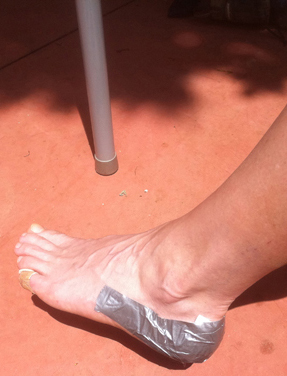
duct tape low-res 1  Elke's duct taped foot low-res 986


“Stick a sanitary napkin in the bottom of your boot—it will soak up the sweat. It works!”


“Slather your foot in Vaseline, then put on your sock.”


“Put a few tufts of sheep’s wool inside your boot. That’ll keep you dry.”

heel blister low-res 402

One of my heel blisters


Blister remedies—El Camino style. These are just a few I heard while walking with sore blisters for the first three weeks of my pilgrimage in France and Spain. Who knew that tiny blisters on the top and side of your little toe could produce such agony? I also had big ones on my heels, my instep, and under my toes. Blisters on blisters.


For a few days, I wore my Teva sandals because it was too painful for my heel blisters to rub against my Vasque hiking boots. Then I got new blisters from the sandals.


I pondered the symbolic ramifications of my condition. What was I supposed to learn from this? I decided that it was a way to slow me down, to invite me to bring a greater sense of presence to my journey. Too often, I live in my head, speeding along and missing so much around me.


My blisters were a silent reminder: Stay grounded. They forced me to stop earlier or more frequently to rest and ease my discomfort. In turn, I could use this time to admire a cluster of wild poppies against a sprawl of green fields or to chat with a fellow pilgrim whom I might otherwise just pass by and never get to know.


At times, I raged inwardly against the pain. Other times, I tried to push through it with my will, until stabbing jolts made me realize: I need to listen to my body and stop for the day.


I learned to make the pain part of my walking meditation. My blisters became my teachers, inviting me to feel every step and bring more mindfulness to the stony paths, curbs, and uneven surfaces that I encountered. They brought me greater compassion for those with similar afflictions.


blister expert low-res

Receiving expert blister treatment

Through my blisters, I became part of a community of fellow sufferers, both first-time and repeat pilgrims, swapping jokes and stories and comparing remedies. Favourite solutions were to use duct tape or Compeed, a brand of blister treatments found in European pharmacies. Moleskin was a great preventative measure, as long as you covered every potential blister spot, which was tough to do. (I still wonder what happened to the feet of two pilgrims on The Way who were wearing plastic Croc shoes.)


After walking almost 200 kilometres, I paid a Spanish volunteer at an albergue in Santa Domingo, a self-described blister expert, to drain my blisters using a needle and iodine and wrap them in gauze and medical tape. Thankfully, I overcame my reluctance to pay someone else to do a version of what I was already doing on my own. Maybe he could teach me something.


When he peeled off the dressings on my left heel, the inch-wide blister was a disturbing caramel brown. The pus that drained from it was the same colour. The guy shook his head.


“It’s infected,” he said. Obviously, I didn’t know as much about my feet as I thought.


“Don’t use Compeed,” he told me. “Once you’ve got a blister, it seals it off and doesn’t let it breathe.” I’d been using Compeed-like blister packs recommended by a Swiss-German friend.


blotchy foot low-res 381

some of the red blotches on my feet:
allergic reaction or heat rash?

“Change the dressings every two days and change your socks every two hours,” he said. “And don’t put cream on your feet in the morning—do it in the evening.” His advice about the cream treatment contradicted what I’d read and seen other people doing.


He told me that the itchy red splotches on my feet and ankles, which I assured him were heat rash, were an allergic reaction to the chemicals in sweat. “It’s a common thing. I’ve seen a lot of that.”


After my visit with the expert, on day 12 of my pilgrimage, I started to take my boots and socks off about every two hours and air out my feet. That helped. I added gauze to my first-aid repertoire, which included antibiotic cream. And I never put cream on my feet in the morning, only at night.

I tried the sanitary napkin treatment—but can’t tell if it made a difference. The daily Vaseline-in-the-sock option sounded too yucky to me; besides, how would the guck come out every night with hand-washing?


In preparation for the Camino, I had bought two pair of expensive Merino wool socks, recommended by outfitters and guidebooks. But after the itching and rashes started, I switched to cotton socks.


Before arriving in France and Spain, I had taken time to break in my new, super-comfortable waterproof boots, wearing them continuously for days and with a loaded pack. But on the first four days of The Way, in almost solid downpour and mud, my feet had gotten wet, which I learned is the worst breeding ground for blisters.

shelves of hiking boots low-res 403

A common sight at every albergue:
pilgrims’ boots stored en masse


By week three of the Camino, I joked to pilgrims that my fantasy was to arrive at Santiago Cathedral free of blisters, like a leper miraculously cured. And it happened. My blisters dried up and I was walking pain free for the last week. Yahoo!


And while blister free, I didn’t speed up. I slowed down even more, to appreciate the mountains, vineyards, and orchards that made me think of B.C. My feet, literally, showed me The Way: I’ve never maintained such a prolonged, intimate relationship with them or with ground surfaces.

NEXT WEEK: All Creatures Great and Small

August 9, 2013 at 4:17 pm Comments (4)
El Camino: Trust your inner yellow arrow

HC on a country road low-res 961

I’m a country pilgrim, content in shade

“Spirituality is living from an authentic inner self that exists beyond ego identity and materialist reality. It means following one’s spirit into the Unknown and risking loss of perceived security and safety. It means connecting to a vast, divine essence that can provide deep guidance and fulfillment.”


Simply put, spirituality involves letting go of fear. I wrote the three sentences above in response to a list of self-assessment questions or “inner waymarks” in The Pilgrim’s Guide to the Camino de Santiago. This guidebook by John Brierley, used by almost every native English-speaking person on The Way—includes prompts such as “What do you see as the primary purpose of your life?” and “How will I recognize the right help or correct answer?” (Brierley, a former oil executive and Dubliner, realigned his priorities towards inner growth after a pivotal visit to Scotland’s Findhorn community in 1987.)

hotel eslava low-res 264

Hotel Eslava in Pamplona, Spain

I wrote these answers on day five of the Camino Frances, while resting at Hotel Eslava in Pamplona, Spain. In response to the question “How will I recognize resistance to any changes that might be necessary?” I wrote “Fear and worry are my resistance . . . [along with] self-doubt and negativity.”


Trusting myself and others has been a lifelong challenge. On the issue of “confidence to follow my intuitive sense of the right direction,” I gave myself 7 out of 10. This did not refer to geography but life direction—when would I know that I was choosing a path that reflected an authentic self, rather than one motivated by a need for recognition?


As part of this 800-kilometre walk, I was determined to open myself up to greater trust. Unlike some pilgrims, who called ahead to reserve at hostels or hotels or read about all the albergues in each town, I decided to trust that I would find what I needed when I needed it. Whenever it felt right or my body was too exhausted to continue, I would stop. Each day, I didn’t read my guidebook or look at its maps too thoroughly because I wanted to stay open to spontaneous discovery.


That process worked. Only once in my 34-day journey was one of the albergues I had ended up at full. Every day, starting on the path by about 7:30 a.m. helped ensure that I would arrive at most places by early afternoon, when beds were still available at hostels.

yellow arrow low-res 717

Camino’s ubiquitous yellow arrows
provide comforting reassurance


Four days before arriving in Santiago, I came to a crossroads on a country path between Mercadoiro and Portos. A large rock had a yellow arrow pointing in a different direction than what my intuition told me to follow. I wanted to keep going on the wide dusty path that I was already on; it seemed like a natural continuation. But that yellow arrow, part of the directional system of the entire Camino route, had never led me astray.


My cynical mind wondered: Did some prankster move the rock so that the arrow pointed in the wrong direction? I chided myself for such thoughts. This was the Camino, after all, a space that promotes a spirit of sharing and truthfulness. After two other solo pilgrims arrived, both middle-aged men, and chose to obey the arrow, I decided to follow them.


For about an hour, the three of us walked down a path with no way markers or yellow arrows visible. Finally, we realized that this was not the right direction and had to retrace our steps. I felt irritated at this “wasted” time. I had put more faith in others’ choices and made the yellow arrow an external authority over my own intuition. That arrow had never been wrong before. What could I learn from this? Maria Theresa, a pilgrim from Colorado whom I met repeatedly along the route, said: “We need to learn to follow our inner yellow arrow.”


Ironically, the only other time that I got lost and wandered off the Camino was later that afternoon.  Alone, I found myself in a field of tall, dried grass, descending a long, steep cow path barely wide enough for my feet. I had no desire to go back up. Continuing downwards, I trusted that it would connect with the highway, which I could see below me. I hoped that I wouldn’t have to cross one of the electric fences I had seen or jump down to reach the road. Thankfully, the pathway led right down to the highway. After consulting my guidebook map, I cut through the closest town and managed to return to the Camino route, feeling proud of my ability to get back on track.

path to highway low-res 941

This narrow path (left, foreground) led me safely back to the highway

By this time, I had walked the Camino for a month. For six of those days, I shared the path with a married, middle-aged German businessman who walks portions of the Camino every few years as a nurturing solo holiday. A lovely man, he expressed an attraction towards me but I had no interest in any connection beyond friendship. At times, he said that I seemed fearful; I worried that he would say or do something inappropriate. Would I have to fend him off? After we discussed my desire for openness and trust, he assured me that he would not do anything to hurt me. After suffering assaults on previous travels, I deeply appreciated his conviction. With that bond of trust, we have stayed friends and continue to email each other as supportive friends.

See Camino Guides for more information about John Brierley’s multiple guidebooks.

NEXT WEEK: Feet and the Camino

, , , , , , , , ,
August 2, 2013 at 9:45 am Comments (6)

The Camino: Blisters and bliss on The Way

me with group and cathedral low-res

With Camino friends in front of the cathedral in Santiago, Spain (I’m the one on the left)


“The law of love could be best understood and learned through little children.”

—    Mahatma Gandhi


This is the first in a series of weekly blog posts that will address my journey on the Camino de Santiago route in May and June this year. I welcome your comments.


Seated on a narrow wooden pew in the cathedral of Santiago, Spain, I was one of hundreds of global visitors attending a daily “pilgrim’s mass” at noon. A non-Catholic, I felt little affinity to the Judeo-Christian symbology around me. Crosses and sculptures of a suffering Jesus? They barely seemed to touch my heart. So, why was I sitting here listening to a bishop talk about God, the Saviour, and so on, in Spanish? And I was crying!

The day before, I had arrived in Santiago, my final destination after completing the 800-kilometre Camino de Santiago pilgrimage, which had begun in France 34 days earlier. After this demanding walk of blisters and bliss, I felt both proud and exhausted. Although I embrace eastern philosophy and mysticism, feeling more drawn to Taoist and Tibetan Buddhist concepts than Christian beliefs, I had joined in an archetypal journey, one that required faith in one’s body and soul to succeed. This Way of St. James might be Christian-based, but “The Way” is also a translation for the Tao, or “middle way” of living in harmony with the flow of life.

cathedral interior low-res

The interior of Santiago Cathedral with the St. James cross, a symbol seen throughout the El Camino route, visible in the upper right

For 2,000 years, millions of people have walked this path called the Camino Frances, from the Romans who constructed early portions of the route to Christian pilgrims who have come to this cathedral for 13 centuries to see the remains of the Camino’s honoured patron, Saint James.

A Catholic friend wanted to know how my Camino journey compared to my seven months of solo spiritual exploration in India more than two decades ago. The biggest difference was the overriding sense of community on the France-Spain route. In India, spiritual seekers for centuries have chosen a path like mine, but I was not sharing it daily with others. Alone, I had no defined route. With periods of extended meditation in India, I was choosing stillness and solitude, rather than constant movement and companionship.

On the Camino, the path’s two ever-present way markers—the scallop shell symbol of St. James and a yellow arrow—link all pilgrims on the route in a powerful, unifying goal: to keep moving forward on the path. It’s a global village on the go, so to speak, and that’s a heady force to draw from.

On the Camino, I usually walked between 20 to 30 kilometres a day. This provided form, structure, and a logical sequence for each day. In India, I had no such limits except those I imposed myself. In this Asian nation, I felt closer to timelessness; I could wake up and go to sleep as I chose. The Camino fits closer to a routine; the albergues or pilgrim hostels require all visitors to be gone by 8 a.m. and most close by 10 p.m., requiring silence and lights-out by then. Normally, I’m one who disdains routine but on the Camino, I welcomed it. The albergue life provides sanctuary, a bed of relief from exhaustion, and a global community of potential friends.

For me, the Camino trip was more externally based than my India questing; it required more attention to physical needs. Although each journey required keen awareness of my footing to avoid accident or injury, the Camino walk prompted more physical pain and suffering. This ranged from shooting pain caused by a blister to sore joints that sometimes delayed walking. While in India, my pain was more internal; I was troubled and confused about many things and trying to let go of negative habits. On the Camino, I often felt at peace, providing a listening ear and support to others.

waymarker low-res photo 372

An example of the Camino’s many waymarkers bearing the scallop shell icon and yellow arrow

Any spiritual growth often requires some level of suffering, especially when progressing to a less-reactive self. How will I choose to respond to any challenge? What can I learn from this encounter? How can my level of awareness deepen my connection with my surroundings and those who I meet along the way?

Both my time in India and on the Camino allowed me to immerse myself in nature, finding moments of profound oneness in the sprawling beauty of landscapes.

In Santiago, I was delighted to see a live sculpture in one of the busy tourist plazas near the cathedral: a bald man with glasses, wearing sandals and a draped cloth, painted head to toe in white, stood motionless on a platform, looking like a Mahatma Gandhi mannequin. This appearance of an Indian icon, one whom I admire tremendously, felt like a validating touch of eastern welcome amidst this city of Catholic gatherers.

When I dropped some coins in the young man’s small bucket, he reached into a pocket and asked me if I preferred Spanish or English. He pulled out a tiny scroll of white paper, less than an inch wide, tied with a fuschia-coloured piece of wool.

“A small piece of wisdom from Mahatma Gandhi,” he said, handing me the scroll. Later, I unrolled it, and read the quotation about children that appears at the top of this post.

gandhi statute low-res

Every day, we can find blessings anywhere—not just on the Camino. We need only to keep our hearts open to receive and to overcome biases about what form these tiny miracles might take.


NEXT WEEK: Trust and the Camino


July 29, 2013 at 9:25 am Comments (14)

I’m in a new anthology: Seraphim Books’ “Emails from India” slated for fall 2013 release

I’m thrilled to learn that Seraphim Books of Woodstock, Ont.—my mom’s home town—has accepted the anthology Emails from India: Women Write Home for publication. I’m one of the book’s 30 or so contributors.

“Seraphim Editions fell in love with the book,” editor Janis Harper wrote yesterday in an email to the book’s writers. The small publisher has decided to fast-track it for release this fall and has already come up with a mock-up for the cover, shown above.

My piece in the book is about a visit to a bird sanctuary in Bharatpur. It’s a revised excerpt from the memoir that I’ve almost completed, No Letter in Your Pocket: Twenty Years Healing a Family Secret. This memoir of creative nonfiction features tales of my India travels, interwoven with family experiences and childhood memories.

I look forward to the release of Emails from India and discovering the writing of more than two dozen females. Group readings are planned in both Vancouver and Toronto. It will be fun to share this with audiences.


, , ,
March 17, 2013 at 6:57 pm Comments (0)

An urban solstice: a labyrinth, garden magic, and memorable food

Our group at Catch 122 (I’m on the front right, in blue; Annie’s beside me, in green)

While in Vancouver, BC on Dec. 21, I was tempted to carry a tongue-in-cheek placard that read “The end is near,” just to see what responses it would spawn. I decided against it. Instead, I joined my friend Annie at her “end of the world” brunch at Catch 122, a fine-foods bistro at 122 W. Hastings in downtown Vancouver, BC. She’s part of a food bloggers’ Meetup group, which gathers regularly at various urban eateries.


Eight of us enjoyed a memorable meal. I’m not a foodie at all, yet I loved my dish, the namesake “Catch 122.” It was poached eggs on a croissant with house-smoked wild sockeye salmon, melted gorgonzola bleu cheese, arugula, and Yukon nugget potato hash. Delicious!


Owner Brent Kyle  introduced himself  to our group, noting the historical origins of the restored building (he’s got photo murals of 1909 Vancouver street scenes on the back walls, which show the original brick exteriors). He said that he wanted to create an eatery that has great coffee and excellent bistro food. And he’s done it. My sole complaint is that he needs more non-meat dishes. As a pescetarian ( fish and seafood are the only meat I eat), there were only two dishes on the brunch menu that I could choose.


I appreciate Kyle’s sense of humor. He has two 1950s style signs that read “Unattended Children Will Be Given Espresso and a Free Kitten” and “Drink Coffee — Do Stupid Things Faster with More Energy.”

That solstice evening, my friend Vicki and I walked an outdoor labyrinth in Vancouver’s West End, created by Les Blydo. He made an 11-circuit pattern on the beach at low tide, below Beach Avenue near the Aquatic Centre. It looked lovely, with the outer circle illuminated by mini candles, and the lights of Granville Island flickering in the background, leaving reflections on the water.

Later we walked to the Sun Yat Sen Garden in Vancouver’s Chinatown, where we enjoyed a beautiful outdoor array of lantern creations as part of the Winter Solstice Lantern Festival, produced by Secret Lantern Society. Reminiscent of the annual summer Illuminares, this celebration of creativity displayed whimsical paper lanterns of animals, birds, and fish, arranged on-site as if interacting naturally with habitat. Their collective layout looked stunning.

We wandered through the various corners of the garden, delighting in the serendipitous encounters with tree branches full of lit-from-within owls, a heron, and other creatures, including a row of lotus flowers spread across the garden’s still pond. Inside were fun lanterns of a tea set by Carmen Rosen and a large, elongated Year of the Snake lantern by Jacquie Rolston, made with lunaria seed pods. Many thanks to all of the volunteers and artists who helped provide an imaginative world of magical escape

, , , , , , ,
December 28, 2012 at 1:39 pm Comments (0)

The spark of spiritual travel: find new connections

                                                                                       — photos by Lois Brassart

How does spiritual travel differ from regular travel? It can involve a pilgrimage or group meditation, a quest to find one’s inner self in a new environment, or a shared encounter of nature or beauty in a foreign country that opens a deeper gateway to your Soul.


Sometimes, a regular trip can open into a spiritual one through a simple question or casual discussion. A retiree friend of mine, Lois Brassart, was amazed at how one question inspired a whole new connection and relationship with a fellow traveller. Lois was recently in Turkey for “a few weeks of adventure” with a group of strangers as part of an amateur photography trip. On the last day, she was chatting with one of the other trip participants, Cheryl from Australia. Here’s how Lois explains what happened:


“My story starts with Cheryl’s prompt, ‘Talk to me about your spiritual life’ and ends 12 hours later with ‘Do you and Bruce have rituals?’ We [Cheryl and I] learnt more about each other in that one day than we did in the whole two weeks together. Cheryl has lived an amazing life. She has met Mother Teresa. She intentionally built a home with a labyrinth in her backyard and she meditates. She really knows how to connect with people. She walks the talk and believes that we are all amazing people.”

Cheryl’s one comment created a deep, new link to Lois, who shared her own spiritual yearnings and beliefs with her new friend. Without that mutual enquiry, they might never have discovered each other’s inner essence. In Lois’ words: “Cheryl is a woman of rituals, a woman with deep understanding of us humans. I’m a human learning my way, a human who recently joined the ritual, spiritual world after a long stint in corporate life. Meeting Cheryl has made me braver and more willing to take baby steps toward risk.”


After meeting this kindred spirit, Lois says that she and Cheryl opened their hearts to themselves and others, which broke through any language barrier with locals. Previously, their group had emphasized snapping the perfect photo, rather than getting to know each other or the Turkish people.


Cheryl acknowledges the openness that Lois shared in off-the-beaten-track Turkish villages, where their group was invited to share many cups of chai with the locals. She says: “Lois is REAL – what a gift to the world.  Turkish people recognized this fact and so did I.  We  learnt so much about these people with such generous hearts.  Lois would, without exception, touch them with her interest in their garden or their family and of course, she would make them laugh.


“One day, we sat in a bakery, a little cave where women made the most wonderful bread for the community. We simply hung out with three generations of women and girls, used sign language, and laughed.”

Lois says of her new friendship with Cheryl: “I wondered if this was a fleeting connection. No! We are on email at least three times a week. We share photos, including hers of bees sitting on lavender and of oh-so-cute baby ducks. We share her stories of summer at Christmas and battling 43-degree [Celsius] temperatures and me explaining that I don’t want to go out in the cold and take photos. But I do go out and send along photos of raindrops and reflections in puddles.”


Cheryl, in turn, says that Lois’s love of learning enables their conversations to go in many different directions. Like Lois, she wondered if their new friendship would survive the distance and demands of life, yet has discovered that their conversation has grown even richer.


Lois has shared many  resources with Cheryl, from the values and approach taken by local farmers’ markets, and a meditation for Thanksgiving, to  stories about group preparations prior to travel to South Africa, and, of course, photographs.


Cheryl says: “I get so excited when I see a message from Lois because I know I will be nurtured, stimulated, and learn something new.  I feel blessed to have found a kindred spirit and know that our connection will continue and our paths will cross again.”


The Internet allows Lois and Cheryl to deepen their connection despite the distance that separates them on different continents. Lois says: “We continue our relationship by keeping our hearts open to each other and sharing the beauty of our lives through photos taken miles and miles away, and through words of wonder.”


I experienced a similar connection with a New Delhi man, initially a stranger, while travelling in India for seven months. His one comment to me (an explanation about a photographic exhibition I was viewing) resulted in three hours of non-stop dialogue on a myriad of heartfelt topics. He was the first man, other than my spiritual mentor, with whom I shared my spiritual self.


We vowed that we would always remain in each other’s lives, and have maintained contact for 23 years between India and Canada. I’m writing about this relationship, and my path of personal discovery while travelling in India in my memoir No Letter in Your Pocket – Twenty Years Healing a Family Secret.

If you have a similar travel tale, please share it.

 Click here to see Lois’ photo gallery of her Turkey trip.


, , , , ,
January 15, 2012 at 5:13 pm Comments (3)

Tzoonie Narrows: a special wilderness spot by the sea

family-portrait-resized
                                                                                                                       — Heather Conn photos

 Art and Aleta Giroux with grandchildren Lindsay (holding pug Molly) and Fraser


What a weekend it was. By day, hiking took us about a kilometre uphill through classic west-coast rainforest of mossy cedars, magnificient firs, creek beds . . .and plenty of bear scat.  At dusk, we dined on delectable grilled sockeye salmon and fresh oysters garnished with sea asparagus. At night, we watched the flickers and dance of light in the sea: the neon array of bioluminescence.

 scenic-horizontal-resized

My husband Frank and I just spent a marvellous, too-short time at the Tzoonie Outdoor Adventures Wilderness Resort in the Inland Sea, which is part of British Columbia’s Sunshine Coast west of Vancouver. We arrived on Friday night, after owner Art Giroux loaded us, his grandchildren Lindsay and Fraser, and our gear onto his 23-foot aluminum launch in Sechelt. We zoomed out past kayakers and salmon farms to a blissfully remote patch of beach and woods.


tent-resized

Ah, what silence and beauty this wilderness area offers. Our grand, spacious tent looked out onto mountains reflected in the sea, the low-tide shoreline full of oysters and sea asparagus. Our cluster of tents and small, wood-shingled cabins stood under the shady sweep of old-growth cedars and other trees next to giant ferns and a burbling creek, which served as impromptu fridge for brews and such.

 frankt-at-water-resized

At night, on our queen-sized bed, I heard nothing at all, even after straining my ears to pick up something. Fraser said that the background chortle of the creek directly below his cabin helped him fall asleep easily. In the morning, a kingfisher chittered by the beach and a small flock of seagulls squawked across the water close to the opposite shore. During our entire visit, we saw only two boats go by this idyllic site.

canada-geese-resized

 We brought our own food and enjoyed communal dining in their open kitchen area, which Art has rigged up with solar power and 110-volt lighting. Art and Aleta both provided such warmth and caring, making us feel as if we were part of their family scene.  All of the taps offered fresh spring water for drinking, which was a treat, and I certainly didn’t expect the luxury of a hot shower and a flush toilet.

forest-resized

I joked that above the resort, the looming  mountain of wild forest and no roads (except one inactive logging road) would make the perfect habitat for a sasquatch. This part of the inlet has no dwellings at all for many kilometres on either side.

frank-hiking-resized

Although it rained hard for much of Saturday, Frank and I did a short hike in the late afternoon after it eased off. (We admittedly had a lazy day of snoozing and reading.) The forest canopy kept us mostly dry, adding only the light patter of rain on leaves and branches as accompaniment. (I was so grateful for the rain after weeks of dryness and hundreds of fires in B.C.)


Along our hike, I couldn’t resist some ripe thimbleberries, which the bears had obviously not yet touched.  We passed the camp’s 1,000-gallon water tank and a creek with water cascading down smooth, sloping rock. Everywhere, wild greenery offered multi-shades of saturated colour.  

bench-resized1

Throughout the property, Art’s brother has built artful driftwood benches that add a cozy touch to the remarkable scenery. On one private spot on the beach, he’s built a homemade wooden swing for two people, the perfect retreat for a couple like us celebrating their anniversary. Sigh. Thanks, Art, Aleta, Lindsay, Fraser, and Molly for making our weekend such a peaceful pleasure.

August 8, 2010 at 5:40 pm Comments (5)

Typos: a chuckle or irritant?

As a long-time writer and editor, I am horrified by common abuses of the English language and punctuation, like the far-too-common error of spelling the possessive form of “its” with an apostrophe. Yet, I also find great humor in unintentional typos or mistranslations, especially when travelling. Here are some of my favorites from menus and signs in India and Nepal:


child beer (rather than “chilled”)

biled potatoes (rather than “boiled”)

Please don’t pluck the flowers

You look good from hotel view


Some quaint terms posted on the Internet include these foreign gems:

pic19647

pic20932

 pic229261

                                                    (Apology to photographers: no photo credits provided)

However, you don’t have to travel to another country to find such groaners. At an apartment complex in Vancouver, BC, I saw a notice advising residents to go to “the area of refuse” in case of a fire. For years, Jay Leno has offered outrageous headline bloopers, sent in by people across North America.

Do you have any favorites? Please share them.

July 26, 2010 at 12:44 pm Comments (0)

Trinidad, Cuba: a post-9/11 view

Photo used with permission from Adam-m.ca


Under a backlit street of penetrating sun, residents in Trinidad, Cuba appear and disappear within the shadows of open doorways in a silent prelude to darkness.


It is mid-October 2001, barely a month after 9/11. At this seemingly post-apocalyptic time, most world travelers are too afraid to fly here. In this south-central town of 50,000, my friends and I see almost no other tourists. We feel grateful for this reprieve: no belching tour buses, no jarring crowds, no kamikaze camera hounds.


The town’s languid feel, in the steamy heat of hurricane season, is a welcome sanctuary from the fear and frenzy of CNN. The television news, available here via satellite at our oceanfront hotel, has positioned the United States on a metaphorical abyss, following the fiery demise of the World Trade Center and its 3,000 dead. Engulfed in the search for Osama bin laden, Wolf Blitzer warns of the impending anthrax crisis. His tiny image and impassioned coverage on my hotel-room screen appear oddly surreal in this land of smiles and siestas.  


Yet, beneath its perfect-holiday atmosphere, Cuba bears a collective pain of its own. Sure, this island nation, rich with salsa and jazz, offers the calendar gloss of white-sand beaches, delectable mojitos, Hemingway nostalgia, and photo-pretty 1950s sedans in gleaming colours. But the first Spanish invaders brutalized and enslaved Cuban people, even feeding some live to their dogs.


Cuba continues to suffer under the U.S. embargo imposed in 1962, resulting in a lack of medical, educational, and mundane supplies like soap, notebooks, and guitar strings. The country bears the highest suicide rate in the Western Hemisphere, and inaccessibility to food at various periods has resulted in needless deaths, bringing many past urban residents to near-starvation. (Our informal group received government permission to import and transport medical supplies for distribution in remote clinics.)


Understandably, with few tourists present, the locals in Trinidad are desperate for our business. In Trinidad’s main town square, a genteel enclave of colonial homes and palm trees, street vendors display homemade wares: toy cameras and planes made of pop and beer cans, open-weaved tops and tablecloths of lace, lively street scenes painted in a flourish of colour.


Declared a World Heritage Site by UNESCO in 1988, Trinidad remains a living museum of its heyday in the mid-1800s, when the surrounding area produced a third of the country’s sugar. Founded in 1514 by Cuba’s first governor, Diego Velasquez, Trinidad was the third settlement ever formed in this fiercely independent Caribbean nation. An early haven for smugglers, the town and its region later became a focus for the importation of slaves and goods, shifting to cattle ranching and tobacco-growing for its wealth. When 50 small sugar mills started northeast of the downtown core in the early 19th century, sugar cane became the area’s crop of prosperity.


The 2000 Lonely Planet edition of Cuba describes modern Trinidad this way: “Its baroque church towers, Carrera marble floors, wrought-iron grills, red-tile roofs, and cobblestone streets have changed little in a century and a half.”


The must-see building off the town’s main plaza is Museo Historico Municipal, a mansion that wound up in the hands of a German sugar plantation owner in the 19th century. He reportedly gained control of huge sugar estates by poisoning an old slave trader and marrying his widow, who also died mysteriously. The building’s neoclassical décor and its outstanding view of Trinidad readily evoke the power and privilege of Cuba’s former ruling class. Today, in Castro’s economy of agrarian collectives and nationalized companies, this refurbished symbol of colonial grandeur remains an antiquated testament to comparative wealth.

Click here for a published account of my Cuba trip.


Here are a few travel books on Cuba:

Cuba (Lonely Planet Guide), by David Stanley, 2000

Cuba: A Concise History for Travellers by Alan Twigg 2000

The Reader’s Companion to Cuba, edited by Alan Ryan, 1997

The Rough Guide to Cuban Music by Philip Sweeney, 2001

Travelers’ Tales Cuba, edited by Tom Miller, 2001

July 21, 2010 at 12:01 pm Comment (1)

« Older PostsNewer Posts »