Heather Conn Blogs

spoutin’ about by the sea

I’m in a new anthology: Seraphim Books’ “Emails from India” slated for fall 2013 release

I’m thrilled to learn that Seraphim Books of Woodstock, Ont.—my mom’s home town—has accepted the anthology Emails from India: Women Write Home for publication. I’m one of the book’s 30 or so contributors.

“Seraphim Editions fell in love with the book,” editor Janis Harper wrote yesterday in an email to the book’s writers. The small publisher has decided to fast-track it for release this fall and has already come up with a mock-up for the cover, shown above.

My piece in the book is about a visit to a bird sanctuary in Bharatpur. It’s a revised excerpt from the memoir that I’ve almost completed, No Letter in Your Pocket: Twenty Years Healing a Family Secret. This memoir of creative nonfiction features tales of my India travels, interwoven with family experiences and childhood memories.

I look forward to the release of Emails from India and discovering the writing of more than two dozen females. Group readings are planned in both Vancouver and Toronto. It will be fun to share this with audiences.


, , ,
March 17, 2013 at 6:57 pm Comments (0)

An urban solstice: a labyrinth, garden magic, and memorable food

Our group at Catch 122 (I’m on the front right, in blue; Annie’s beside me, in green)

While in Vancouver, BC on Dec. 21, I was tempted to carry a tongue-in-cheek placard that read “The end is near,” just to see what responses it would spawn. I decided against it. Instead, I joined my friend Annie at her “end of the world” brunch at Catch 122, a fine-foods bistro at 122 W. Hastings in downtown Vancouver, BC. She’s part of a food bloggers’ Meetup group, which gathers regularly at various urban eateries.


Eight of us enjoyed a memorable meal. I’m not a foodie at all, yet I loved my dish, the namesake “Catch 122.” It was poached eggs on a croissant with house-smoked wild sockeye salmon, melted gorgonzola bleu cheese, arugula, and Yukon nugget potato hash. Delicious!


Owner Brent Kyle  introduced himself  to our group, noting the historical origins of the restored building (he’s got photo murals of 1909 Vancouver street scenes on the back walls, which show the original brick exteriors). He said that he wanted to create an eatery that has great coffee and excellent bistro food. And he’s done it. My sole complaint is that he needs more non-meat dishes. As a pescetarian ( fish and seafood are the only meat I eat), there were only two dishes on the brunch menu that I could choose.


I appreciate Kyle’s sense of humor. He has two 1950s style signs that read “Unattended Children Will Be Given Espresso and a Free Kitten” and “Drink Coffee — Do Stupid Things Faster with More Energy.”

That solstice evening, my friend Vicki and I walked an outdoor labyrinth in Vancouver’s West End, created by Les Blydo. He made an 11-circuit pattern on the beach at low tide, below Beach Avenue near the Aquatic Centre. It looked lovely, with the outer circle illuminated by mini candles, and the lights of Granville Island flickering in the background, leaving reflections on the water.

Later we walked to the Sun Yat Sen Garden in Vancouver’s Chinatown, where we enjoyed a beautiful outdoor array of lantern creations as part of the Winter Solstice Lantern Festival, produced by Secret Lantern Society. Reminiscent of the annual summer Illuminares, this celebration of creativity displayed whimsical paper lanterns of animals, birds, and fish, arranged on-site as if interacting naturally with habitat. Their collective layout looked stunning.

We wandered through the various corners of the garden, delighting in the serendipitous encounters with tree branches full of lit-from-within owls, a heron, and other creatures, including a row of lotus flowers spread across the garden’s still pond. Inside were fun lanterns of a tea set by Carmen Rosen and a large, elongated Year of the Snake lantern by Jacquie Rolston, made with lunaria seed pods. Many thanks to all of the volunteers and artists who helped provide an imaginative world of magical escape

, , , , , , ,
December 28, 2012 at 1:39 pm Comments (0)

The spark of spiritual travel: find new connections

                                                                                       — photos by Lois Brassart

How does spiritual travel differ from regular travel? It can involve a pilgrimage or group meditation, a quest to find one’s inner self in a new environment, or a shared encounter of nature or beauty in a foreign country that opens a deeper gateway to your Soul.


Sometimes, a regular trip can open into a spiritual one through a simple question or casual discussion. A retiree friend of mine, Lois Brassart, was amazed at how one question inspired a whole new connection and relationship with a fellow traveller. Lois was recently in Turkey for “a few weeks of adventure” with a group of strangers as part of an amateur photography trip. On the last day, she was chatting with one of the other trip participants, Cheryl from Australia. Here’s how Lois explains what happened:


“My story starts with Cheryl’s prompt, ‘Talk to me about your spiritual life’ and ends 12 hours later with ‘Do you and Bruce have rituals?’ We [Cheryl and I] learnt more about each other in that one day than we did in the whole two weeks together. Cheryl has lived an amazing life. She has met Mother Teresa. She intentionally built a home with a labyrinth in her backyard and she meditates. She really knows how to connect with people. She walks the talk and believes that we are all amazing people.”

Cheryl’s one comment created a deep, new link to Lois, who shared her own spiritual yearnings and beliefs with her new friend. Without that mutual enquiry, they might never have discovered each other’s inner essence. In Lois’ words: “Cheryl is a woman of rituals, a woman with deep understanding of us humans. I’m a human learning my way, a human who recently joined the ritual, spiritual world after a long stint in corporate life. Meeting Cheryl has made me braver and more willing to take baby steps toward risk.”


After meeting this kindred spirit, Lois says that she and Cheryl opened their hearts to themselves and others, which broke through any language barrier with locals. Previously, their group had emphasized snapping the perfect photo, rather than getting to know each other or the Turkish people.


Cheryl acknowledges the openness that Lois shared in off-the-beaten-track Turkish villages, where their group was invited to share many cups of chai with the locals. She says: “Lois is REAL – what a gift to the world.  Turkish people recognized this fact and so did I.  We  learnt so much about these people with such generous hearts.  Lois would, without exception, touch them with her interest in their garden or their family and of course, she would make them laugh.


“One day, we sat in a bakery, a little cave where women made the most wonderful bread for the community. We simply hung out with three generations of women and girls, used sign language, and laughed.”

Lois says of her new friendship with Cheryl: “I wondered if this was a fleeting connection. No! We are on email at least three times a week. We share photos, including hers of bees sitting on lavender and of oh-so-cute baby ducks. We share her stories of summer at Christmas and battling 43-degree [Celsius] temperatures and me explaining that I don’t want to go out in the cold and take photos. But I do go out and send along photos of raindrops and reflections in puddles.”


Cheryl, in turn, says that Lois’s love of learning enables their conversations to go in many different directions. Like Lois, she wondered if their new friendship would survive the distance and demands of life, yet has discovered that their conversation has grown even richer.


Lois has shared many  resources with Cheryl, from the values and approach taken by local farmers’ markets, and a meditation for Thanksgiving, to  stories about group preparations prior to travel to South Africa, and, of course, photographs.


Cheryl says: “I get so excited when I see a message from Lois because I know I will be nurtured, stimulated, and learn something new.  I feel blessed to have found a kindred spirit and know that our connection will continue and our paths will cross again.”


The Internet allows Lois and Cheryl to deepen their connection despite the distance that separates them on different continents. Lois says: “We continue our relationship by keeping our hearts open to each other and sharing the beauty of our lives through photos taken miles and miles away, and through words of wonder.”


I experienced a similar connection with a New Delhi man, initially a stranger, while travelling in India for seven months. His one comment to me (an explanation about a photographic exhibition I was viewing) resulted in three hours of non-stop dialogue on a myriad of heartfelt topics. He was the first man, other than my spiritual mentor, with whom I shared my spiritual self.


We vowed that we would always remain in each other’s lives, and have maintained contact for 23 years between India and Canada. I’m writing about this relationship, and my path of personal discovery while travelling in India in my memoir No Letter in Your Pocket – Twenty Years Healing a Family Secret.

If you have a similar travel tale, please share it.

 Click here to see Lois’ photo gallery of her Turkey trip.


, , , , ,
January 15, 2012 at 5:13 pm Comments (3)

Tzoonie Narrows: a special wilderness spot by the sea

family-portrait-resized
                                                                                                                       – Heather Conn photos

 Art and Aleta Giroux with grandchildren Lindsay (holding pug Molly) and Fraser


What a weekend it was. By day, hiking took us about a kilometre uphill through classic west-coast rainforest of mossy cedars, magnificient firs, creek beds . . .and plenty of bear scat.  At dusk, we dined on delectable grilled sockeye salmon and fresh oysters garnished with sea asparagus. At night, we watched the flickers and dance of light in the sea: the neon array of bioluminescence.

 scenic-horizontal-resized

My husband Frank and I just spent a marvellous, too-short time at the Tzoonie Outdoor Adventures Wilderness Resort in the Inland Sea, which is part of British Columbia’s Sunshine Coast west of Vancouver. We arrived on Friday night, after owner Art Giroux loaded us, his grandchildren Lindsay and Fraser, and our gear onto his 23-foot aluminum launch in Sechelt. We zoomed out past kayakers and salmon farms to a blissfully remote patch of beach and woods.


tent-resized

Ah, what silence and beauty this wilderness area offers. Our grand, spacious tent looked out onto mountains reflected in the sea, the low-tide shoreline full of oysters and sea asparagus. Our cluster of tents and small, wood-shingled cabins stood under the shady sweep of old-growth cedars and other trees next to giant ferns and a burbling creek, which served as impromptu fridge for brews and such.

 frankt-at-water-resized

At night, on our queen-sized bed, I heard nothing at all, even after straining my ears to pick up something. Fraser said that the background chortle of the creek directly below his cabin helped him fall asleep easily. In the morning, a kingfisher chittered by the beach and a small flock of seagulls squawked across the water close to the opposite shore. During our entire visit, we saw only two boats go by this idyllic site.

canada-geese-resized

 We brought our own food and enjoyed communal dining in their open kitchen area, which Art has rigged up with solar power and 110-volt lighting. Art and Aleta both provided such warmth and caring, making us feel as if we were part of their family scene.  All of the taps offered fresh spring water for drinking, which was a treat, and I certainly didn’t expect the luxury of a hot shower and a flush toilet.

forest-resized

I joked that above the resort, the looming  mountain of wild forest and no roads (except one inactive logging road) would make the perfect habitat for a sasquatch. This part of the inlet has no dwellings at all for many kilometres on either side.

frank-hiking-resized

Although it rained hard for much of Saturday, Frank and I did a short hike in the late afternoon after it eased off. (We admittedly had a lazy day of snoozing and reading.) The forest canopy kept us mostly dry, adding only the light patter of rain on leaves and branches as accompaniment. (I was so grateful for the rain after weeks of dryness and hundreds of fires in B.C.)


Along our hike, I couldn’t resist some ripe thimbleberries, which the bears had obviously not yet touched.  We passed the camp’s 1,000-gallon water tank and a creek with water cascading down smooth, sloping rock. Everywhere, wild greenery offered multi-shades of saturated colour.  

bench-resized1

Throughout the property, Art’s brother has built artful driftwood benches that add a cozy touch to the remarkable scenery. On one private spot on the beach, he’s built a homemade wooden swing for two people, the perfect retreat for a couple like us celebrating their anniversary. Sigh. Thanks, Art, Aleta, Lindsay, Fraser, and Molly for making our weekend such a peaceful pleasure.

August 8, 2010 at 5:40 pm Comments (5)

Typos: a chuckle or irritant?

As a long-time writer and editor, I am horrified by common abuses of the English language and punctuation, like the far-too-common error of spelling the possessive form of “its” with an apostrophe. Yet, I also find great humor in unintentional typos or mistranslations, especially when travelling. Here are some of my favorites from menus and signs in India and Nepal:


child beer (rather than “chilled”)

biled potatoes (rather than “boiled”)

Please don’t pluck the flowers

You look good from hotel view


Some quaint terms posted on the Internet include these foreign gems:

pic19647

pic20932

 pic229261

                                                    (Apology to photographers: no photo credits provided)

However, you don’t have to travel to another country to find such groaners. At an apartment complex in Vancouver, BC, I saw a notice advising residents to go to “the area of refuse” in case of a fire. For years, Jay Leno has offered outrageous headline bloopers, sent in by people across North America.

Do you have any favorites? Please share them.

July 26, 2010 at 12:44 pm Comments (0)

Trinidad, Cuba: a post-9/11 view

Photo used with permission from Adam-m.ca


Under a backlit street of penetrating sun, residents in Trinidad, Cuba appear and disappear within the shadows of open doorways in a silent prelude to darkness.


It is mid-October 2001, barely a month after 9/11. At this seemingly post-apocalyptic time, most world travelers are too afraid to fly here. In this south-central town of 50,000, my friends and I see almost no other tourists. We feel grateful for this reprieve: no belching tour buses, no jarring crowds, no kamikaze camera hounds.


The town’s languid feel, in the steamy heat of hurricane season, is a welcome sanctuary from the fear and frenzy of CNN. The television news, available here via satellite at our oceanfront hotel, has positioned the United States on a metaphorical abyss, following the fiery demise of the World Trade Center and its 3,000 dead. Engulfed in the search for Osama bin laden, Wolf Blitzer warns of the impending anthrax crisis. His tiny image and impassioned coverage on my hotel-room screen appear oddly surreal in this land of smiles and siestas.  


Yet, beneath its perfect-holiday atmosphere, Cuba bears a collective pain of its own. Sure, this island nation, rich with salsa and jazz, offers the calendar gloss of white-sand beaches, delectable mojitos, Hemingway nostalgia, and photo-pretty 1950s sedans in gleaming colours. But the first Spanish invaders brutalized and enslaved Cuban people, even feeding some live to their dogs.


Cuba continues to suffer under the U.S. embargo imposed in 1962, resulting in a lack of medical, educational, and mundane supplies like soap, notebooks, and guitar strings. The country bears the highest suicide rate in the Western Hemisphere, and inaccessibility to food at various periods has resulted in needless deaths, bringing many past urban residents to near-starvation. (Our informal group received government permission to import and transport medical supplies for distribution in remote clinics.)


Understandably, with few tourists present, the locals in Trinidad are desperate for our business. In Trinidad’s main town square, a genteel enclave of colonial homes and palm trees, street vendors display homemade wares: toy cameras and planes made of pop and beer cans, open-weaved tops and tablecloths of lace, lively street scenes painted in a flourish of colour.


Declared a World Heritage Site by UNESCO in 1988, Trinidad remains a living museum of its heyday in the mid-1800s, when the surrounding area produced a third of the country’s sugar. Founded in 1514 by Cuba’s first governor, Diego Velasquez, Trinidad was the third settlement ever formed in this fiercely independent Caribbean nation. An early haven for smugglers, the town and its region later became a focus for the importation of slaves and goods, shifting to cattle ranching and tobacco-growing for its wealth. When 50 small sugar mills started northeast of the downtown core in the early 19th century, sugar cane became the area’s crop of prosperity.


The 2000 Lonely Planet edition of Cuba describes modern Trinidad this way: “Its baroque church towers, Carrera marble floors, wrought-iron grills, red-tile roofs, and cobblestone streets have changed little in a century and a half.”


The must-see building off the town’s main plaza is Museo Historico Municipal, a mansion that wound up in the hands of a German sugar plantation owner in the 19th century. He reportedly gained control of huge sugar estates by poisoning an old slave trader and marrying his widow, who also died mysteriously. The building’s neoclassical décor and its outstanding view of Trinidad readily evoke the power and privilege of Cuba’s former ruling class. Today, in Castro’s economy of agrarian collectives and nationalized companies, this refurbished symbol of colonial grandeur remains an antiquated testament to comparative wealth.

Click here for a published account of my Cuba trip.


Here are a few travel books on Cuba:

Cuba (Lonely Planet Guide), by David Stanley, 2000

Cuba: A Concise History for Travellers by Alan Twigg 2000

The Reader’s Companion to Cuba, edited by Alan Ryan, 1997

The Rough Guide to Cuban Music by Philip Sweeney, 2001

Travelers’ Tales Cuba, edited by Tom Miller, 2001

July 21, 2010 at 12:01 pm Comment (1)

Hands Across The Sands: A Jedediah adventure

hands-across-sands-low-res-1
                                                                                                                      — Heather Conn photos

Four kayaking companions and I, camped on Jedediah Island on British Columbia’s Sunshine Coast,  joined the June 26 global event Hands Across the Sand  to protest offshore oil drilling. From our low-tide beach at Home Bay, we gathered around noon and stretched our hands across a shoreline to support clean energy choices. Like thousands of others around the world, we took this symbolic gesture to draw a line in the sand against the threat that oil drilling poses to coastal economies and the marine environment.


The Hands Across the Sand movement, founded by U.S. resident Dave Rauschkolb, began in Florida on Feb. 13 this year. Thousands of residents across the state, representing 60 towns and cities and more than 90 beaches, joined hands to protest attempts by the Florida and the U.S. governments to lift the ban on oil drilling near and off the state’s shores. The movement created partnerships with major environmental organizations such as the Sierra Club, Greenpeace, and Audubon.


The impetus for the June Hands Across the Sand event, which involved 860 locations, came from the environmental devastation of the ongoing British Petroleum oil spill. The mission of Hands Across the Sand is to draw attention to our global dependence on fossil fuels and adopt policies that encourage renewable energy sources.

our-camp-1-low-res

 At our  idyllic location on Jedediah, a marine provincial park, tiny crabs scrabbled in the shallows while dozens of live sand dollars wafted in low waters. By the thousands, oysters and periwinkles covered the sea bed, surrounded by thick clusters of mussels and barnacles on nearby rocks. At low tide, three raccoons hunted for food in the mud while red-footed oyster catchers flew past,  screeching like banshees. Ever-present seagulls dropped shellfish onto the beach to break open their food.


With such natural richness hinged to the sea, it was disturbing to imagine how an oil spill in these waters could easily destroy this abundance. While hundreds of thousands of barrels of BP oil continue to pour into the Gulf of Mexico,  Chevron is drilling underwater off Newfoundland at almost twice the depth as BP’s rig that blew out.

our-camp-2-low-res

 Meanwhile, B.C. Premier Gordon Campbell wants to drill oil off the northwest coast of the province, by the Queen Charlotte Islands. Along with the federal government and Enbridge, he’s poised to create an oil pipeline from Alberta’s Tar Sands to Kitimat, B.C. This would result in oil tankers traversing the province every day through fragile ecosystems and challenging waters in central and northern B.C. (For more details, see my archived feature ”No oil tankers on the B.C. coast” posted Dec. 1, 2009 under “Environment.”)

hands-across-sands-low-res-2

On a more upbeat note, the abandoned wooden building in the background of this photo is the old homestead on Jedediah that once belonged to the Palmers. Mary and Al Palmer bought the island as a summer holiday destination in 1949, then became full-time residents in 1972. They both farmed the land and cherished the island’s 600 acres, which includes cedar, old-growth fir and arbutus, peaceful bays, and stunning views. Mary was determined to prevent any  development. (Palmer describes life on the island, complete with historic family photos, in her book Jedediah Days, a B.C. bestseller published by Harbour Publishing.)

homestead-low-res

The Palmers worked hard to preserve the island, helped by a province-wide fundraising campaign, started by the late Dan Culver’s Follow Your Dream Foundation. Many groups rallied to raise money to create a park, including Friends of Jedediah, the Marine Parks Forever Society, and the Nature Trust of B.C. Countless individuals and organizations provided financial support, which included $1.1 million from Culver’s estate. The B.C. government donated millions more and the Palmers agreed to sell the island for $4.2 million, far less than its market value. Thanks to their generosity and the dedication of so many donors and volunteer fundraisers, Jedediah Island became a provincial park in 1995.

scenic-low-res

Now thousands of people can enjoy this unsullied spot every year. A flock of wild sheep still roams the island and several dozen mountain goats, said to be descendants of those left by Spanish explorers, can peer down at you from rocky bluffs. The island has four registered archaeological sites, including a First Nations fish weir.

gibraltar-low-res1

 I took the photo above from Gibraltar, a rocky viewpoint towards the north-central part of the island. A cairn of stones marks the spot with a heavy plastic tube that contains scribbled notes from hikers over the years. Of course, I added a message from our group. Towards the centre of the island, we wandered through forests pastoral and open, without tangles of thick underbrush. We saw the grave of the Palmers’ beloved horse Will, which bears visitors’ strange offerings and detritus from the sea, from a toy car and flattened soccer ball to a plastic marine float. Elsewhere, the island’s open meadows, pungent with mint-like scent, are still home to neglected fruit trees.

moss-low-res

 Jedediah has frequent patches of startling green moss and clusters of yellow wild flowers. It was wonderful to explore this island and see only a handful of people over several days. Thanks to the Palmers’ vision and commitment to conservation, this quiet wilderness sanctuary will never see development . . .and hopefully, oil will never tarnish its shores.

sunset-low-res

June 29, 2010 at 2:28 pm Comment (1)

Walk in peace

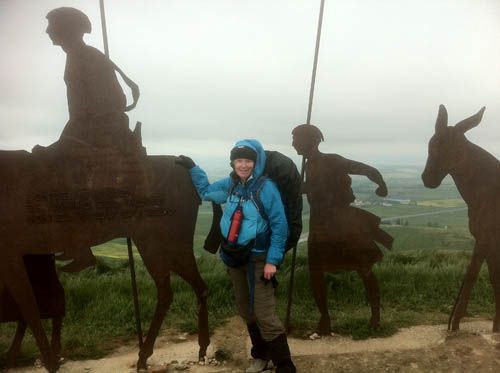
For years, I’ve wanted to hike the El Camino trail in France and Spain as my own form of spiritual pilgrimage. But every year, work or something else seems to intervene. As someone who does walking meditations and loves labyrinths, I acknowledge the grace and power of walking with slow, intentional steps, observing breath and thoughts. Joseph Campbell says: “Pilgrimage is poetry in motion . . .a winding road to meaning.”


An informal group on the Sunshine Coast, the Peace Walker Society, leads 10-day trips on the El Camino. I like their purpose and stated aims: “The Peace Walker Society is a group of concerted, committed citizens who recognize that peace is a process, an exquisite journey of enriching ourselves and giving back to the planet we live on. For us, there is no final destination.


“Our ongoing journey promotes unity and reconciliation, which transcend past conflicts and support the development of a sustainable future. Along the way, we hope to rediscover the “true self,” for in order to change the world, we must begin with ourselves.”


I’m currently writing a book about my seven months of solo travel in India, living out my own version of Heal Yourself, Heal the World. I’ve long admired the now-deceased woman known as Peace Pilgrim, who gave up all possessions and committed herself to walking the earth to promote peace. She refused to accept any money and survived solely on others’ offers of food and shelter.


Peace Pilgrim displayed tremendous trust in life and commitment to her cause, speaking informally to groups, media, and anyone who stopped their car along her path to chat. She died in 1981 — ironically, as a passenger in a car — but her spirit and vision live on through an organization dedicated to her memory and goals of peace.


Satish Kumar, the editor of Resurgence magazine, did an 8,000-mile peace pilgrimage in 1962, inspired by Bertrand Russell’s civil disobedience against the atomic bomb. Without any money, he dedicated himself to a peace walk from Bangalore, India to the four capitals of the nuclear world: Moscow, Paris, London, and the U.S.


After settling in Devon England, Kumar did another pilgrimage when  he turned fifty. Again, for this walk, he carried no money. (I would love to know his secret.) He visited the holy places of Britain, including Glastonbury, Canterbury, Lindisfarne, and Iona.


Kumar wrote of his travels in his 1978 autobiography No Destination; Green Books has since published an updated edition. I recommend his book to anyone who enjoys contemplative journeys and spiritual reflection. Throughout his life, Kumar has aimed to promote Gandhi’s values of peaceful coexistence and land reform. In 2001, he received the Jamnalal Bajaj International Award for Promoting Gandhian Values Abroad.


I wish that we had more grassroots people and leaders who incorporated peaceful and spiritual values into their advocacy and activism. Although it would be great to have more more Peace Pilgrims and Satish Kumars, we can all create greater peace every day through loving thoughts and actions. Are you up for the challenge?

June 14, 2010 at 3:40 pm Comment (1)

Mary Jo Kopechne would have turned 69 last week

Accident on the Bridge at Chappaquiddick: Do you know what happened 40 years ago?

chappaquiddick-bridge1

         — Heather Conn photo   

(A condensed version of this post was published in The Coast Reporter in Sechelt, BC, Canada on July 17, 2009.) 

          If Mary Jo Kopechne had lived, she would have celebrated her sixty-ninth birthday last week.   

          Early last month, almost 40 years after Chappaquiddick became synonymous with Kopechne’s name and that of U.S. Democratic senator Ted Kennedy, I peered down from the notorious Dike Bridge in Martha’s Vineyard, Mass. This otherwise innocuous span, about 10 feet wide and 75 feet long, sits by the easternmost coast of the Vineyard, a well-heeled island retreat about seven miles south of Cape Cod.

            Amidst the area’s rural tranquility, it took straining to imagine that this plain structure, which straddles a six-knot channel and leads to Cape Poge lighthouse and a wildlife refuge, ever bore any stain of tragedy. (Kopechne, passenger in a black Oldsmobile owned and allegedly driven by Kennedy, died on July 18, 1969, after the vehicle plunged off the bridge into about 15 feet of water. Kennedy pleaded guilty to leaving the scene of an accident after causing injury and received a two-month suspended sentence.)


            Nothing suggests that this planked span ever played a role in the death of a young female campaign worker or ended an ambitious senator’s run for the U.S. presidency. Except, of course, that it’s now one of the most fortified small wooden bridges you’ll likely ever see. With stanchions, thick wooden railings, and huge galvanized bolts jutting from its horizontal sides of  pressure-treated 12 x 12 beams (all added after the accident), this bridge looks like it could withstand a nuclear blast.


            (Immediately after the incident, some tasteless souls added graffiti that read “Ted loves Mary Jo” and “Ted’s car wash.” Others hacked off or hammered out tiny pieces of the bridge as mementos. When the car was towed to a local garage, zealous souvenir-seekers stole pieces of it, from its windshield to door handles. Thankfully, e-bay didn’t exist then.)


            Some might consider this site a bizarre tourist attraction, but the conflicting accounts of the Kennedy accident have always fascinated me. From everything I’ve read and seen, I certainly don’t believe that Kennedy was driving the car, for instance. I think that Kopechne, likely scared and disoriented, wound up alone at the wheel, in a vehicle unfamiliar to her, in an area she didn’t know.


           (Earlier that evening, a police officer had walked towards the vehicle when she and Kennedy were reportedly parked in the dark in the area, but had not approached the occupants.  I think that Kennedy chose to avoid any possible discovery and subsequent damage to his reputation by choosing to walk home, leaving Kopechne to find her way. There has been some suggestion that his nephew, Joseph, might have been involved; he was reportedly seen later that evening in the area, wandering alone on a main road, soaking wet. )  


             Curious to see the bridge, my husband and I drove our peppy blue Smart car, rented in the Vineyard’s northeastern town of Oak Bluffs, to the site via the three-vehicle “Chappy ferry.” It took barely two minutes to cross to Chappaquiddick, an island-within-an-island; the Vineyard itself is only 100 square miles. Thankfully, we were there in early June before the summer crowds, when the on-island population swells to 120,000.


            I was surprised to find no mention of the bridge in local media or tourist literature; area bookstores did not display any of the many tomes written about the accident. After all, sensationalist stories, even decades old, sell. Notoriety brings tourists, especially during a recession.


            But “Hype your infamy” is no Vineyard attitude. Guess that’s one reason why so many Hollywood types flock there for holidays. This laid-back haven of 15,000 yearround residents nurtures the privacy of its celebrities, whether they’re residents or summer visitors, from the likes of Bill and Hillary Clinton to singer Carly Simon.


            At the time of the Chappaquiddick accident, Kennedy had spent decades competing in an annual regatta in Edgartown on Martha’s Vineyard. Today, he’s instigated and influenced more positive changes in  the state of Massachusetts than any other politician, according to my husband, a long-time fan and Mass. resident. Yet I’m a west-coast Canadian; in my eyes, Kennedy lied about the Chappaquiddick incident and ignored advice from close friends and advisors immediately afterwards to tell the whole truth. Now it looks as if he’ll die without us ever knowing what really happened. The late Dominick Dunne, a novelist and Vanity Fair crime columnist, said that Kennedy “lived recklessly, performed brilliantly in Congress, and often failed miserably in life.”


If you would like to read more of my travel stories, please visit

http://www.heatherconn.com/category/travel/ and  http://www.thetraveleditor.com/authors/846/Heather_Conn/


July 21, 2009 at 2:50 pm Comments (7)