Heather Conn Blogs

spoutin’ about by the sea

Hands Across The Sands: A Jedediah adventure

hands-across-sands-low-res-1
                                                                                                                      — Heather Conn photos

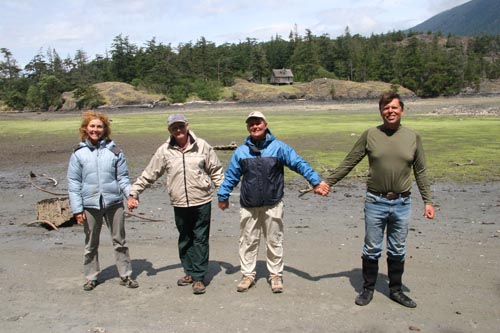
Four kayaking companions and I, camped on Jedediah Island on British Columbia’s Sunshine Coast,  joined the June 26 global event Hands Across the Sand  to protest offshore oil drilling. From our low-tide beach at Home Bay, we gathered around noon and stretched our hands across a shoreline to support clean energy choices. Like thousands of others around the world, we took this symbolic gesture to draw a line in the sand against the threat that oil drilling poses to coastal economies and the marine environment.


The Hands Across the Sand movement, founded by U.S. resident Dave Rauschkolb, began in Florida on Feb. 13 this year. Thousands of residents across the state, representing 60 towns and cities and more than 90 beaches, joined hands to protest attempts by the Florida and the U.S. governments to lift the ban on oil drilling near and off the state’s shores. The movement created partnerships with major environmental organizations such as the Sierra Club, Greenpeace, and Audubon.


The impetus for the June Hands Across the Sand event, which involved 860 locations, came from the environmental devastation of the ongoing British Petroleum oil spill. The mission of Hands Across the Sand is to draw attention to our global dependence on fossil fuels and adopt policies that encourage renewable energy sources.

our-camp-1-low-res

 At our  idyllic location on Jedediah, a marine provincial park, tiny crabs scrabbled in the shallows while dozens of live sand dollars wafted in low waters. By the thousands, oysters and periwinkles covered the sea bed, surrounded by thick clusters of mussels and barnacles on nearby rocks. At low tide, three raccoons hunted for food in the mud while red-footed oyster catchers flew past,  screeching like banshees. Ever-present seagulls dropped shellfish onto the beach to break open their food.


With such natural richness hinged to the sea, it was disturbing to imagine how an oil spill in these waters could easily destroy this abundance. While hundreds of thousands of barrels of BP oil continue to pour into the Gulf of Mexico,  Chevron is drilling underwater off Newfoundland at almost twice the depth as BP’s rig that blew out.

our-camp-2-low-res

 Meanwhile, B.C. Premier Gordon Campbell wants to drill oil off the northwest coast of the province, by the Queen Charlotte Islands. Along with the federal government and Enbridge, he’s poised to create an oil pipeline from Alberta’s Tar Sands to Kitimat, B.C. This would result in oil tankers traversing the province every day through fragile ecosystems and challenging waters in central and northern B.C. (For more details, see my archived feature “No oil tankers on the B.C. coast” posted Dec. 1, 2009 under “Environment.”)
hands-across-sands-low-res-2

On a more upbeat note, the abandoned wooden building in the background of this photo is the old homestead on Jedediah that once belonged to the Palmers. Mary and Al Palmer bought the island as a summer holiday destination in 1949, then became full-time residents in 1972. They both farmed the land and cherished the island’s 600 acres, which includes cedar, old-growth fir and arbutus, peaceful bays, and stunning views. Mary was determined to prevent any  development. (Palmer describes life on the island, complete with historic family photos, in her book Jedediah Days, a B.C. bestseller published by Harbour Publishing.)

homestead-low-res

The Palmers worked hard to preserve the island, helped by a province-wide fundraising campaign, started by the late Dan Culver’s Follow Your Dream Foundation. Many groups rallied to raise money to create a park, including Friends of Jedediah, the Marine Parks Forever Society, and the Nature Trust of B.C. Countless individuals and organizations provided financial support, which included $1.1 million from Culver’s estate. The B.C. government donated millions more and the Palmers agreed to sell the island for $4.2 million, far less than its market value. Thanks to their generosity and the dedication of so many donors and volunteer fundraisers, Jedediah Island became a provincial park in 1995.

scenic-low-res

Now thousands of people can enjoy this unsullied spot every year. A flock of wild sheep still roams the island and several dozen mountain goats, said to be descendants of those left by Spanish explorers, can peer down at you from rocky bluffs. The island has four registered archaeological sites, including a First Nations fish weir.

gibraltar-low-res1

 I took the photo above from Gibraltar, a rocky viewpoint towards the north-central part of the island. A cairn of stones marks the spot with a heavy plastic tube that contains scribbled notes from hikers over the years. Of course, I added a message from our group. Towards the centre of the island, we wandered through forests pastoral and open, without tangles of thick underbrush. We saw the grave of the Palmers’ beloved horse Will, which bears visitors’ strange offerings and detritus from the sea, from a toy car and flattened soccer ball to a plastic marine float. Elsewhere, the island’s open meadows, pungent with mint-like scent, are still home to neglected fruit trees.

moss-low-res

 Jedediah has frequent patches of startling green moss and clusters of yellow wild flowers. It was wonderful to explore this island and see only a handful of people over several days. Thanks to the Palmers’ vision and commitment to conservation, this quiet wilderness sanctuary will never see development . . .and hopefully, oil will never tarnish its shores.
sunset-low-res

June 29, 2010 at 2:28 pm Comment (1)

Walk in peace

For years, I’ve wanted to hike the El Camino trail in France and Spain as my own form of spiritual pilgrimage. But every year, work or something else seems to intervene. As someone who does walking meditations and loves labyrinths, I acknowledge the grace and power of walking with slow, intentional steps, observing breath and thoughts. Joseph Campbell says: “Pilgrimage is poetry in motion . . .a winding road to meaning.”


An informal group on the Sunshine Coast, the Peace Walker Society, leads 10-day trips on the El Camino. I like their purpose and stated aims: “The Peace Walker Society is a group of concerted, committed citizens who recognize that peace is a process, an exquisite journey of enriching ourselves and giving back to the planet we live on. For us, there is no final destination.


“Our ongoing journey promotes unity and reconciliation, which transcend past conflicts and support the development of a sustainable future. Along the way, we hope to rediscover the “true self,” for in order to change the world, we must begin with ourselves.”


I’m currently writing a book about my seven months of solo travel in India, living out my own version of Heal Yourself, Heal the World. I’ve long admired the now-deceased woman known as Peace Pilgrim, who gave up all possessions and committed herself to walking the earth to promote peace. She refused to accept any money and survived solely on others’ offers of food and shelter.


Peace Pilgrim displayed tremendous trust in life and commitment to her cause, speaking informally to groups, media, and anyone who stopped their car along her path to chat. She died in 1981 — ironically, as a passenger in a car — but her spirit and vision live on through an organization dedicated to her memory and goals of peace.


Satish Kumar, the editor of Resurgence magazine, did an 8,000-mile peace pilgrimage in 1962, inspired by Bertrand Russell’s civil disobedience against the atomic bomb. Without any money, he dedicated himself to a peace walk from Bangalore, India to the four capitals of the nuclear world: Moscow, Paris, London, and the U.S.


After settling in Devon England, Kumar did another pilgrimage when  he turned fifty. Again, for this walk, he carried no money. (I would love to know his secret.) He visited the holy places of Britain, including Glastonbury, Canterbury, Lindisfarne, and Iona.


Kumar wrote of his travels in his 1978 autobiography No Destination; Green Books has since published an updated edition. I recommend his book to anyone who enjoys contemplative journeys and spiritual reflection. Throughout his life, Kumar has aimed to promote Gandhi’s values of peaceful coexistence and land reform. In 2001, he received the Jamnalal Bajaj International Award for Promoting Gandhian Values Abroad.


I wish that we had more grassroots people and leaders who incorporated peaceful and spiritual values into their advocacy and activism. Although it would be great to have more more Peace Pilgrims and Satish Kumars, we can all create greater peace every day through loving thoughts and actions. Are you up for the challenge?

June 14, 2010 at 3:40 pm Comment (1)

Mary Jo Kopechne would have turned 69 last week

Accident on the Bridge at Chappaquiddick: Do you know what happened 40 years ago?

chappaquiddick-bridge1

         — Heather Conn photo   

(A condensed version of this post was published in The Coast Reporter in Sechelt, BC, Canada on July 17, 2009.) 

          If Mary Jo Kopechne had lived, she would have celebrated her sixty-ninth birthday last week.   

          Early last month, almost 40 years after Chappaquiddick became synonymous with Kopechne’s name and that of U.S. Democratic senator Ted Kennedy, I peered down from the notorious Dike Bridge in Martha’s Vineyard, Mass. This otherwise innocuous span, about 10 feet wide and 75 feet long, sits by the easternmost coast of the Vineyard, a well-heeled island retreat about seven miles south of Cape Cod.

            Amidst the area’s rural tranquility, it took straining to imagine that this plain structure, which straddles a six-knot channel and leads to Cape Poge lighthouse and a wildlife refuge, ever bore any stain of tragedy. (Kopechne, passenger in a black Oldsmobile owned and allegedly driven by Kennedy, died on July 18, 1969, after the vehicle plunged off the bridge into about 15 feet of water. Kennedy pleaded guilty to leaving the scene of an accident after causing injury and received a two-month suspended sentence.)


            Nothing suggests that this planked span ever played a role in the death of a young female campaign worker or ended an ambitious senator’s run for the U.S. presidency. Except, of course, that it’s now one of the most fortified small wooden bridges you’ll likely ever see. With stanchions, thick wooden railings, and huge galvanized bolts jutting from its horizontal sides of  pressure-treated 12 x 12 beams (all added after the accident), this bridge looks like it could withstand a nuclear blast.


            (Immediately after the incident, some tasteless souls added graffiti that read “Ted loves Mary Jo” and “Ted’s car wash.” Others hacked off or hammered out tiny pieces of the bridge as mementos. When the car was towed to a local garage, zealous souvenir-seekers stole pieces of it, from its windshield to door handles. Thankfully, e-bay didn’t exist then.)


            Some might consider this site a bizarre tourist attraction, but the conflicting accounts of the Kennedy accident have always fascinated me. From everything I’ve read and seen, I certainly don’t believe that Kennedy was driving the car, for instance. I think that Kopechne, likely scared and disoriented, wound up alone at the wheel, in a vehicle unfamiliar to her, in an area she didn’t know.


           (Earlier that evening, a police officer had walked towards the vehicle when she and Kennedy were reportedly parked in the dark in the area, but had not approached the occupants.  I think that Kennedy chose to avoid any possible discovery and subsequent damage to his reputation by choosing to walk home, leaving Kopechne to find her way. There has been some suggestion that his nephew, Joseph, might have been involved; he was reportedly seen later that evening in the area, wandering alone on a main road, soaking wet. )  


             Curious to see the bridge, my husband and I drove our peppy blue Smart car, rented in the Vineyard’s northeastern town of Oak Bluffs, to the site via the three-vehicle “Chappy ferry.” It took barely two minutes to cross to Chappaquiddick, an island-within-an-island; the Vineyard itself is only 100 square miles. Thankfully, we were there in early June before the summer crowds, when the on-island population swells to 120,000.


            I was surprised to find no mention of the bridge in local media or tourist literature; area bookstores did not display any of the many tomes written about the accident. After all, sensationalist stories, even decades old, sell. Notoriety brings tourists, especially during a recession.


            But “Hype your infamy” is no Vineyard attitude. Guess that’s one reason why so many Hollywood types flock there for holidays. This laid-back haven of 15,000 yearround residents nurtures the privacy of its celebrities, whether they’re residents or summer visitors, from the likes of Bill and Hillary Clinton to singer Carly Simon.


            At the time of the Chappaquiddick accident, Kennedy had spent decades competing in an annual regatta in Edgartown on Martha’s Vineyard. Today, he’s instigated and influenced more positive changes in  the state of Massachusetts than any other politician, according to my husband, a long-time fan and Mass. resident. Yet I’m a west-coast Canadian; in my eyes, Kennedy lied about the Chappaquiddick incident and ignored advice from close friends and advisors immediately afterwards to tell the whole truth. Now it looks as if he’ll die without us ever knowing what really happened. The late Dominick Dunne, a novelist and Vanity Fair crime columnist, said that Kennedy “lived recklessly, performed brilliantly in Congress, and often failed miserably in life.”


If you would like to read more of my travel stories, please visit

http://www.heatherconn.com/category/travel/ and  http://www.thetraveleditor.com/authors/846/Heather_Conn/


July 21, 2009 at 2:50 pm Comments (5)

Newer Posts »