Quatchi’s sasquatch face might be splashed on everything Olympian from goalie masks to scarves and hats, but he’s no match for his twin sister Quarotchety, an activist and challenger. Tired of her brother’s shameless corporate shilling, she has finally emerged from the “mysterious forests of Canada” to speak her furry mind on Olympics-related subjects skirted by the mainstream media. Besides, there’s nothing like sibling rivalry to get passions flowing. Quarotchety, after all, was born three minutes before her “little” brother.

— Heather Conn photos
Here she is on February 4, watching the Coastal Renaissance ferry departing Langdale terminal with Premier Gordon Campbell, political poohbahs and hundreds of other Olympic boosters onboard. Quarotchety is ticked off that she and many other taxpayers were left onshore, uninvited, while they pay ever-increasing ferry rates and will pick up the tab for this five-ring love-in.

Quarotchety tried to sneak on board to eavesdrop and give Gordo a grilling over Olympics spending and his budget slashing of British Columbia’s arts and school sports, but security-minded BC Ferries personnel nabbed her. They let her go with a warning, hollering to her hirsute rump: “Go back to the forests where you belong.” She was incensed.
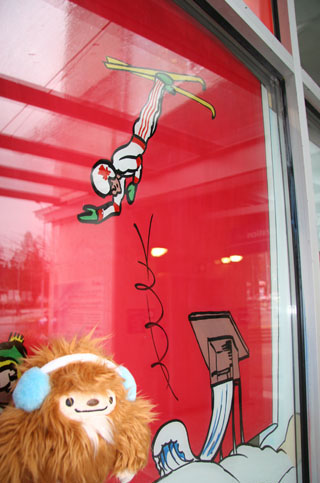
At Horseshoe Bay terminal, Quarotchety noticed a window painting of ski jumpers, which got her fuming over why men can compete as ski jumpers in the 2010 Olympics but women can’t. (Since Nagano in 1998, the International Olympics Committee has denied women ski jumpers from competing.) Yet, Lindsey Van, a 25-year-old U.S. skier, holds the record for both men and women for the longest jump off of Whistler, B.C.’s normal ski jump. Quarotchety, whose mood was beginning to match the colour of the mural’s background, wondered: “How high do women truly have to jump to break that glass ceiling?”

When Quarotchety saw a stuffed polar bear during her free visit to the Olympics’ Canada North Pavilion, all she could think of was global warming, diminishing ice floes, and species extinction. She wondered: Is this the only way that future generations will get to see polar bears — dead and under glass?
These gloomy thoughts were making Quarotchety crotchety, so she figured that she’d take a tip from Olympic sponsor Coca-Cola and “open happiness.” But that got her pondering the nine million bottles of water that Coke was hoping to sell during the Olympics and the landfill mess that would make. She felt distressed over Coke’s efforts to gain exclusive access rights to aquifers and rivers, draining her source of natural drinking water. Quarotchety thought that maybe she could try, like the little boy who kept his finger on the hole in the dyke, to stop this endless outflow of water, so she jumped into a Coke machine like an Olympic diver but all she did was get stuck.
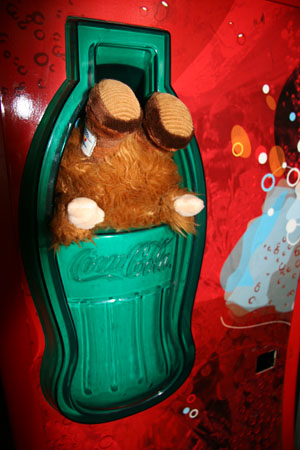
She wondered if her awkward, upside-down position is how public school officials feel when they host a “Coke Day” event for students and sign exclusive contracts with Coca-Cola that legally prevent them from publicly criticizing any of Coke’s products. Or how university administrators feel when they remove drinking fountains so that Coke machines won’t have any on-campus competition. That got Quarotchety thinking again of the slashing of public education budgets.
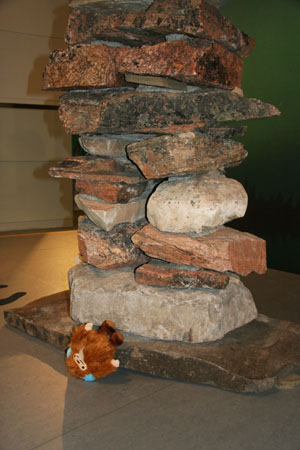
Overwhelmed, Quarotchety decided to find inspiration from arts and culture and stopped to admire an innukshuk at the Canada North Pavilion. Instead, this made her think of how poorly Canada has treated its First Nations people and how poorly Stephen Harper and Gordon Campbell have treated artists in this country. Poor Quarotchety couldn’t forget that Vanoc had made all Cultural Olympiad artists sign contracts preventing them from publicly criticizing the Olympics. And she thought that she lived in a democracy with free speech . . .

Quarotchety had to lie down to compose herself with these troubling thoughts, but the garbage fumes from the mounting trash made her wonder about the claim that Vancouver is the “greenest Olympics ever.”

Rather than silently stew, Quarotchety decided to exercise her citizen’s right to free speech and serve as witness to the several hundred Olympics protesters of the torchy relay on Vancouver’s Commercial Drive. Quatchi begged her not to participate, fearing that observers might mistake her for him and as a result, he would lose all of his lucrative Olympics merchandising contracts. But Quarotchety is a redhead, after all, and follows her own heart.

Although Quarotchety likes the cachet of phrases like “To the Barricades!”, she is committed to peaceful protest and admires the civil disobedience legacy of people like Martin Luther King Jr. and Gandhi.

When some black-clad protesters with kerchief-hidden faces started stretching string across Commercial Drive at Venables, she wondered how effective this would be in stopping the torch relay. When they added a line of barbed wire, she thought: This could get ugly. Then one angry protester threw down five large rocks along the barbed wire.

The situation seemed tense and Quarotchety thought to herself: That’s not how peace is supposed to feel. She appreciated all of the signs like “Homes for all” and “Communities not Olympics” but why stop the torch relay?

Although the Vancouver police had a paddy wagon waiting on Commercial Drive, officers stood curbside and made no effort to interfere with the protest. Quarotchety was pleased to see that the protest had kept the Coke-mobile silent and parked, so she wouldn’t have to endure its grating, blared music and dancing, youthful smile-athon.

Quarotchety was grateful that the protest did not result in any arrests or violence. It caused the torch relay to get rerouted along Clark Drive, which left hundreds of seniors, schoolchildren, and immigrant families without a chance to see the torch. They had waited along the curb for blocks, waving or wearing Canadian flags. She wondered: Was this disturbance fair to them?

Quarotchety was glad to see musicians and entertainers join the protest, putting the fun back into freedom of speech. She especially enjoyed the red-clad folks who danced salsa at the February 12 protest by the Vancouver Art Gallery. They wore shirts that said on the front: “I want to celebrate” and on the back, each one made an important statement like “Homes for All” and “Quality Public Education.” This made Quarotchety think of anarchist Emma Goldman’s famous quote: “If I can’t dance, I don’t want to be part of your revolution.”

Quarotchety is still worried about Olympic debt and homelessness in Vancouver and outraged that such vital considerations disappear under the “it’s-party-time” media coverage of the Olympics. (What does she expect? Canwest Global, an Olympics sponsor now taken over by Shaw, owns most of Vancouver’s TV and newspapers.) But protest or no protest, Quarotchety is proud to be Canadian and will continue to speak up when she sees injustice and hypocrisy at work. She’ll keep razzing her brother too. And working on her anger issues.

