Heather Conn Blogs

spoutin’ about by the sea

Occupy Vancouver: 3,000+ bring power to the people


“First they ignore you

Then they laugh at you

Then they fight you

Then you win” – Gandhi

(on a sign at Occupy Vancouver)


“In times of universal deceit,

Telling the truth is a revolutionary act”

— George Orwell

(on a sign at Occupy Vancouver)


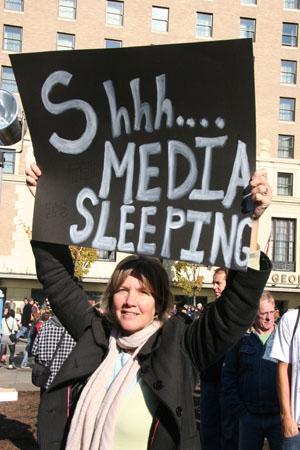
Under the menacing glare of gargoyles perched high on the corners of Hotel Vancouver, across from looming RBC and HSBC buildings, we gathered downtown, 3,000+ strong on Oct. 15. This Occupy Vancouver movement, spawned by weeks of Occupy Wall Street activism in New York City, had set up a sprawling camp of tents, plus tents for food, first aid, public education, and a children’s area, in front of the art gallery.


                                                                                                               — photos by Heather Conn

A handful of friends and I from British Columbia’s Sunshine Coast sat on the edge of the mosaic fountain in front of the Vancouver Art Gallery, surrounded by people of every age, ethnicity, and background: infants, white-haired grandmothers, laid-off workers, disgruntled professionals, business people in suits, women in high heels and fashionable dress, bohemians in masks and costumes . . .They were all a highly visible part of the 99 per cent of western society seeking to be heard and counted as banks, corporations, and governments have gained hugely skewed levels of power, making decisions with little accountability over issues that affect the earth, the public good, and livelihoods. As activist Naomi Klein said a week earlier as part of Occupy Wall Street: “Our system is crashing economically and ecologically.” As one of the dozens and dozens of homemade signs in Vancouver, held high among the throng, said on this day: “Another world is possible.”


I was heartened to see more than a thousand people gathered by 10 a.m., after premier Christy Clark and others had dismissively predicted that few would appear at the event. More and more people kept arriving, until at least 3,000 (some reports claimed 5,000) marched peacefully in a square along four downtown blocks, starting northward at Georgia and Howe. No one smashed windows, threw food at cops, or yelled verbal abuse at passersby. Cars honked in support of the moving crowd. A police officer wore an orange flower in his lapel. The sea of signs gave heart and meaning to what was a living, growing statement (not “a protest”) shared with others who were organizing publicly on the same day in 1,000 cities across the globe:


“One World, One Humanity, Share the World’s Resources”

“Serve the people”

“Close the gap”

“Vancouver wakes up”

“A fair taxation system is overdue”

“We’re the #1 Highest Child Poverty Rate in Canada – Way to go B.C.”

In the first general assembly that morning, various speakers, as part of a moderating team, stood on the art gallery steps and explained the proposed working model for consensus. As defined in the handout provided to the crowd: “A consensus is a decision-making process that attempts to be inclusive and accommodating of the desires and needs of an entire group.” Workers in Venezuela and other Latin American countries have used such models for decision-making in factories and collectives. As one of the moderators pointed out: “It’s not pretty.” It was slow, tedious, and the process bumbling. We were all new at this; our capitalist system had not created models for such forms of decision-making. People would holler out occasionally: “This is what democracy looks like.”


Eager for action and group-based agreements, I grew impatient as different speakers read through the consensus document, word for word, using the mike and then having people within the crowd repeat each phrase in a “human mike” format. Requests went out for translators in a host of languages, from Farsi to Spanish. Hand gestures were given as symbols for how each participant could indicate whether he or she agreed with a proposal, had reservations, would stand aside (“I cannot support this proposal and will not help implement it but do not want to stop the group or block the proposal”) or would block it (“I have a fundamental disagreement with the proposal that must be addressed and has not been resolved”). This repetitive process took an hour and a half.


I was soon growing bored and frustrated. I had to examine my own impatience and desire for a quick outcome, over the inclusion of all questions and requests for something to be repeated. Rather than feeling energized, hopeful, and excited, this process left me feeling deflated and in limbo. But the non-stop stream of informal speakers from the crowd, who took turns at the microphone, helped to draw me back to the power of a group assembly. (The maximum time allotment for each speaker, decided by the group as a whole, was five minutes.) A speaker asked: “Do you trust the system?”

“No,” the crowd roared back. If the group thought that someone was going on too long or the remarks were too self-serving, they hooted or called “Wrap it up” or made the accompanying hand signal. Here is a selection of those who spoke, besides David Eby of the B.C. Civil Liberties Association and Seth Klein (Naomi’s brother) of the Canadian Centre for Policy Alternatives:
 

  • Bob, a unionized meter reader for BC Hydro, who will be replaced by a smart meter within a year, after receiving only a 1% pay increase in a decade: “Gordo (former premier Gordon Campbell) exempted smart meters from due process”;


  • an artist from Montreal: “We’re losing our neighbourhoods”;


  • Paul Grignon, creator of animated films such as Money as Debt;


  • a representative from Zeitgeist Vancouver, part of the Zeitgeist world movement: “What are the root problems?”


  • Activist and grandmother Betty Krawczyk: “Our environment is going, our wild salmon are going. We won’t tolerate it. Their (government/corporate) power comes with our permission, from our acquiescence. True power is in our hands. The power belongs to us, always and forever.” That brought on loud cheers.


  • The Raging Grannies: “Your right is to be heard.”


Later that day, after meeting a client and some of his medical colleagues for lunch at upscale Shaughnessy Restaurant, I was heartened (again) to hear that one of them, a successful doctor, had wanted to join the Occupy Vancouver events himself. He said that he had felt like going down there and throwing something. I was surprised to hear such a remark in that context from such a professional; you never know where you’ll find someone of like mind.

The day’s events did not topple any existing structures or result in resounding changes. However, the simple act of people coming together in peace in a public space to voice discontent and seek more compassionate and inclusive alternatives was a powerful reminder that the power of the people lies innately with the people and in democratic process. We are the power of the majority and we control how much of that we choose to keep or give up.

After returning home just before the seven p.m. general assembly, my husband and I stopped to watch an astounding natural sight: thousands upon thousands of crows were flying, seemingly without end, through the sky. They kept coming and coming, a sprawling black flap of wings across blue, heading east above the Commercial Drive SkyTrain station. They appeared to be coming from downtown. I thought to myself: “Maybe they had their own gathering.” I had never seen such a massive group of crows in my life. I took it as a sign.


Click here for a Buddhist perspective on Occupy Wall Street, by Buddhist teacher and psychotherapist Michael Stone, author of Awake in the World: Teachings From Yoga and Buddhism for Living an Engaged Life.


Click here to watch U.S. news commentator Keith Olbermann outline what Wall Street protesters want (October 05, 2011)


, , , ,
October 18, 2011 at 12:50 pm Comments (5)

What does a TRUE community forest mean? Not stumps and short-sightedness

Seeing first-growth trees in a forest marked with a red dot or blue number, surrounded by flagging tape, is a stark reminder of how different eyes view what I’ll call “wild wood.”


I had this unwelcome reminder last Sunday while hiking through part of the Wilson Creek forest on British Columbia’s Sunshine Coast. Along with about 15 others, informally guided by members of Elphinstone Logging Focus (ELF), I saw first-hand towering coastal Douglas firs, giant Sitka spruce, and other trees – part of 19 hectares that could be logged by early next year.


The red dots on sporadic trees indicated ones that would be saved, not logged. These “lucky” trees would be left to stand, unprotected from strong winds, in open patches of stumps. The blue numbers on trees, painted by timber cruisers, showed that these “lucky” trees had been chosen as samples of the entire forest slated for logging; the cruisers would make calculations, based on this tiny patch, and extrapolate the data as representative of the whole.


These human-created visuals, bright-coloured stains on an otherwise earthy palette, reminded me of those who see this forest as an untapped resource, ready for harvest, not as a haven for blue grouse, black bear, the red-legged frog, ravens, cougars, and salmon downstream in Wilson Creek. During the several hours our group spent in this silent, woodsy haven, we heard the playful call and response of multiple ravens. Some of us saw a teensy grey-green frog, about an inch long, hopping on the forest floor. The ground beneath us felt spongy and light, the result of multi-years of decayed trees and undergrowth.


Across British Columbia, maturing, old-growth coastal Douglas-fir forests, like the one we were in, are identified as “at risk.” Their ecosystems are threatened province-wide. That’s why ELF is demanding the stop to any logging plans in this region; instead, they want to make this forest a key parcel in the proposed 1,500-hectare Mount Elphinstone Provincial Park expansion.


This issue is not sappy, “tree-hugger” sentiment; it’s a wise and practical response to forest management. Sadly, only three per cent of old-growth coastal Douglas firs across British Columbia are protected. The area designated as Wilson Creek Forest serves as an important connector between two existing Old Growth Management Areas (OGMAs). The current Wilson Creek watershed, already heavily logged, needs all existing intact forests to be left in their natural state, to heal the hydrological damage.


“There are some prize Douglas firs in here,” said ELF member Ross Muirhead, while standing in front of one particularly large fir about 1.5 kilometres in from the trail head. “Once this forest is gone, it’s gone.”


During our hike, I saw the disturbing damage already caused by erosion along the banks above Wilson Creek. A long swathe of cliffs is exposed clay. Any logging, even with a buffer zone next to the creek, would destabilize the nearby earth, causing further erosion and the risk of silt contaminating and even damming a portion of the creek.


Does your local politician put profit over conservation?


Within months, all of this beauty could be gone. With a local election approaching, it’s time to make your local politicians accountable for their stance on forest protection and logging. Do they put profit over conservation? The Elphinstone Logging Focus extended an invitation to Sechelt council to come out and see the local forests at risk; councillor Alice Janisch is the only one who appeared. That’s no surprise – the Sunshine Coast Community Forest, a local logging operation, is wholly owned by the District of Sechelt.


Find out what a true community forest means. It’s one that remains a forest, which has long-term value to a community by staying intact and providing an ongoing role as habitat, soil and water stabilizer, and keeping carbon sequestered. It’s not an expanse of stumps.  


Go to the ELF website, open “Wilson Creek Forest Campaign,” read it, then take action. Your email will got to Sechelt Council and Community Forests. The trees and the animals they provide homes for can’t talk – but you can. You can make a difference.


, , , , , ,
October 11, 2011 at 8:30 pm Comment (1)

Want to curb your consumer waste? See The Clean Bin Project

Now, every time I throw something out, I think of the one, tiny basket of garbage that Grant Baldwin and Jenny Rustemeyer each had left after one year. The Vancouver, B.C. couple, creators and stars of the documentary The Clean Bin Project,  achieved almost zero waste after a year of purchasing nothing except food and work-related necessities. I found their dedication (Jen was the most committed of the two) truly inspirational. Jen started growing veggies, she made her own toothpaste, created hand-made family Christmas gifts, and avoided plastic when buying food by re-using a mesh bag for veggies and requesting that items such as cheese be cut from a large block, rather than purchasing some prepackaged.


Their 2010 documentary is an entertaining look at the competitive fun the two had in seeing who would end up with the least amount of household waste after one year. At the end, they each weighed their individual trash bins — I won’t tell you who won. Besides the humor and drama of their ongoing challenges, the movie includes an interview with Brian Burke, compost and recycling guru at Quayside Village Co-Housing in North Vancouver; international artist Chris Jordan (who traded in 10 years of wealth and over-consumption as a New York corporate lawyer to create photographic art composed of mini-images of trash heaps); and Charles Moore, who first discovered the miles-long pile of floating plastic waste that circulates in the Pacific Ocean.


The most poignant part of the film for me was watching Jordan photograph the remains of dead albatross on tiny Midway Island near Hawaii (the atoll is home to almost 70 per cent of the world’s Laysan albatross population). Each skeleton in the sand appeared with what were once the bird’s stomach contents:  a motley assortment of colored bottle caps and other plastic debris. Each young bird was suffocating to death after swallowing plastic, which its body couldn’t process. The mother albatross fly out to sea, retrieve what they believe is food from the floating debris pile in the Pacific, and then feed it to their young ones. How’s that for a powerful metaphor of what our consumer society is doing to life itself?


I appreciated the global perspectives that these interviews added to the immediate story of Grant and Jen’s one-year adventure in waste reduction and recycling. It truly put their efforts in a much-needed perspective of how all human consumption and waste patterns affect the planet, ourselves, and all living things.


The Clean Bin Project film has won a variety of awards, including Best Canadian Documentary at the 2011 Projecting Change Film Festival. The filmmaking duo is on tour to promote the film and its messages. I saw it in Gibsons, BC as part of the excellent Green Film Series sponsored by the Gibsons Green Team and Sustainable Coast Magazine. It’s guaranteed to get you changing your consumer habits — or, if you’re a diehard, at least thinking more about them. 


,
October 2, 2011 at 12:18 pm Comment (1)

Giant yellow cedars at risk on Dakota Ridge: Save our ancient forests

Local conservationists Rick O’Neill (left) and Hans Penner
measure the girth of a giant yellow cedar on Dakota Ridge.


While a woodpecker tapped in the distance, a massive presence stood above the forest floor, a silent giant amidst hundreds of trees never touched by fire.


It was an ancient yellow cedar on Dakota Ridge on British Columbia’s Sunshine Coast, only about a half-hour walk from the upper parking lot of this popular recreational area. About thirty of us had gathered on a sunny 9/11 to honor twin towers of another kind: two yellow cedars of 1,000+ years, both currently slated to be logged.


These magnificent trees are part of a roughly 20.2-hectare (50-acre) cut block that could soon be little more than stumps. If logged, this yellow cedar will be exported to Asia, used as finishing wood for temples and expensive homes in Japan or China.


It took about a half-hour to walk in, along the forest floor, spongy with moss, past mountain hemlock and clusters of wild blueberries, to reach these rare old cedars. Along the way, local conservationist Hans Penner told us: “This forest hasn’t had a fire since the last ice age. Every tree here is an individual with its own history.”


As a co-founder of Elphinstone Logging Focus (ELF), which organized this guided hike, Penner emphasized the difference that public protest has made so far in the future of these magnificent trees. Last winter, B.C. Timber Sales  put this cut block out for tender, advertising it to interested logging companies.


However, ELF discovered that in addition to these first-growth yellow cedars, the proposed cut block contained culturally modified trees (CMTs). (Local First Nations have used such trees for centuries for stripping off bark to make clothing, hats, baskets, and more.) Any cutblock believed to contain CMTs that predate 1846 or are thought to predate 1846 requires a permit for logging, as per the Heritage Conservation Act.

Hans Penner indicates one of the culturally modified
trees in the cutblock.


When ELF notified B.C. Timber Sales of their discovery, the government body withdrew its advertising before late December last year. It has commissioned a “detailed archaeological assessment” that will examine the scarred trees in this cutblock for their potential to be officially declared CMTs. The auctioning of the timber sale for these hectares has been deferred until B.C. Timber Sales receives the recommendations of the archaeological report.


In the meantime, dozens of local residents have written to the premier, B.C. Timber Sales, and the Ministry of Forests to request that this area be made an ecological preserve (see below for details).


Today, a sign painted with a thunderbird symbol, left by Willard Joe of the Sechelt Indian Band, remains near the first giant yellow cedar as his family symbol and a reminder of the significance of this wood in First Nations traditions.


“We’re looking for a human connection to the past,” said Penner. He and local conservationist Rick O’Neill spread a measuring tape around the biggest ancient yellow cedar in this cut block. It measured 203.8 cm (79.92 inches), reaching two metres or 6.7 feet across.


O’Neill noted that if this ancient forest was logged, leaving perhaps just a half-dozen trees, it would not provide enough habitat for animals. “Even mice travel a mile,” he said, “and amphibians won’t cross a clearcut.”


Penner said: “The living forest has no dollar value.” Our ancient forests are priceless and irreplaceable. We need to protect them. Go up and see these special trees yourself. Write to or phone your local politician.

Take action!

If you would like to preserve old-growth forest on Mount Elphinstone, please contact the Ministry of Forests, Mines and Lands and B.C. Timber Sales, quoting Block A84612.  Ask, or demand, that they place the cutblock and all remaining old-growth on Mt. Elphinstone under a moratorium until permanent protection is granted. Request that this forest be made an ecological preserve. Call and/or write to:

  • W. Blake Fougère, Resource Stewardship Officer, Ministry of Forests, Lands and Natural Resource Operations, Sunshine Coast District, 7077 Duncan Street Powell River, B.C. V8A 1W1, Phone 604-485-0728 Fax 604-485-0799 Blake.Fougere@gov.bc.ca
Mr. Fougère is a key Ministry individual who has considerable sway in choosing the immediate stoppage of logging in  Dakota Ridge and regarding the Elphinstone Park Expansion Campaigns. He is seeking public input NOW. Please write, call or email him about the urgent need to protect our Sunshine Coast from further logging. He’ll present this feedback for the B.C. Government’s Timber Supply Review, which will start soon. With this public input, the B.C. Government will plan its future logging of the Sunshine Coast.
Please feel free to write to any of the following too, and cc: Mr. Fougère on the correspondence:
  • Dana Hayden, Deputy Minister of Forests, Mines and Lands, Victoria Ph (250) 356-5012, email: forests.deputyministersoffice@gov.bc.ca
  • Copy to: Mike Falkiner, Executive Director, Field Operations, BCTS Tel: 250-387-8309, email: Forests.ExecutiveDivisionOffice@gov.bc.ca
  • and cc to: Norm Kemp, Planning Forester, BCTS Campbell River Ph. (250) 286-9359, email: Norm.Kempe@gems7.gov.bc.ca

For more information contact: Ross Muirhead 604-740-5654, or Hans Penner 604-886-5730. Email Elphinstone Logging Focus at loggingfocus@gmail.com and become ELF’s friend on Facebook.

For more information, see my archived blog post “A ‘living museum’ on Mount Elphinstone could be logged” (scroll down and you’ll find it here, under my Environment category).

, , , ,
September 12, 2011 at 4:36 pm Comment (1)

The fear of risk: Eagles wait to soar


In the wide, stick nest across the street from us, two “baby” bald eagles (they’re now almost the size of their parents) are getting ready to fly. Only one appears at a time, a high brown hulk, sitting on the edge of the nest, repeatedly opening and closing its wings, as if testing out the equipment. It will hop from one side of the nest to the other, flap its wings some more, then stop.


These short-distance hops and the wing fluttering have gone on for weeks. Sometimes, one will bend down from the side of the nest, look below, then sit up again. A few moments later, it will peer over the side of the nest again. To me, it’s thinking: Gee, that’s a long way down. The nest is about 100 feet up in a thin Douglas fir.


Yesterday, one of the babies sat perched on a branch to the right of the nest. This was progress – for the first time, it had ventured beyond the nest itself. But, ever the impatient one, I’ve been wondering: What are they waiting for? Are they trying to get the courage to jump off? Why don’t they just go for it?


Too ready to judge them for cowardice, I remind myself of my own fears about jumping off into new creative work or a different career path. It feels risky to leap when you don’t know what’s waiting for you. It takes time to build resolve. The eagles remind me of the courage required to let go and surrender to flight in all of its forms.


As for the height itself, I’ve had my own surprises. Normally, I love being in high places; I’ve climbed to 20,000 feet and feel exhilarated when I’m on a mountain or looking down at some astounding panoramic view. Yet, last year, when I tried the zip line set up in downtown Vancouver for the Winter Olympics, I felt petrified just walking up the few flights of stairs to the launch site, then stepping down three small steps to take off. It was only about three stories up, for heaven’s sake. I couldn’t believe that my legs were wobbling. I was teamed up with a construction worker, who’s used to spending weeks at least 30 floors up on high-storey buildings, and he had the same reaction. This surprised us both.


Years ago, while up in a hot-air balloon in Langley, BC, I was too afraid to let go of the vertical supports to take photos. We were only about 1,500 feet off the ground. This mystified me. I told myself it was because we were moving around in the air, not resting on something solid.


Next month, the CN Tower in Toronto will open its Edge Walk, letting harnessed people walk on, and hang out from, a platform that has no guardrail and is 1,168 feet up. I doubt that humans will ever stop pushing for new high-level thrills. Yet, fear is always there, waiting.


I’m feeling more compassion for these young eagles now and their probable fear. Let them take more time before they fly. Maybe they’re just exercising what I need more of: patience.


, , ,
July 30, 2011 at 12:32 pm Comments (0)

2011 Sustainability Congress: one step closer to regional change

Okay, so I learned a lot more than what dematerialization is — and it’s not when someone on Star Trek vaporizes, then reappears in regular form. It is the process of directing more activities “to achieve an improved quality of life that is not based on increased consumption of materials, will allow continued economic growth, and help redress the imbalance in resource consumption between industrialized and industrially less developed countries” (Metro Vancouver definition).

When I first heard about the 2011 Sustainability Congress hosted by Metro Vancouver, BC, I was skeptical. The five featured male panelists were all what I’d call power brokers in mainstream business; I hardly expected them to come up with grassroots solutions that weren’t blinkered by privilege and prosperity. They were David Berge, Vancity’s senior vp of community investment; Tun Chan, director of The Vancouver Foundation; Stephen Owen, vp of external, legal and community relations at UBC; Robin Silvester, president and CEO of Port Metro Vancouver; and Bing Thom of Bing Thom Architects.

Yet, as one of 600 registrants who attended this free event, held June 25 in downtown Vancouver, I came away feeling contentedly surprised. Each speaker revealed far more insights and sensitivity to the needs of the Metro Vancouver region than I had expected. With a focus on three pillars — environment, economy, and society — the first part of the event highlighted these issues:

  • the value of First Nations culture and our need for connectedness and a revitalized sense of community;
  • competing pressures on land; the impact of population; the limitations of the landscape (mountains, waterways, and a delta) that define the area
  • our region’s vulnerability in the event of a widespread catastrophe such as a pandemic
  • a desire to return to small, community-responsive businesses on Vancouver’s Downtown Eastside and elsewhere
  • a need for more cross-cultural sharing of all ages in media, neighbourhoods, and religious practices, beyond token events like an annual Multiculturalism Day. One solution: Build up regional town centres and make them cultural hubs.
  • Over the next five years, women will be the biggest growth economy, double the combined growth of China and India (!)
  • Sustainability takes strategic thinking; leadership; collaboration and dialogue; a change in thinking at the individual level; and participation. Tung said: “Knowledge is nothing unless you put it into action.” (Rather than sustainability, Owen preferred the terms “resilience” and “mitigation.”)

_______________________________________________________

“Sustainability was far more than just a buzz word to these executives”

_______________________________________________________

The panel of “community leaders,” moderated by Vancouver Sun columnist Vaughn Palmer at the Fairmont Waterfront Hotel, began the Saturday event, which ran from 9 to 2:30 p.m. As a whole, the tone of their talk was warm and spirited, yet pointed, with an obvious “Let’s get to it” refrain. These weren’t guys who just ramble along, spouting rhetoric. They’re results-oriented, solutions-based thinkers who function in a context of success (literally, in Chan’s case — he’s former CEO of S.U.C.C.E.S.S.). It was clear that sustainability was far more than just a buzz word to these executives; they were familiar with top thinkers and contemporary authors in the field.

I enjoyed Thom’s comments the best. He was the most outspoken, considering it lunacy to have built Richmond on land so vulnerable to outside forces, from earthquakes to sea-level rise. He noted that it will cost billions to replace the dykes in Richmond as a result, and he called the decision to run the Canada Line to Richmond “insane.” Instead, “We needed it to Coquitlam.” He stressed the need for a clear head when making such large, regional-use decisions: “We need to think strategically.”

As someone immersed in the arts who makes creativity my lifeblood, I loved these remarks by Thom: “Don’t underestimate the power of culture and the arts. The human heart is only twelve inches away [from our head] but it’s the hardest to reach.”

Johnny Carline, Metro Vancouver’s commissioner and chief administrative officer, said that he heard less on energy from the speakers than he had expected, and I agree. I heard very little mention of transportation issues and alternative energy, other than Owen who mentioned that UBC is looking at bio-energy for its heating system. (I was surprised to hear Owen citing Guy Dauncey, a popular author on climate change solutions, and president of the B.C. Sustainable Energy Association. That pleased me.) Within the “society” pillar, I heard nothing about the homeless and creating affordable housing. Similarly, Metro Vancouver’s initiative to use incineration for waste disposal makes a mockery of clean-air concerns and worries about greenhouse gas emissions. 

_______________________________________________________

We were meant to answer: Where do we need to focus time and resources?

Who should lead the charge?

_______________________________________________________

Following the panel event, attendees broke into groups in separate rooms, to discuss responses and possible solutions, and ultimately, to vote on five priority areas defined by Metro Vancouver: food; climate change; energy; security; and dematerialization. (Before the Congress, we had received by email the worksheet Future of the Region: Building a Shared Roadmap.) For each of the five topics, we were meant to answer: Where do we need to focus time and resources? Who should lead the charge?

At my table, our group of nine was a great mix of thinkers and experience, ranging from a PhD student at UBC focusing on food security issues, and a woman from Society Promoting Environmental Conservation to a businessman who does propane conversions on vehicles. A Metro Vancouver employee served as our informal moderator and kept us on task. We shared respectful, open-minded, and passionate talk, discussing whether a certain area would be best handled by Metro Vancouver, local groups, or at the national and international level.

(I found it intriguing that some of the opinions voiced around security issues in post-Canucks-riot Vancouver echoed the same ones I heard that week at a community meeting in rural Roberts Creek on the Sunshine Coast: We don’t need a bigger police presence. People at the community level need to be more watchful of each other.)

After a working lunch and our separate discussions, we reconvened upstairs as a plenary, where we each received a small, portable voting machine to vote electronically. The results were immediately tabulated and displayed on large screens before us, dividing us into our professional groups, ranging from business and government to “other” like me. The majority thought that Metro Vancouver was the best level to address all of the areas, except for security. (Click here to see the results breakdown.)

I applaud Metro Vancouver for seeking public feedback on these important issues and hosting such a well organized, multi-media event. We didn’t revolutionize change in the region or the world in a day, but we did create strong footing and inspiration for future action.

To make sustainability a reality, we need to create connections across, and beyond, many otherwise political, social, and cultural barriers. When it comes to saving our future and our planet, we need a broad vision that requires building new relationships with an open mind. This Congress helped to forge that path.

The Congress was live streamed and a video of the proceedings is available on the Metro Vancouver website. The event will be broadcast on Shaw TV on July 10 at 9pm, repeating at July 16 at 4pm, July 17at 3pm and  July 23 at 9am

(For anyone who thinks that technology hasn’t taken over communication, consider this: When Congress moderator Johnny Carline asked who, in the gathering of hundreds, did not own a cell phone, only about 10 people put up their hand.)

, , , , ,
July 5, 2011 at 12:56 pm Comments (0)

Goo-goo, ga-ga: Raptors make great neighbours

             My husband likes to watch – bald eagles, that is. Every day, he has a telescope trained on the white-capped couple who live in the penthouse — a large nest of uneven sticks — in a Douglas fir across the street in Roberts Creek. Before moving to Canada’s west coast from the eastern U.S., he had never even seen a bald eagle. He’s enthralled by every screech and movement they make and always tries to get me to come to the telescope to watch them.


            Sometimes I do, but most of the time, I’m thinking: I’ve seen bald eagles for over thirty years. I’ve seen a pair join talons in the sky. I’ve seen one dive for a salmon and fly off. I’ve seen dozens of bald eagles of all ages in Brackendale, BC. While sleeping near the sea, I’ve been shaken awake by one when it landed on the tree that supported my hammock. I love hearing them cry and squeak and watching them soar while I’m working at my desk, but mostly, I’ve been a bit jaded when it comes to bald eagles.


            Until last week. My husband urged me, more emphatically than usual, to look through the scope. I did, and this time, saw a small fuzzy head rise slightly above the top of the nest. A baby! I felt like an auntie. My husband christened the youngster Chester. Today, my hubby made another discovery – Chester has a sibling. Hester. We’re thrilled. Who needs a 24-hour eaglecam? We’ve got our own vicarious family in the ‘hood.

June 19, 2011 at 10:20 pm Comment (1)

Annie Leonard says: NOPE, We need systemic change

As far as inspirational speakers go, I’d put my friend Annie Leonard among the top. I recently heard her give a talk to several hundred folks on Salt Spring Island, BC in Canada’s Pacific Northwest. After listening to her impressive knowledge of depressing facts regarding pollution levels and how we’re destroying our planet — “We’re in a system in crisis” — you’d think that I’d come away feeling hopeless.

Not at all. Instead, her passion, smarts and insightful perspectives inspired me to take immediate action on an issue I had previously dismissed. Her talk expanded my view of how we can make meaningful and lasting change on a broader scale. I felt invigorated by her enthusiasm.

We’ve all heard the quick ways to help our planet: Ride a bike. Unplug appliances. Buy organic produce. Start a vegetable garden. Yet, when it comes to truly transforming the planet and society, a focus on small, individual actions is ultimately a placebo and mere distraction, says Annie Leonard of The Story of Stuff fame.

“We’re so used to identifying with our consumer role: Shop differently,” she told a crowd of young and old at Salt Spring Island’s Centre for Child Honouring. “We have to start to re-engage as a citizen and engage in our civil society. Our citizen muscle has atrophied.”

She reinforced that individual lifestyle changes are not enough. As a provocative systems thinker, Annie believes that we need deeper, systemic change and to ask tougher questions beyond: Where should I shop? (She promotes the approach of “NOPE” (Not on Planet Earth) rather than the all-too-common NIMBY (Not in my backyard).) She asked a fundamental question: “Why is economy based on growth?” Who says that we need growth? What happened to “Small is beautiful”?

In Annie’s view, we need to rethink our role on the planet to the core, beyond commonly accepted approaches espoused even by many environmentalists. For instance, think in terms of “Waste less” not “Recycle more.”

She says: We need to change the rules of our production methods, to do a life cycle analysis of products. Resist upgrades of electronics. Make them safe. Make them last.

Annie identified our three “simple” problems:

  • We’re trashing the planet
  • We’re trashing each other
  • We’re not having fun.

Besides that, we’re carrying toxic body-burden levels, she says. Annie has had her own body analyzed for harmful chemicals and had 80+ identified. Today’s babies are born pre-polluted with high levels of chemicals found in their umbilical cord, she noted. At the same time, one billion people are chronically hungry.

Amidst North America’s rush for materialist goodies, Annie pointed out four things, according to researchers, that determine happiness:

  • the quality of our social relationships
  • having leisure time
  • a sense of purpose and  meaning in our life
  • coming together with others with shared goals.

Facing an audience that included Green Party leader Elizabeth May in the front row, Annie outlined a few of her solutions for creating a healthier planet of happier people:

  • Build a clean, healthy, green economy.
  • Apply technology to help the planet, whether it’s using zero-waste designers or  biomimicry, whereby scientists study and emulate the processes and systems of nature to solve human problems. For example, how does a peacock make black? (See Biomimicry Institute for more details.)
  • Honour and embrace children as a culture. One way is to have nation-wide, annual testing of breast milk, to monitor what chemicals our vulnerable infants are ingesting. Elizabeth May stood up and told the group: “Nobody can breastfeed without fear on this planet.” Annie expressed her own dismay and worry while breastfeeding: industry has contaminated our most elemental human relationship. (Find out more at Making Our Milk Safe.)

Another way to honour children is to spend more time with them. As  a  single mom who’s on the  road a lot, Annie makes quality time with her daughter Dewi a top priority. When she can, she brings Dewi with her as a combined work trip/holiday. “Children should be first and foremost in our decision-making,” she said.

Our education system offers a great forum for honouring children and offering them ways to serve the planet and society. Annie has worked with teachers to develop curriculum and actions guides for youth around her concepts in The Story of Stuff. (She shared how neocon commentator Glenn Beck raged against her for a week on his previous talk show, telling schools that they should punish any teacher who showed The Story of Stuff in class.)

  • Adopt the same regulatory approach as the European Union. For example, the EU has banned 11,000 chemicals; the United States has banned only 11.
  • “Get corporations out of our democracy.” As event host, Raffi (Annie’s friend, a well-known children’s entertainer and founder of the Centre for Child Honouring) asked: “What choices are you being given by corporations?”

Overall, Annie reinforced that we need to make doing the right thing our default action. In her simplest terms: “hope, love, truth — not fear.” She said: “We need to rebuild community and communication. There is a giant dim sum table of possibilities.” Let’s dig in.

, , , , , , , , ,
June 5, 2011 at 6:03 am Comments (0)

Elizabeth May a small-c conservative?

Since my post this week on the election of Green Party president Elizabeth May, a leftie friend has sent me more info about her, citing a 2008 article in Canadian Jewish News. Initially, I found some  of it disturbing, but it did not all pan out.

I have always considered Canada’s Green Party a progressive, leftist force; it certainly garners a lot of leftie support. Well, May’s political roots seem to come from the right. In the mid-1980s, she served as senior policy adviser to Tom McMillan, the Tory environment minister under then-prime minister Brian Mulroney. That’s distressing, yet I’d like to know: How  much have her views and policies changed since then?

In this year’s federal election,  she received an endorsement from Fraser Smith, who spent six years on the Reform party’s executive committee, according to a National Post article. (My friend said that Smith was May’s chief strategist, but I couldn’t find any online info to confirm that.) Smith called her “a good conservative” in her views about the economy.  I don’t have an issue with that. If she’s not going to spend us into humungous debt, that’s a good thing.

May has apparently said herself that her party is not of the left. And yet she’s got  Ken Wu, a former forestry activist with the Western Canada Wilderness Committee, as her communications manager. He doesn’t sound like somebody who would support a Tory.  (I dislike such limiting terms as “right” and “left” yet they make convenient labels. Unfortunately,  they usually lend themselves too easily to black-and-white thinking. Humans and their activity are a lot more complex than that.)

Back in 2008, May said that she would raise the GST back to six per cent and use this as a source of revenue for “community-level” needs such as public transit, sewer and water facilities, recreation areas and bike paths. That sounds good to me.

She’d also reduce corporate tax rates, supposedly tied to the incentive of reducing greenhouse gases. That sounds more dubious and more conservative. Yet she also said that she wanted to direct more money to low-income Canadians. And she claimed that the Green Party would scrap the Conservatives’ child-care tax benefit (a token $100 a month per child up to age six) in favour of fully accessible child-care spaces,  early learning educational experiences, and support for  families who want to raise a child at home. That all sounds great to me.

I’m not worried that May is a closet Tory in green clothing. I think that she’s got enough progressive thinkers and activists around her, and who voted for her, to keep her honest and to remind her that protecting the environment, indeed, is a prime mandate — not an impediment to jobs and corporate “progress.”
*                          *                              *                            *                        *                          *
Meanwhile, the thought of what prime minister Harper can do in Canada with a majority government is truly frightening. As someone said to me, the Canada that Tommy Douglas built might never be the same. Still, I’d rather put my energy into proactive responses and activism and hope rather than despair and alarmist rhetoric.

Yet, my friend points out that the first thing Harper plans to do is legislate away all funding to political parties. (Right now, they get a financial amount based on their number of popular votes.) As my friend wrote me in an email: “Since the Liberals are heavily in debt, this may be another nail in their coffin (which is Harper’s intent). Can you spell f-a-s-c-i-s-t? This guy is very, very dangerous.”


May 7, 2011 at 3:21 pm Comments (3)

Go May go! Stephen, ya gotta go

image1

Go Greens Go! I am thrilled and delighted that Canadian Green Party Leader Elizabeth May has won her seat in British Columbia. This is the first election of a Green Party candidate in North America. At last. She even ousted the Conservative incumbent Gary Lunn.

May achieved this success in her Saanich-Gulf Islands riding even after a media consortium, which included the CBC, refused to allow her to participate in the nationally televised federal candidates’ debate. Her victory occurred in a province where some people think that even Stephen Harper’s views are too liberal (scary!).

For instance, a local eight-page rag where I live, The Sunshine Coast Times,  was promoting the “search for truth, justice and the real Canadian way” of the Western Block [sic] Party. The publisher includes this disclaimer in his paper: “If you are a tree hugging, dope smoking, granola eating, left wing commie pinko and are prone to vote liberal, the material herein will probably cause you some serious pain.”

Like I said: scary. Go, May, go. However, one measly seat in a huge nation like Canada does not give a party any significant clout. The Green Party here is still only a ghost of its political role and impact in Germany, its founding nation. In Australia, the Greens have five senators, one MP, and 24 elected reps in state and territory parliaments plus more than 100 local councillors, according to Wikipedia. Canada, we need a lot more elected green thinkers in the political arena.

Meanwhile, the NDP has become the official opposition in Canada, for the first time ever. Another tremendous victory. Yet people are saying  that NDP leader Jack Layton will have less power now than he did as part of the previous coalition. I think that’s an overstatement.

However, the new majority government of Stephen Harper’s Conservatives is indeed a sad day for Canadians and the environment. What are people thinking? Harper is a strong proponent of Alberta’s Tar Sands, and like his former U.S. political buddy, George W. Bush, refuses to acknowledge the threat of global warming and the related impact of human activity. I won’t regurgitate  Harper’s long, poor record on disregarding ecological concerns — it would read too much like a eulogy for the earth.

You can get a good summary of Harper’s standing on the environment and other issues by watching this tongue-in-cheek video by a group of edgy women on Saltspring Island, part of May’s riding. Sadly, Canadians didn’t hear their message: Stephen, ya gotta go.

*                            *                                      *                                  *                                    *

UPDATE: A friend who read this post tells me that he’s skeptical of Elizabeth May, since learning her stance on abortion. Leftie activist Judy Rebick ended her support for the Green Party after she says that May called abortion “frivolous.” May is quoted on Life Site News as saying: “I don’t think a woman has a frivolous right to choose. What I don’t want is a desperate woman to die in an illegal abortion.”

What does May mean by “frivolous”? I don’t know. May does support her party’s position of keeping abortions legal. You can read the original story, posted in 2006, on the link above and make your own decision.

May 3, 2011 at 7:35 am Comments (4)

« Older PostsNewer Posts »