Heather Conn Blogs

spoutin’ about by the sea

Every day is Earth Day

Two days after Earth Day, birds are chasing each other in my trees while a male robin puffs out his chest, looking for a mate. He makes me think of a strutting general, laden with medals. (I’m told that they do this because they’re cold, but I prefer to think it’s a form of flirtation.) For weeks, the male red-headed sapsucker has been tapping on our metal downspout, trying to attract a female. (Poor guy — I guess persistence works.) I heard the buzzing whir of a hummingbird yesterday, my first of the season. Time to put up the feeder.

Spring is my favorite time of year. I love the smell of hyacinths in our garden, the yellow splash of daffodils, and the blossom colours on streets here and in Vancouver: bursting branches of apple, cherry, and magnolia petals. It’s a glorious time of new buds, fresh dark soil, and clearing out dried old leaves and underbrush.

David Suzuki says that every day is Earth Day, and I agree. Having special days of ritual are important to celebrate Mother Earth and draw attention to her plight, but circumstances don’t change the next day. Global warming still remains, as does the need for all of us to conserve energy and tread more lightly on the planet.

Let’s keep spring — and all seasons — a time of magic. Think of the Earth when you’re making choices about transportation and travel, buying products from dish soap to a car, and who to vote for. Your decisions now can make a difference.

April 24, 2011 at 11:50 am Comments (0)

A “living museum” on Mount Elphinstone could be logged

yellowcedar-d-ridge-2-low-res

A threatened yellow cedar on Dakota Ridge

— photos by Michael Maser
It’s one thing to seek protection of old-growth forest for the purely theoretical and  practical sake of conservation and sustainability.  It’s another to stand beneath centuries-old cedars or Douglas firs and absorb their size and wonder in your heart and gut, witnessing the canopy and life they provide for so many creatures, big and small. At such times, it’s hard to imagine an ancient forest without all of its trees and flora and fauna that thrive in symbiosis, from a creek to the nurse logs to the mushrooms to the moss to the birds and so on.

I still remember, decades ago, standing amidst the vast array of stumps of old-growth trees in the Carmanah Valley on Vancouver Island, B.C., feeling sickened by the gutted, clearcut landscape. Right next to it stood a thriving forest of cedars and firs. I stared at both of these side-by-side scenes, which represented the opposite extremes of devastation and vibrant life, and wondered: How could anyone witness this loss of ancient life, so close to an abundant forest,  and not think that something was out of kilter?

A friend of mine recently went up to the forest on Mount Elphinstone near Dakota Ridge recreation area on British Columbia’s Sunshine Coast, where ancient yellow cedars are slated for logging, and shared these comments:

“I was astounded with what I discovered. Just 300-400 metres from the access road (quite nearby to the D-Ridge parking lot & warming hut) is a forest unlike any I’ve seen anywhere — and I’ve explored plenty of forests. It’s a high-elevation Old-Growth remnant (i.e. an island) about 45 hectares in size, chock-a-block with veteran yellow cedar and hemlock trees, many of which are easily 400-1000 years of age. I’ve never seen such a dense old growth forest.

“But that’s only part of it — by rough estimate, at least a couple dozen of the veteran Yellow Cedar trees still living here are ‘culturally-modified’ – that is, they bear signs of having had bark removed (“modified”) several hundred years ago by ancestors of the Sechelt Indian Band. It is like a living museum.

“Clearly this site is incredibly precious — for its cultural, biological, and educational values as well as a carbon sink (old growth coastal forests store huge amounts of carbon).

“And … this small, remnant forest is all ringed with orange flagging tape as a proposed ‘elimination’ logging site for BC Timber Sales, which is the logging company owned and operated by the provincial government. Log it and in a few short weeks, it’s gone forever. At rock-bottom prices for lumber and pulp. Save it and we will have an educational site more valuable than Stanley Park or Cathedral Grove (which lack the culturally modified trees).”

yellowcedar-d-ridge-low-res

I recently wrote to various B.C. government ministers, requesting that this rare parcel of forest (it’s 44 hectares or 110 acres, known as Block A84612) be spared from logging. I received a letter, dated January 12, from Tom Jensen, Assistant Deputy Minister of Forests, Mines and Lands. He explained the various regulations that pertained to this cutblock, stating that this “landscape unit . . .is considered available to timber development opportunities.” He said that this cutblock does not affect class 1, 2 or 3 marbled murrelet (species at risk) nesting habitat and that “significant old growth ecosystems on the Sunshine Coast are protected in parkland.” By that reasoning, anything that is not parkland is fair game for logging, right?

The minister added that any cutblock believed to contain Culturally Modified Trees (CMTs) that predate 1846 or are thought to predate 1846 requires a permit for logging, as per the Heritage Conservation Act. B.C. Timber Sales has commissioned a “detailed archaeological assessment” that will examine the scarred trees in this cutblock for their potential to be CMTs. Therefore, the auctioning of the timber sale for these hectares has been deferred until B.C. Timber Sales receives the recommendations of the archaeological report.

Since then, 24 CMTs have been identified and tagged in this cutblock, including “taper peels” (long strips of cedar bark removed), notched planks, and test-holes.

Meanwhile, the Elphinstone Logging Focus (ELF) Group states that an estimated, less-than-two-per-cent of original, old-growth forests remains after a century of logging in the Mt. Elphinstone Forest Service map area.

“Old-growth forests provide ongoing environmental, recreational, and cultural services that need to be recognized as key economic contributors,” says ELF’s Ross Muirhead. “Short-term logging revenues pale in comparison, especially in light of the fact that BC Timber Sales has been losing money for several years. ”

Muirhead notes that new ways of assigning values to intact forests (I’m not sure what he means by that) show that forests actually generate up to $7,000 per hectare in services. That means that a 44-hectare forest provides $294,000 in yearly services to our community.

” We are not prepared to sit back and see our remaining old-growth forests that support bio-diversity be plundered,” says Muirhead.

If you would like to take action to preserve old-growth forest on Mount Elphinstone, please contact the Ministry of Forests, Mines and Lands and B.C. Timber Sales, quoting Block A84612.  Ask, or demand, that they place the cutblock and all remaining old-growth on Mt. Elphinstone under a moratorium until permanent protection is granted. Call and/or write to:

  • W. Blake Fougère, Resource Stewardship Officer, Ministry of Forests, Lands and Natural Resource Operations, Sunshine Coast District, 7077 Duncan Street Powell River, B.C. V8A 1W1, Phone 604-485-0728 Fax 604-485-0799;Blake.Fougere@gov.bc.ca
Mr. Fougère is a key Ministry individual who has considerable sway in choosing the immediate stoppage of logging in  Dakota Ridge and regarding the Elphinstone Park Expansion Campaigns. He is seeking public input NOW. Please write, call or email him about the urgent need to protect our Sunshine Coast from further logging. He’ll present this feedback for the B.C. Government’s Timber Supply Review, which will start soon. With this public input, the B.C. Government will plan its future logging of the Sunshine Coast.
Please feel free to write to any of the following too, and cc: Mr. Fougère on the correspondence:
  • Dana Hayden, Deputy Minister of Forests, Mines and Lands, Victoria Ph (250) 356-5012, email: forests.deputyministersoffice@gov.bc.ca
  • Copy to: Mike Falkiner, Executive Director, Field Operations, BCTS Tel: 250-387-8309, email: Forests.ExecutiveDivisionOffice@gov.bc.ca
  • and cc to: Norm Kemp, Planning Forester, BCTS Campbell River Ph. (250) 286-9359, email: Norm.Kempe@gems7.gov.bc.ca

For more information contact: Ross Muirhead 604-740-5654, or Hans Penner 604-886-5730. See them on Facebook by searching for Elphinstone Logging Focus

protest-sign-dakota-ridgeelphin-park-cutblock-189-low-res1

, , , , , , , , ,
January 23, 2011 at 4:39 pm Comments (3)

From Kenya to the Creek: it takes courage to save a forest

We might not live in Kenya, but we have something in Roberts Creek, BC unique to the world: 1,000-year-old yellow cedars in ancient coastal rainforest that has never been logged. Like Wangari Maathai, founder of Kenya’s Green Belt Movement, we face a challenge to stop logging of these untouched forests on local Crown land.


For more than 30 years, Maathai endured army-led beatings, police harassment, public humiliation, and condemnation as an enemy of her Kenyan government, all because she led a grassroots movement to plant trees in her native land. Founder of Kenya’s Green Belt Movement and 2004 winner of the Nobel Peace Prize, Maathai is inspirational proof of the impact that one courageous and determined woman can have.


Few people would imagine a link between this East African activist, who has saved Kenya’s dwindling forests and launched the planting there of more than three million trees a year, with a logging issue in upper Roberts Creek, BC. But on Dec. 3, about three dozen locals learned of the disturbing parallels between Maathai’s environmental struggle and our own here on the Sunshine Coast.


We watched the documentary Taking Root — the Vision of Wangari Maathai, thanks to the Green Team at Gibsons United Church. This excellent, award-winning film by Lisa Merton and Alan Dater highlights how Maathai’s efforts to teach Kenyan village women to plant trees grew into a nation-wide force to save the environment, defend democracy, and protect human rights.


In the film, Maathai recalls growing up amidst lush forest and mountains (sound familiar?), where a beloved “spirit tree” nearby, centuries old, is logged. Both the forest and the stream, where Maathai played as a kid, disappear. Decades later, when Kenya’s corrupt president Daniel Arap Moi decides to build a glossy skyscraper and four-storey statue of himself in Nairobi’s only park, Maathai and dozens of women, including many grandmothers, launch a hunger strike and sit-in at the park to prevent destruction of the area’s forest. Democracy activists join them, and soon the military move in with their batons, beating defenceless women.


We see Moi’s public shaming of Maathai and his legacy of brutal rule in a country where the average income is a dollar a day. We discover how the profits from sales of timber, logged on Kenya’s Crown land, go to his political cronies. Maathai and other women confront the loggers to prevent the cutting of forests, and again, Moi calls in soldiers to beat and disperse the group. Eventually, after 24 years in power in a country where he outlawed opposition, Moi leaves the presidency in 2004. In Maathai’s words: “It is the people who  must save the environment. It is the people who must make their leaders change. And we cannot be intimidated.”


By then, some of the same soldiers who had once challenged and beaten Maathai and her supporters are now planting trees on military property. As one soldier says, he sees these seedlings as brothers: the trees protect the environment, while the soldiers protect the people. Maathai, the first woman in East Africa to receive a PhD, becomes Kenya’s deputy minister of the environment. (Maathai’s success and Green Belt movement are cited as sources of tremendous hope in Hope’s Edge, written by Frances Moore Lappe and her daughter Anna. Click here to read my review of the book, published in Alive magazine.)


After the film screening, local activist Hans Penner explained how a British colonial system in both Kenya and our own province adopted the same practices and policies: exploit forests as much as possible for profit, ignore traditional, indigenous uses of the land, and don’t acknowledge the negative impact of logging on groundwater and watersheds. 


BC Timber Sales will soon be advertising to sell off chunks of our rare old-growth trees — 1,000-year-old yellow cedars — on Crown land in upper Roberts Creek to private bidders. They have slated three cutblocks on 44 hectares (109 acres) on Mount Elphinstone; in one of these areas, at least 30 families get their water. This never-logged area stands at about 900 metres (3,000 feet) altitude. Two of the cutblocks are within only about a kilometre of the road access to Dakota Ridge ski area.


“A thousand-year-old tree is a real treasure,” said Penner. “The forest that’s there is an irreplaceable heritage. There’s nothing like it on the planet. In this upper-elevation forest, there’s never been a forest there, it’s never been logged. The forest has been living since the last ice age.” He noted that most people have never even seen a forest like this one, which has no stumps.


Sometimes, forestry companies consider ancient trees a hazard and cut them down without even using the wood, said Penner. “They’re mowing the forest right down to the ground,” he told us.


When he and local Ross Muirhead recently snowshoed through two of the proposed cutblocks, they flagged 30 cedar trees, 300 to 400 years old, deemed “culturally modified” because local First Nations people have used their bark as part of their customs and heritage.


“We’re the closest people in the world to this,” said Penner. “We have a special responsibility. “We’re like witnesses to a crime, where we’re standing there.”


Who will take action and who will remain a silent bystander? Penner recommends writing to the following people in government: B.C.’s forestry deputy minister Dana Hayden forests.deputyministersoffice@gov.bc.ca, who has the authority to stop the timber sale ads, B.C. Minister of Forests Pat Bell (pat.bell.mla@leg.bc.ca), and Don Hudson at BC Timber Sales (don.hudson@gov.bc.ca).

You can also contact the deputy minister to the premier, Allan Sekel.  His phone number is 250-356-2209. The government website does not include his email address — how’s that for open government? — but his address is P.O. Box 9041, Stn. Prov. Gov’t, Victoria, BC V8W 9E1.


If you’re on Facebook, you can join the group Elphinstone Logging Focus and/or contact our MLA Nicholas Simons on Facebook. Nicholas is also available at 250-387-3655 or Nicholas.Simons.MLA@leg.bc.ca. For more information about this issue, you can call Ross Muirhead at 604-740-5654 or Hans Penner at 604-885-5730.

December 5, 2010 at 1:18 pm Comments (0)

A victory for the polar bears

 Polar bears have gained an edge in U.S. Arctic waters — for now. A federal U.S. court has stopped oil and gas companies from going ahead with drilling  operations in millions of acres across Alaska’s Chukchi Sea. known as one of the country’s “polar bear seas.”

This victory comes after George W. Bush sold off drilling rights cheap in the fnal days of his administration.  This move prompted a federal lawsuit from Alaska First Nations residents and environmental groups such as Earthjustice and Natural Resources Defense Council (NRDC). The suit charged that the U.S. government had failed to study the long-term impact of oil development and had broken the nation’s environmental law.

A federal judge agreed, ordering the Obama administration, which had adopted the Bush administration’s drilling policy, to start again and obtain missing information about environmental risks.

“We can’t afford a repeat of the Gulf oil spill disaster in the Arctic,” said Chuck Clusen, director of NRDC’s Alaska projects.

Unfortunately, this court ruling does not cover the Beaufort Sea, where Shell and BP still operate. Shell says that it will apply for new permits to drill in this region next year after Obama last summer put Shell’s plans on hold to drill off the coast of the Arctic National Wildlife Refuge. BP also is preparing to drill in the Beaufort, using the biggest drill rig in the world. Environmental activists are demanding that the Obama administration reject BP’s appication to drill, and they will go to court on this, if necessary, to stop the drilling.

Meanwhile, the Canadian federal government is studying the “economic benefit” of polar bears. Gee, I guess just existing as magnificent wild creatures, with lives threatened by global warming,  isn’t enough these days.

The Globe and Mail had a funny editorial cartoon on Oct. 1 about this. It depicts a government tax man with a briefcase standing in an inflatable raft, pointing an income tax form at a polar bear on an ice floe; he’s notifying the perplexed creature of its tax reporting obligations and deadline.

(Most of this information came from the NRDC newsletter Nature’s Voice.)

October 12, 2010 at 10:51 am Comments (2)

At last — I saw the grey whale

For weeks I’ve been hearing about the grey whale that’s hanging around not far offshore, here on British Columbia’s Sunshine Coast. Last Sunday, it spent the whole day off Roberts Creek Beach, close to where I live, but I was away. People I know have seen it off Snickett Park in Sechelt; I went there the following day, but it didn’t show. A friend of mine with an ocean view has watched it almost every day in Halfmoon Bay. Several visitors I know, here just for the day, have seen it.


Some people claim that it’s a mother and calf. Others say that they have seen a pod. Yet another said he thinks it’s a humpback whale, because he saw what looked like ridges on its side. With all of these descriptions and stories circulating, I was beginning to think that I was fated never to view the beautiful beast. 


After listening to friends’ accounts of awe and admiration in seeing this wild sea creature, I felt as if I was truly missing out. After all, it is rare to see a grey whale off our shores, particularly one that remains about 15 metres or so from land. A U.S. television news report recently stated that if a whale stays close to shore, it means that it’s sick and dying, according to scientists. I don’t know if that applies to the whale in our region or not.


Well, this week, I finally saw it, and it was a thrill to watch it. I was driving from Roberts Creek to Sechelt before 9 a.m. and wondered why there was such a traffic bottleneck in Davis Bay. Then I noticed people on the pier and shore staring out to sea, looking in the same direction. That’s when I saw it. It astounded me how close it was.


In Davis Bay, a square wooden float, which people use as an informal diving platform, lies anchored about 20 metres or so offshore. The whale was between this float and the shore. You could see the length of its body underwater by the smooth water surface it left above itself. Periodically, you could see its vertical fin, encrusted with white barnacles, poke above the water. Its tail also flicked above the surface occasionally. Every so often, it would blow air through its blow hole. I assumed that it was feeding. It was moving very slowly, not like the orcas that I’ve seen.


A few people in a rowboat were off to its side, about 20 metres or so away, just watching it. I parked the car and went over and looked at it from the beach. What a glorious sight. I feel truly blessed to have gotten a glimpse of it. I had my camera in the car, but did not think to bring it out; I felt that I wanted to have a direct visual connection with the whale, not place a barrier between us.


It buoys me to know that in today’s technology-crazed society, in which a multitude of images and messages are flashed at people every day, many can still find the sight of a wild whale a remarkable treat, worthy of stopping their car. Maybe there’s still hope for our species.

August 20, 2010 at 12:49 pm Comment (1)

Ecology flag: Who created it 41 years ago?

Ecology 3ft x 5ft Printed...

I woke  up this morning with an intuitive prompt to write about the ecology flag, which I remember as a ‘tween in the 1970s. (That was when I wore white go-go boots and paisley, bell-bottomed pajamas and thought that I was cool.) The image intrigued me back then, even though I didn’t fully understand its significance.


The symbol first appeared in the Los Angeles Free Press (hurray for alternative media) on November 7, 1969, according to Wikipedia. Creator Ron Cobb, then a political cartoonist for the Free Press, put it in the public domain, bless his heart. One Internet source says that the Paramount Flag Company in San Francisco made the first ecology flag in August 1967, but I can’t verify that. If it’s true, perhaps Cobb adopted it for publication.


The yellow symbol is a combination of the letters “e” (for ecology, earth, evolution, empathy, and so on) and “o” (for organism, oneness, om, oracle, etc). Cobb was inspired by the circle or mandala as a universal symbol of timeless unity and harmony, by the yin-yang symbol, the concept of equinox, and the ellipse, “the transcendent unity that pervades all dualities.” (You can find out more details about the symbol and its meaning on Ron Cobb’s website.)


The ecology flag reportedly flew for the first time on Earth Day 1971 as a 4 x 6  green-and-white banner. Like her namesake Betsy Ross, who stitched the first U.S. flag, Betsy Boze (now Betsy Vogel) sewed the flag as a 16-year-old environmental and social activist in Louisiana. However, C.E. Byrd High School in Shreveport denied her permission to fly the flag. Like any effective advocate, Boze refused this “no” and sought and received authorization from the Louisiana legislature and governor John McKeithen to display the flag in time for Earth Day.


Kudos to Boze for seeking out state power to support her cause. What a great tribute to one woman’s vision and determination, especially at an age when many contemporaries were more focused on acne angst and dating gossip.


I’m sad that the flag didn’t gain widespread use, and that Cobb limited his symbol to a facsimile of the U.S. flag. The concept of ecology spans far more than one nation’s borders. If he was truly thinking “oneness,” why not choose a more universal concept?


Even though many had ecological concerns in the 1960s and 1970s, it has taken 40 years or more for mainstream thinkers, politicians, and businesses to reflect environmental awareness. It’s sad to me that it took this long but hey, I”m grateful that at last, caring for the earth has become part of mass public consciousness.

July 16, 2010 at 7:40 am Comments (0)

Hands Across The Sands: A Jedediah adventure

hands-across-sands-low-res-1
                                                                                                                      — Heather Conn photos

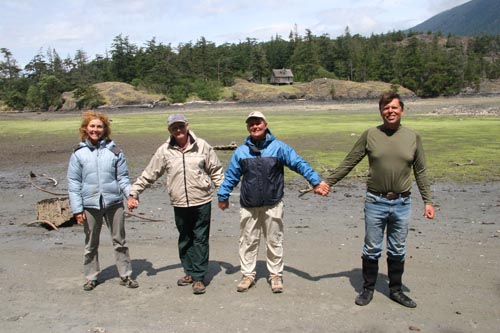
Four kayaking companions and I, camped on Jedediah Island on British Columbia’s Sunshine Coast,  joined the June 26 global event Hands Across the Sand  to protest offshore oil drilling. From our low-tide beach at Home Bay, we gathered around noon and stretched our hands across a shoreline to support clean energy choices. Like thousands of others around the world, we took this symbolic gesture to draw a line in the sand against the threat that oil drilling poses to coastal economies and the marine environment.


The Hands Across the Sand movement, founded by U.S. resident Dave Rauschkolb, began in Florida on Feb. 13 this year. Thousands of residents across the state, representing 60 towns and cities and more than 90 beaches, joined hands to protest attempts by the Florida and the U.S. governments to lift the ban on oil drilling near and off the state’s shores. The movement created partnerships with major environmental organizations such as the Sierra Club, Greenpeace, and Audubon.


The impetus for the June Hands Across the Sand event, which involved 860 locations, came from the environmental devastation of the ongoing British Petroleum oil spill. The mission of Hands Across the Sand is to draw attention to our global dependence on fossil fuels and adopt policies that encourage renewable energy sources.

our-camp-1-low-res

 At our  idyllic location on Jedediah, a marine provincial park, tiny crabs scrabbled in the shallows while dozens of live sand dollars wafted in low waters. By the thousands, oysters and periwinkles covered the sea bed, surrounded by thick clusters of mussels and barnacles on nearby rocks. At low tide, three raccoons hunted for food in the mud while red-footed oyster catchers flew past,  screeching like banshees. Ever-present seagulls dropped shellfish onto the beach to break open their food.


With such natural richness hinged to the sea, it was disturbing to imagine how an oil spill in these waters could easily destroy this abundance. While hundreds of thousands of barrels of BP oil continue to pour into the Gulf of Mexico,  Chevron is drilling underwater off Newfoundland at almost twice the depth as BP’s rig that blew out.

our-camp-2-low-res

 Meanwhile, B.C. Premier Gordon Campbell wants to drill oil off the northwest coast of the province, by the Queen Charlotte Islands. Along with the federal government and Enbridge, he’s poised to create an oil pipeline from Alberta’s Tar Sands to Kitimat, B.C. This would result in oil tankers traversing the province every day through fragile ecosystems and challenging waters in central and northern B.C. (For more details, see my archived feature “No oil tankers on the B.C. coast” posted Dec. 1, 2009 under “Environment.”)

hands-across-sands-low-res-2

On a more upbeat note, the abandoned wooden building in the background of this photo is the old homestead on Jedediah that once belonged to the Palmers. Mary and Al Palmer bought the island as a summer holiday destination in 1949, then became full-time residents in 1972. They both farmed the land and cherished the island’s 600 acres, which includes cedar, old-growth fir and arbutus, peaceful bays, and stunning views. Mary was determined to prevent any  development. (Palmer describes life on the island, complete with historic family photos, in her book Jedediah Days, a B.C. bestseller published by Harbour Publishing.)

homestead-low-res

The Palmers worked hard to preserve the island, helped by a province-wide fundraising campaign, started by the late Dan Culver’s Follow Your Dream Foundation. Many groups rallied to raise money to create a park, including Friends of Jedediah, the Marine Parks Forever Society, and the Nature Trust of B.C. Countless individuals and organizations provided financial support, which included $1.1 million from Culver’s estate. The B.C. government donated millions more and the Palmers agreed to sell the island for $4.2 million, far less than its market value. Thanks to their generosity and the dedication of so many donors and volunteer fundraisers, Jedediah Island became a provincial park in 1995.

scenic-low-res

Now thousands of people can enjoy this unsullied spot every year. A flock of wild sheep still roams the island and several dozen mountain goats, said to be descendants of those left by Spanish explorers, can peer down at you from rocky bluffs. The island has four registered archaeological sites, including a First Nations fish weir.

gibraltar-low-res1

 I took the photo above from Gibraltar, a rocky viewpoint towards the north-central part of the island. A cairn of stones marks the spot with a heavy plastic tube that contains scribbled notes from hikers over the years. Of course, I added a message from our group. Towards the centre of the island, we wandered through forests pastoral and open, without tangles of thick underbrush. We saw the grave of the Palmers’ beloved horse Will, which bears visitors’ strange offerings and detritus from the sea, from a toy car and flattened soccer ball to a plastic marine float. Elsewhere, the island’s open meadows, pungent with mint-like scent, are still home to neglected fruit trees.

moss-low-res

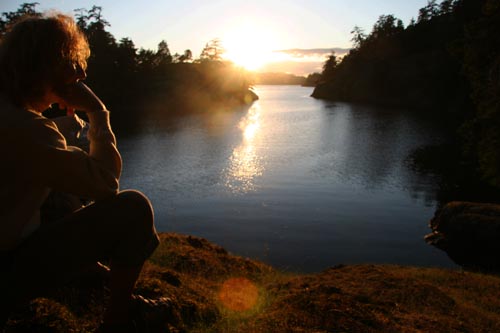
 Jedediah has frequent patches of startling green moss and clusters of yellow wild flowers. It was wonderful to explore this island and see only a handful of people over several days. Thanks to the Palmers’ vision and commitment to conservation, this quiet wilderness sanctuary will never see development . . .and hopefully, oil will never tarnish its shores.

sunset-low-res

June 29, 2010 at 2:28 pm Comment (1)

A bear in the back seat

A ggggrrrrrr in the glove compartment. A bear in bucket seats.  What would you do if momma bear hunkered down in your car’s front seat and decided: Hmmm, this one feels just right?


In my nearby town of Gibsons, BC, Canada, a mother bear recently found herself locked inside a resident’s car. Somehow, she figured out how to open the unlocked vehicle with her teeth and decided to get in for a sniff. Trapped with the door shut, she couldn’t get out but faced another, more serious problem: her cub was left alone outside, terrified.


The mother bear proceeded to tear up the interior of the car, probably frantic in her attempts to get to her cub. The publisher of one of our weeklies, The Local, wrote about the incident: “The bear was gingerly released from the car and joined her cub up the nearest tree.” I am not sure how to interpret that statement, although I can easily picture some cowering driver slowly opening the car door and hiding behind its glass and metal for protection.


I guess squatter’s rights don’t apply here. No one was hurt and the displaced momma was reunited with her treed offspring. However, the same bear apparently entered two other vehicles after this event. That’ll teach the owners to keep their car doors unlocked.


I’ve always been a huge bear fan and have photographed the rare kermode bear and grizzly bears in the wild in British Columbia. A bear has crashed through our wooden fence, knocked out the vertical slats in our gate, taken down our bird feeders, gotten into our garbage, and torn a slit in our soft-top Mazda convertible, but I still love the big critters. They’re so wrongly maligned and misrepresented, especially the grizzly.


Humans need to stay bear aware and follow simple rules:

  • Keep your garbage in bear-safe containers. If your trash contains meat, don’t put it out until the last minute.
  • Pick fruit readily from your trees so that it doesn’t entice bears.
  • Keep your bird feeders high and out of reach of bears. Use feeders only in the winter, when bears are hibernating.
  • Respect bears as smart creatures. Once they’ve discovered a food source, they will return to the same spot for years.


To read and see photos about a truly remarkable bond between a human and bear, click here.

June 22, 2010 at 4:48 pm Comments (0)

A bird in the house: love not tragedy

A rufous hummingbird recently flew through an open window into our house, buzzing around in multi-directions. It wound up beating against an interior window, flying up and down in a vertical line, while giving its characteristic chirp. Wanting  to help without terrifying this wee orange flash of a creature, I slid the window across to create a space for it to escape, but the tiny bird continued its up-and-down motion, flapping its wings against the glass. Its deep red neck told me that it was a male.


At one point, the bird stopped and tucked its body into the bottom of the window frame. I thought it might have died from shock since it appeared completely motionless. Then I noticed its minute eyelids blinking every few seconds. I debated whether to scoop up its fragile form but decided that the resulting scare might kill it. (A birding-expert friend later told me that this would have been fine.)


I ended up grabbing a small rectangle of cardboard and aimed it horizontally towards the bird’s feet. Surprisingly, the little winged being climbed onto the edge of my offering and stayed there. I lifted the cardboard into the air, the hummingbird remained on it, and I quickly put them both out the open window. The now-liberated bird flew off. All of this took about two minutes.


Relieved that the bird was free again, I felt delighted to have shared some inter-species cooperation. I didn’t want to think about the symbolism of a bird in the house, as referenced in Margaret Laurence’s book of short stories A Bird in the House. According to this notable piece of Canadian fiction, having a bird fly into a home means that someone dwelling there will soon die.


I prefer to think of the hummingbird as a symbol of joy, magic, and a loving heart. According to the book Medicine Cards, people have used hummingbird feathers for centuries in making love charms; this bird conjures love and opens the heart. Two decades ago, while in Mexico, I remember a Mexican man giving one of my female companions a dried hummingbird as a love token. We laughed at the time, but I was touched by his gesture.


If you’d like to see a short video of a hummingbird mom and eggs with time-lapse footage of her babies growing up and leaving the nest, click here.

June 4, 2010 at 9:38 am Comments (2)

Carrotmobs: coming to an eco-friendly business near you

food clipart carrot

Does the term “carrotmobs” conjure a riot of raving redheads for you? That’s what it made me think of, especially since I am one of those rare strawberry-locked folks (we’re only four per cent of the population, you know).


But this voice-of-the-veggies phenomenon is no hair-color love fest. No, it’s a citizens’ initiative that began in San Francisco in 2008 and operates on the opposite principle of a boycott. Rather than refuse to patronize a store because of its environmentally destructive business practices, a Carrotmob targets an eco-friendly business and shops there en masse at a designated date and time. This group action encourages consumers to reward stores that have committed to reducing their ecological footprint.

carrot_1


British Columbia’s first Carrotmob action was at Discovery Coffee in Victoria in October 2009. The event tripled the store’s usual sales for the day and has attracted a younger, more eco-aware clientele, according to owner Logan Gray. 


Now Vancouver, BC has launched its first Carrotmob caper for tomorrow, at Salt Spring Coffee on Main Street.  (The swarm site is near Main and 27th Avenue between 11 a.m. to 2 p.m.) Why this business? Omar Mutashar, who founded the Vancouver branch of Carrotmob, says that he interviewed a number of coffee shops on Main Street about the concept and posted video clips on the Internet; online voters chose Salt Spring Coffee as their Carrotmob shop of choice.


Salt Spring Coffee won because it has pledged 110 per cent of its May 16 profits to create more efficient lighting in its store. The progressive company, which started in 1996, uses organic, fair-trade coffee and is striving to become the world’s most sustainable coffee company. Besides the Main Street cafe/store, Salt Spring Coffee has its original shop, the Ganges Cafe, on its namesake island and a kiosk at the BC Ferries terminal in Tsawwassen.


I think that Carrotmobbing is a fun, ingenious way to empower both consumers and businesses. It’s a grassroots action to show stores that their socially responsible practices will reap immediate community benefits and give them a financial edge. I hope to see a lot more Carrotmobs crop up in cities everywhere. Maybe we’ll  have Rhubarbmobs and Tomatomobs too. Here’s hoping . . .


Click here if you’d like to watch a video of a successful Carrotmob event in San Francisco, hosted by the initiative’s founder. As he says, it takes a carrot, not a stick to motivate people to positive action.

normal_carrot_at_rest

May 15, 2010 at 3:17 pm Comment (1)

« Older PostsNewer Posts »