Heather Conn Blogs

spoutin’ about by the sea

Education

Canada and cross-border culture

I recently completed a master’s degree in creative nonfiction writing at Goucher College in Baltimore, Maryland. The program has excellent faculty, including Pulitzer-Prize-winning journalist Tom French, Suzannah Lessard, author of a New York Times bestseller and former New Yorker writer, and Richard Todd, former executive editor of Atlantic Monthly.


Before attending and meeting the faculty, I feared that they might have huge egos and tell pompous, insufferable stories. Boy, was I wrong. The humility and down-to-earth nature of the professors/mentors in this program, not to mention their humor and good will, were an endearing delight. It was a joy to learn with them. As a whole, the faculty all seemed genuinely caring about each student’s project, wanting to nurture it to its best possible form.  


I truly valued the camaraderie and support among the students. The program attracts highly capable and much-published writers, yet no one lorded it over anyone else. We all strived to give our best to our own and each other’s works. I never felt that someone was vying against me; it felt more like having a close-knit group of friends to provide succor and ideas when needed.  


Although we had excellent assigned reading material for the two-year degree program, it was sometimes challenging as a Canadian to read so much U.S.-based writing and hear solely American perspectives. I would have preferred a more multicultural choice of content, with creative nonfiction voices from different countries and continents.


At times, it seemed as if few people knew or cared what writers say or do above the 49th parallel. Sure, I know that all great literature surpasses national boundaries but doesn’t knowing about your neighboring nation help to enrich your views and knowledge of your own country? (Sadly, Canada offers no master’s degree programs devoted solely to creative nonfiction.)


Too often, Canada emerges in American culture as “a country not considered,” to borrow a term from Ken Kesey. Even in U.S. movies, we rarely appear, usually only as an oblique reference. In the celluloid world, we’re that vast, unformed space, the Great White North, where guys on the lam escape to, like a chillier version of Mexico. The impression on screen always seems to be that once any U.S. fugitive crosses into Canada, he or she is as good as gone. No one will ever find ’em up here. It’s all just igloos and melting ice floes, right?


*                     *                  *                      *                           *                       *                      *

The death of literature?

I recently read a book by Canadian writer Don Bailey, which included his experiences as a new writer in Toronto’s literary scene and media world  in the 1970s. I was amazed at the easy access he had to major writers and editors, who seemed to have welcoming, open-door policies for neophytes and lots of time to nurture and network with beginner scribes. That certainly does not appear to be the case now. I wonder if part of the difference now lies in the exponentially higher numbers of  “writers” around. When I shared my thoughts on this topic with a friend, a Canadian author and English professor, he offered these comments:


“[T]he country was smaller then [in the 1970s], so people around writing were more in touch.  Plus there was a spirit that we were all engaged in the same enterprise–the articulation of a country, Canada, and what it might mean (however we defined its people and its issues).  Once the bubble of Canadian nationalism popped, a much more mean-spirited attitude took control which extends to this day: people think about their writing ‘careers,’ which I NEVER heard mentioned when we set out. 


“Academia is only interested in a very narrow band of the spectrum of contemporary literature–besotted with the essentially whacko ideas of the French ‘theorists’ and their disciples, literary academics (or, as some now prefer to regard themselves, “cultural” theorists) are interested in holding forth on only a few non-narrative, non-representational writers. A basic tenet of these critics and their disciples is that most writers are stupid and venal, and only the critics can point out just HOW stupid and venal a writer’s ideas really are.  So an atmosphere of fear and hate settled over the academic study of literature. You’d have to be stupid or venal yourself to love literature, in the prevailing view–the point is not to love it but to point out and denounce its flaws, sins, crimes.  Ditto language itself.


 “So that dead end has taken literary studies out of the equation, except to speak to each other. Its nasty-minded grads find in the outer world that nobody much is interested in their take on literature, so they either drop these concepts or retreat back to the warm womb of some English Department to teach. Thus the beat goes on. I have some faith that this bizarre cycle is coming to an end, but it make take another entire generation to work its way back to a concept of enjoying literature, of seeing language and literature as meaningful rather than misguided.  Your (or Bailey’s) remembrances of the past underscore just how much has been lost.”


A bleak outlook, dontcha think? I’m an idealist and believe that enthusiastic educators can pass on their love of language and literature to  students regardless of prevailing cultural attitudes. Any children who had a parent read aloud to them while growing up already have a foundation in the play of words and joys of story-telling. Nowadays, I wonder: Are blogs killing language and literature?  


 Want to read more of my writing? Check out the Writing link on my main website.

August 30, 2009 at 5:19 pm Comments (0)

Hello world!

 October 30, 2009

Roberts Creek, BC: The chum are running

low-res-spawn-at-bridge

It’s a delight to watch chum salmon running at the mouth of Roberts Creek, which empties into the Pacific Ocean near my home in Canada. Some have swum for thousands of miles to get to this spot on British Columbia’s Sunshine Coast. Some look hardy and dark, ready to forge through the rapids, while others are white and weak with shredded skin, barely flicking their fins.

Two or three will hover in the shallows below the bridge at the centre of the mouth of the creek, while some linger close to shore. Sometimes they’ll splash and surge over each other and skitter off as if they’ve lost their starting position and need to regroup. (Sure, I know that’s anthropomorphism.)

It’s amazing to consider the endurance of these fish and their ability to battle against fierce currents to spawn. Farther up the creek,  on Lower Road about 75 metres from our home, my husband and I will look over the wooden railing of the bridge and watch the chum waiting to go upstream. It often takes a few seconds to spot their usually dark shapes  among the shadows and underwater rocks. It’s fun to see them; I feel like a silent sports fan urging them on.

But overall, the numbers of sockeye salmon in the Pacific ocean and rivers of British Columbia have dropped dramatically. Some blame overfishing, poor regulation of the commercial industry by federal fisheries, salmon farms, and resulting lice and disease in wild salmon spread from farmed salmon. B.C. resident and whale researcher Alexandra Morton has led a fight to stop salmon farming in B.C. and prevent salmon populations from disappearing in the Pacific Northwest. Find out more about her activities in this New York Times article:

http://www.nytimes.com/2008/11/04/science/04prof.html?_r=1

 For a more whimsical, humorous take on a spawning salmon, see my “Sam Mandala” blog post under Creativity.

I’m pleased that this year, pink salmon have returned to nearby Gibsons and Langdale creeks for the first time in many years. A Squamish Nation biologist has said that they likely came from thousands of fry (baby salmon) dumped into Gibsons harbour two years ago. Chapman Creek, part of our watershed, has had the biggest pink salmon run since 1993.


October 24, 2009: International Day of Climate Change

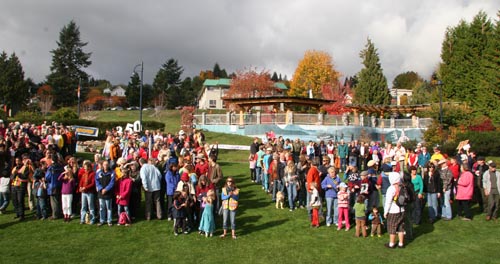
low-res-350-group-shot1

                                                                                                                      — Heather Conn photos

Create a 350 world: Reduce atmospheric carbon dioxide to safe levels


I joined hundreds of others in Gibsons, BC to create a 350 world aerial photo. This was part of a same-day movement around the world, from Nepal to Hungary to the Maldives Islands, where people posed in the formation of “350” for a group photo and pledged their commitment to a “350 lifestyle.” (See www.350.org for great global photos and messages shared from mountaintops, underwater, Antarctica, desert plains, urban rooftops, in front of the White House . . .everywhere!)

The 350 refers to 350 parts per million of carbon dioxide in the atmosphere, which scientists have identified as the safe upper limit for humanity. However, we are already at 388 ppm and rising. As pledge cards stated at the event: “What will it take to turn this lethal trend around and move as quickly as possible to a 350 world?”


low-res-crude-awakening


At the event, participants signed pledge cards that indicated what actions they would take, and how often (from daily to once a month) to reduce their carbon footprint and move towards a 350 lifestyle. This included eight choices from enjoying a Buy Nothing Day to not eating meat and refusing to buy or drink bottled water.

We each signed a pledge card, which read: “I am ready for ambitious, fair and binding global climate policies. I call on world leaders to ensure these are grounded in the latest science and strong enough to get us back to 350.” We chose who we wanted to send this pledge card to: Prime Minister Stephen Harper, B.C. Premier Gordon Campbell, or our local Tory MP, John Weston. I opted to send mine to Harper, who needs to take climate change far more seriously.

The global day of action was a powerful visual gesture to reinforce that we need to lower carbon emissions and make world leaders accountable for the decisions they make, or fail to, regarding climate change.

As an aside, the United Nations recently voted Gibsons, B.C. the most liveable city (with a population of 20,000 or under) in the world due to its policies of sustainability and commitment to green thinking and living.


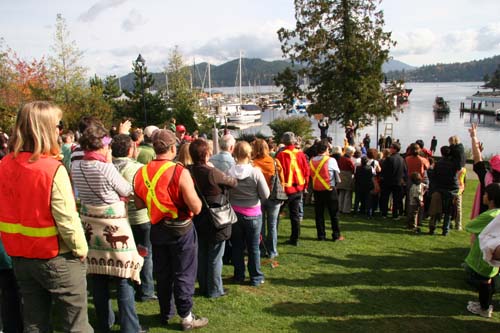
low-res-350-shot-water-view

Gibsons, BC waterfront at Winegarden Park

Sunshine Coast resident Chris Yeske took the 350 Gibsons photos with a remote-controlled camera mounted on a 40-foot mast. To see what his final photos look like, check out these web links:

www.adpov.ca/350org
www.adpov.ca/350org/350org.jpg
www.adpov.ca/350org/littleplanet.jpg
Here’s a link to a photo of yours truly at the event, taken by my photography friend Duane Burnett: http://www.flickr.com/photos/duaneburnett/4040203777/in/set-72157622654231932/
September 22, 2009

img_1999

img_2000

I took the photos above while visiting Sea to Sky Outdoor School for Sustainability Education on Gambier Island near Vancouver on the Pacific northwest coast in British Columbia, Canada. What a fantastic learning environment, full of inspiration, passion and holistic thought. Founder Tim Turner has a wonderfully creative and provocative approach, nudging people out of their familiar mindsets and enthusiastically inviting them to re-examine their relationship to the planet and their community. While listening to his energetic summaries of the school’s work and goals, I kept thinking: Gee, I wish all educational environments were this fun and forward-thinking.

The school caters to elementary and high-school students, mostly from urban environments. Some who visit Sea to Sky have never even been in a rural setting before. The school’s location and backdrop are stunning: the Pacific Ocean, forests of Douglas fir and cedar, and a skyline of mountains. I would love to have attended such a place when I was a student. I hope that it changes the minds and lives of thousands of students who will make life choices as thoughtful guardians of the planet and caring members of their community.

I was visiting the school as part of a team from Sustainability Television (STV), an environmental web portal in Vancouver.  You can watch a short video about the Sea to Sky School on STV’s home page. When you get there, just click “Sea to Sky” in the left-hand column.

*                               *                               *                                *                              *                            * 

Raccoons are not rats

A few weeks ago (Aug. 13, 2009), I wrote a tongue-in-cheek piece about raccoons in The Globe and Mail, Canada’s national newspaper. Here’s the link to the piece (once you’ve opened the link, you have to scroll down until you see the graphic of the raccoon with a rose in its mouth):

http://www.theglobeandmail.com/life/facts-and-arguments/raccoons-this-is-your-warning/article1249899/

After the article appeared, I was surprised at the vehemence of many readers who posted online comments on The Globe’s website. They either described tales of violence against raccoons, or else advocated violence towards these critters, likening them to rats. I was horrified. I don’t see raccoons that way at all. Are people that eager to eliminate something that interferes with their life in a small way? Perhaps my piece gave the wrong impression, but I had hoped that people would realize I was just kidding.


To read some of my published writing on the environment, please check out my website link.

May 29, 2009 at 10:49 am Comments (0)

Newer Posts »