Heather Conn Blogs

spoutin’ about by the sea

Buy local food in B.C.


img_21921
                                                                                                                       — Heather Conn photo

Oh, that lawless lettuce and suberversive zucchini. Those red apple rebels. Did you know that new regulations in British Columbia, Canada strike at the heart of local farming and produce markets? They are taking the small-scale producer out of the province’s food-production system, leaving room for agribusiness and government slaughterhouses to dominate the market. So much for supporting the 100-mile diet.


The B.C. government now requires vendors at farmers’ markets  to submit applications, recipes, and completed lab tests before they can sell their food at market. Essentially, this makes anyone who peddles produce from their garden, whether it’s organic or not, an outlaw.


The province’s Meat Inspection Regulations (MIR), effective since Sept. 30, 2007, stipulate that only meat slaughtered in provincially or federally licensed facilities can be sold for human consumption. In other words, all B.C. farmers who raise cattle, chicken or sheep destined for family dinner tables, and sell such livestock from their property, do so illegally. That’s outrageous.


Even though I don’t support the mass slaughter of animals for human food and don’t eat such meat, I still believe that farmers have a right to sell directly what they produce. I come from several generations of dairy and produce farmers in Ontario. My sister and her husband raised and sold beef cattle in Quebec for years until it no longer remained financially viable.


British Columbia’s regulations have resulted in long-standing, high-quality meat producers in the province losing their farm status and suffering dramatic losses in revenue. Suddenly, their related equipment is useless. One former sheep producer says:


“I had 110 ewes in Langley and maintained 58 ewes in Kelowna since 1999. I sold all my lambs locally and could have sold more if I  had them. 

“In the fall of 2005, I sold off all my sheep as there was no way I could operate under the draconian and ridiculous new meat regulations introduced by our Provincial government. There are no qualifying slaughter houses in our area and it is not economical to transport the lambs to the Fraser Valley.”


The B.C. regulations are supposed to protect consumer health, presumably following the hysteria over mad cow disease and subsequent efforts to prevent the sale of affected meat and cattle. Yet, small, organic framers who raise free-range animals without antibiotics — the more healthy choice for buyers — cannot sell their meat under these new laws.


Today’s eco-savvy consumers want to eat low-stress, humanely treated animals. They want to buy fresh, organic produce from outdoor markets in their neighbourhood. But B.C.’s regulations now ensure that more animals than ever will die in huge slaughterhouses, with animals mixed from different farms. There w ill now be more people handling this meat, risking greater chance of disease transfer. Any meat recalls will now involve tons of meat, rather than the mere pounds that might have resulted from a small-scale producer.


The implementation of the MIR regulations stands in total contradiction to the provincial government’s own policies of climate-change initiatives, green and sustainable communities, and reduced vehicle emissions. This new system demands the transportation of livestock and produce over greater distances and increases concerns over food security.


What happened to those “Buy local” campaigns? A B.C. medical health officer said in a 2005 annual report:


“Buying locally produced food also makes it easier for consumers to trace exactly where their food comes from and how it is produced, improving confidence in the safety of the food system.”


At the federal level, the Codex Alimentarius is an attempt at similar but vastly more far-reaching regulations, which would make local vitamins illegal, for instance. Currently, Codex covers most of the food consumed in Canada; we’re one of 176 countries, including the U.S., under its domain.


In theory, Codex food safety guidelines aim to protect consumers. In reality, they serve to boost the profits of, and further entrench and legitimize, corporate products made by the pharmaceutical, pesticide, biotechnology, and chemical industries. Find out more at www.codexalimentarius.net and www.saveournaturalhealthproducts.ca.


Many thanks to the Farm Food Freedom Fighters on B.C.’s Sunshine Coast for providing the core of this information. One member, an earnest senior, told me that their group had difficulty registering the URL for their website because the web provider thought they were terrorists.


How can you help?

  • Write your local MLA.
  • Write to Premier Gordon Campbell: premier@gov.bc.ca or Room 156, Parliament Buildings, Victoria, V8V 1X4
  • Write to provincial Health Minister Hon. George Abbott: hlth.health@gov.bc.ca
  • Write to federal Health Minister Leona Aglukkaq, minister_ministre@hc-sc.gc.ca 
  • Buy from local farmers at neighbourhood markets.

To find out how people in the U.S. are fighting back against similar regulations, please visit www.healthfreedomusa.org

2188-berries-vertical1

 l

December 5, 2009 at 5:49 pm Comments (0)

No oil tankers on the B.C. coast

Last week, at the University of B.C. in Vancouver, I saw a great multi-media presentation by journalist Andrew Nikiforuk, author of Tar Sands: Dirty Oil and the Future of the Continent, and Ian McAllister, conservation director and co-founder of Pacific Wild. They called their show A Story With Two Ends.


Nikiforuk, a Calgary, AB resident, focused on the Tar Sands project and the global implications of peak oil and Canada’s oil exports. Although Canada is the number-one supplier of oil to the United States, the U.S. is now saying that it doesn’t want our country’s “dirty oil.” Therefore, Canada is targeting China as its next huge market, since “they’re not as picky,” says Nikiforuk.


“The energy ignorance in this country is absolutely profound,” he said while sharing daunting facts about Canada’s “earth-destroying economy”:


  • 100% of the fuel we use in B.C. comes from the Tar Sands
  • the Tar Sands use 20% of Canada’s natural gas
  • the pipeline would increase Tar-Sand production by 40%
  • it takes 12 barrels of freshwater to make one barrel of bitumen, the sticky, tar-like form of petroleum used to create synthetic oil in Canada’s Tar Sands
  • the Tar Sands produces 36 million tons of carbon per year, which forms five per cent of Canada’s total annual carbon emissions
  • 69% of crude oil from Canada to the U.S. goes through an Enbridge pipeline 
  • unlike Norway, Canada has no sovereign fund, leaving it  with a very low percentage of the oil wealth it produces.


The U.S. corporation Enbridge  is lobbying to build 1,200 kilometres of pipeline across northern B.C. from Alberta’s Tar Sands project to Kitimat on the coast. This would end British Columbia’s current moratorium on related tanker traffic and open up a vast, pristine area, including the Great Bear Rainforest, to more than 200 oil tankers a year.


While sharing his stunning photos of grizzly bears, salmon-bearing streams, remote rivers, and wolf families, McAllister told us how the threat of tanker accidents and resulting oil spills would threaten the wildlife and vulnerable ecosystems in north-central B.C. Enbridge’s proposed pipeline would run through the world’s last intact salmon habitat, which includes 1,000 salmon-bearing streams and rivers in British Columbia.


Canada’s Pembina Institute provides a disturbing statistic: In one day, the westbound Enbridge export pipeline would transport almost twice the amount of oil that the Exxon Valdez spilled into Alaska’s Prince Willliam Sound in 1989.


 Canada stands at the crossroads


In this peak-oil era, is that the legacy we want to leave future generations? We cannot afford to let a massive oil spill devastate the land mammals and marine wildlife that depend on B.C. waterways for their habitat and food source.


Through its carbon emissions, Canada’s Tar Sands project not only destroys the environment at home, but harms our global earth atmosphere. It is an unsustainable form of energy production.


“This pipeline would introduce the largest oil tankers in the world to one of the most storm-ridden, dangerous, and difficult-to-navigate coastlines on the planet,” says McAllister. “Canada has a decision to make.  Will it build this pipeline and risk everything: our global reputation, fragile coast and international obligation to combat global warming?  Or will we cancel this pipeline/oil tanker proposal and show the world that Canada is ready to lead by example? 


He adds: “Canada is at a crossroads and the stakes have never been higher.”  


 As alternatives, Nikiforuk recommends a national carbon tax and carbon budget; hard targets for responsible, renewable energy; localized food production; and a sovereign fund that could bring substantial profits to Canada as a result of its  energy production.


To find out more, please visit www.pacificwild.org and www.pembina.org. You can download a copy of the Pembina Institute’s report Pipelines and Salmon in Northern British Columbia: Potential Impacts at www.bc.pembina.org.

Click here to see Nikiforuk’s short overview of the Tar Sands on YouTube.

December 1, 2009 at 4:30 pm Comments (0)

Canada’s Prime Minister no friend of the earth

I think it’s disgusting that until his recent decision to go, Canadian Prime Minister Stephen Harper had no plans to attend this month’s climate change conference in Copenhagen. It’s not surprising, considering he hails from Canada’s petro-province Alberta, home of the Tar Sands project, a major global polluter and carbon-producer. (The Alberta government calls the Tar Sands “the magic sandpile.”) Harper is the son of an Imperial Oil executive. His so-called environment minister, Jim Prentice, also comes from Alberta.


Harper appears to have changed his mind about attending the Copenhagen conference simply because U.S. President Barack Obama is going and because an Angus Reid poll showed that Canadians want him there. He certainly hasn’t made climate change or reducing carbon emissions a priority in our country. Hell, even China has vowed to cut its carbon emissions by up to 45 per cent in the next decade.

December 1, 2009 at 3:49 pm Comments (0)

Hello world!

 October 30, 2009

Roberts Creek, BC: The chum are running

low-res-spawn-at-bridge

It’s a delight to watch chum salmon running at the mouth of Roberts Creek, which empties into the Pacific Ocean near my home in Canada. Some have swum for thousands of miles to get to this spot on British Columbia’s Sunshine Coast. Some look hardy and dark, ready to forge through the rapids, while others are white and weak with shredded skin, barely flicking their fins.

Two or three will hover in the shallows below the bridge at the centre of the mouth of the creek, while some linger close to shore. Sometimes they’ll splash and surge over each other and skitter off as if they’ve lost their starting position and need to regroup. (Sure, I know that’s anthropomorphism.)

It’s amazing to consider the endurance of these fish and their ability to battle against fierce currents to spawn. Farther up the creek,  on Lower Road about 75 metres from our home, my husband and I will look over the wooden railing of the bridge and watch the chum waiting to go upstream. It often takes a few seconds to spot their usually dark shapes  among the shadows and underwater rocks. It’s fun to see them; I feel like a silent sports fan urging them on.

But overall, the numbers of sockeye salmon in the Pacific ocean and rivers of British Columbia have dropped dramatically. Some blame overfishing, poor regulation of the commercial industry by federal fisheries, salmon farms, and resulting lice and disease in wild salmon spread from farmed salmon. B.C. resident and whale researcher Alexandra Morton has led a fight to stop salmon farming in B.C. and prevent salmon populations from disappearing in the Pacific Northwest. Find out more about her activities in this New York Times article:

http://www.nytimes.com/2008/11/04/science/04prof.html?_r=1

 For a more whimsical, humorous take on a spawning salmon, see my “Sam Mandala” blog post under Creativity.

I’m pleased that this year, pink salmon have returned to nearby Gibsons and Langdale creeks for the first time in many years. A Squamish Nation biologist has said that they likely came from thousands of fry (baby salmon) dumped into Gibsons harbour two years ago. Chapman Creek, part of our watershed, has had the biggest pink salmon run since 1993.


October 24, 2009: International Day of Climate Change

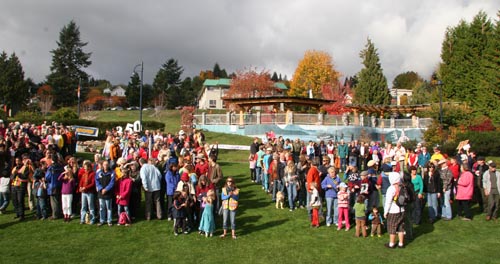
low-res-350-group-shot1

                                                                                                                      — Heather Conn photos

Create a 350 world: Reduce atmospheric carbon dioxide to safe levels


I joined hundreds of others in Gibsons, BC to create a 350 world aerial photo. This was part of a same-day movement around the world, from Nepal to Hungary to the Maldives Islands, where people posed in the formation of “350” for a group photo and pledged their commitment to a “350 lifestyle.” (See www.350.org for great global photos and messages shared from mountaintops, underwater, Antarctica, desert plains, urban rooftops, in front of the White House . . .everywhere!)

The 350 refers to 350 parts per million of carbon dioxide in the atmosphere, which scientists have identified as the safe upper limit for humanity. However, we are already at 388 ppm and rising. As pledge cards stated at the event: “What will it take to turn this lethal trend around and move as quickly as possible to a 350 world?”


low-res-crude-awakening


At the event, participants signed pledge cards that indicated what actions they would take, and how often (from daily to once a month) to reduce their carbon footprint and move towards a 350 lifestyle. This included eight choices from enjoying a Buy Nothing Day to not eating meat and refusing to buy or drink bottled water.

We each signed a pledge card, which read: “I am ready for ambitious, fair and binding global climate policies. I call on world leaders to ensure these are grounded in the latest science and strong enough to get us back to 350.” We chose who we wanted to send this pledge card to: Prime Minister Stephen Harper, B.C. Premier Gordon Campbell, or our local Tory MP, John Weston. I opted to send mine to Harper, who needs to take climate change far more seriously.

The global day of action was a powerful visual gesture to reinforce that we need to lower carbon emissions and make world leaders accountable for the decisions they make, or fail to, regarding climate change.

As an aside, the United Nations recently voted Gibsons, B.C. the most liveable city (with a population of 20,000 or under) in the world due to its policies of sustainability and commitment to green thinking and living.


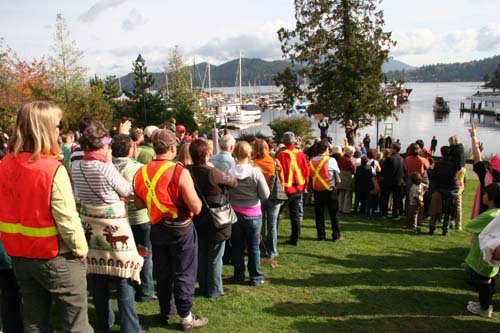
low-res-350-shot-water-view

Gibsons, BC waterfront at Winegarden Park

Sunshine Coast resident Chris Yeske took the 350 Gibsons photos with a remote-controlled camera mounted on a 40-foot mast. To see what his final photos look like, check out these web links:

www.adpov.ca/350org
www.adpov.ca/350org/350org.jpg
www.adpov.ca/350org/littleplanet.jpg
Here’s a link to a photo of yours truly at the event, taken by my photography friend Duane Burnett: http://www.flickr.com/photos/duaneburnett/4040203777/in/set-72157622654231932/
September 22, 2009

img_1999

img_2000

I took the photos above while visiting Sea to Sky Outdoor School for Sustainability Education on Gambier Island near Vancouver on the Pacific northwest coast in British Columbia, Canada. What a fantastic learning environment, full of inspiration, passion and holistic thought. Founder Tim Turner has a wonderfully creative and provocative approach, nudging people out of their familiar mindsets and enthusiastically inviting them to re-examine their relationship to the planet and their community. While listening to his energetic summaries of the school’s work and goals, I kept thinking: Gee, I wish all educational environments were this fun and forward-thinking.

The school caters to elementary and high-school students, mostly from urban environments. Some who visit Sea to Sky have never even been in a rural setting before. The school’s location and backdrop are stunning: the Pacific Ocean, forests of Douglas fir and cedar, and a skyline of mountains. I would love to have attended such a place when I was a student. I hope that it changes the minds and lives of thousands of students who will make life choices as thoughtful guardians of the planet and caring members of their community.

I was visiting the school as part of a team from Sustainability Television (STV), an environmental web portal in Vancouver.  You can watch a short video about the Sea to Sky School on STV’s home page. When you get there, just click “Sea to Sky” in the left-hand column.

*                               *                               *                                *                              *                            * 

Raccoons are not rats

A few weeks ago (Aug. 13, 2009), I wrote a tongue-in-cheek piece about raccoons in The Globe and Mail, Canada’s national newspaper. Here’s the link to the piece (once you’ve opened the link, you have to scroll down until you see the graphic of the raccoon with a rose in its mouth):

http://www.theglobeandmail.com/life/facts-and-arguments/raccoons-this-is-your-warning/article1249899/

After the article appeared, I was surprised at the vehemence of many readers who posted online comments on The Globe’s website. They either described tales of violence against raccoons, or else advocated violence towards these critters, likening them to rats. I was horrified. I don’t see raccoons that way at all. Are people that eager to eliminate something that interferes with their life in a small way? Perhaps my piece gave the wrong impression, but I had hoped that people would realize I was just kidding.


To read some of my published writing on the environment, please check out my website link.

May 29, 2009 at 10:49 am Comments (0)

Newer Posts »