Heather Conn Blogs

spoutin’ about by the sea

Mochrie and Stiles bring new laughs to Vancouver

I saw two of the quickest minds in improv theatre perform this week and they were hilarious. Colin Mochrie and Ryan Stiles, stars of the former TV show Whose Line Is It Anyway?, headlined a sold-out fundraiser at the Vancouver East Cultural Centre on Monday night (Feb. 21). Joining them were local improv actors Gary Jones, of Vancouver TheatreSports, Veena Sood, who trained at Loose Moose Theatre in Calgary, and stand-up comedians Christine Lippa and Denny Williams.

Williams started with a tongue-in-cheek thank you to Charlie Sheen for enabling Stiles to perform; Sheen’s TV show Two and a Half Men, which features Stiles, has been on hiatus while Sheen is in rehab. The evening’s actors, most of whom know each other from decades ago in Vancouver’s stand-up or improv scene, fell easily into teasing banter, repeat gags, and scenes of impromptu irony or outrageousness.

With his trademark dry comments, Mochrie narrated two comic tales from his  life while the others reenacted the events. One was his first kiss,  shared in a closet with a seven-year-old named Heather in Scotland, while playing the game “post office.” Lippa, Williams, and Sood gave that lots of body contact and bawdy innuendo.

The second story followed when Jones asked Mochrie about a time when he thought he was going to die. Mochrie recounted a true experience: while on a passenger jet with his wife and son, an engine malfunction forced an emergency landing. His wife, a nervous flier to start with, took his hand from across the aisle, and said: “I love you,” thinking that this might be the end. In response, Mochrie just shrugged and made a face. (He says now it was because he didn’t think the incident was that serious.)

With jiggly feet and mischievous flair, Williams aptly portrayed Mochrie’s son, who, of course, had to go to the bathroom, while Sood gave a great overly dramatic good-bye as Mochrie’s wife, reaching her arm across the aisle to clutch his hand.

At times, it was hard to hear some of the lines because the audience laughter was so loud. I haven’t laughed so hard so often in a long time. The two-hour show, with a break, included de rigeuer  volunteer participation and yelled-out ideas from the audience. Two young female volunteers, chosen from rows in the front, provided quirky sound effects for a helicopter, chainsaw, and other objects while Jones and Mochrie acted out a woodsy scenario as loggers.

I remember seeing Mochrie and Stiles perform decades ago at Granville Island (or maybe it was The Cultch) when they were part of the Vancouver improv theatre scene. Even then, their facial expressions and quick responses stood out. Williams spoke with obvious fondness of old times at Vancouver’s stand-up venue Punchlines, shared with Stiles. (For trivia lovers, Stiles met his wife at Punchlines; she was a waitress there.)

This week’s one-night-only event was a homecoming, of sorts, for Stiles and Mochrie. (I found out, through quick Internet research, that Stiles lives outside Bellingham, Wa. when he’s not in Hollywood. He’s even opened the Upfront Theatre, a small theatre in Bellingham dedicated to live improv comedy. Kudos to him for providing a new arts venue for local talent.   

All of the performers generously donated their performance time to help out The Cultch. In these harsh days of arts cutbacks, that means a lot. Thanks to The Cultch, whose executive director went to high school with Mochrie, the stellar performers, and everyone else who made Monday night such an uproarious good time.

February 25, 2011 at 8:52 am Comments (0)

Two great films embrace life and death

Last night, three female friends came over to my place to watch the 1971 classic film Harold and Maude. In previous conversation, we had discovered that this movie was an all-time favourite for all of us, so I invited them for a group screening.

What a hoot. As my husband would say, this movie “has legs” even four decades after it was made. It was wonderful to watch this much-loved flick again and savour its irreverence. This movie is a tremendous affirmation to live life to its fullest, follow your heart, and embrace both life and death as an ongoing continuum. Ironically, without my realizing it until later, this informal screening  took place four months to the day that my dad died.

I don’t want to spoil plot specifics for those who haven’t seen it, but the film follows the coming together of a death-obsessed young man and an almost-80-year-old woman who share hilarious antics to the consternation of police, Harold’s wealthy, uptight mother, his shrink, priest, and wacky military uncle. The characters and dialogue are truly delightful. Stars Ruth Gordon and Bud Cort capture the perfect blend of rebellious eccentricity, gutsy imagination, go-for-it spirit, and refusal to conform to mind-numbing routine. They’re great role models for anyone who’s a creative anarchist at heart.

I was surprised at some of the scenes that I had forgotten and relished again; to avoid a spoiler alert, I won’t recount them. Several times, the movie makes a point of mentioning that what Harold and Maude are drinking or eating is “organic”; this was 4o years ago — the mainstream world is just waking up to such choices now.

Director Hal Ashby, who also directed another irreverent classic, Being There, has a cameo in the film as a scruffy, bearded guy in a midway complex. Screenwriter Colin Higgins unfortunately died of AIDS in 1988 at the age of 47. The screenplay for Harold and Maude came out of his MFA screenwriting thesis at UCLA. He also wrote and directed Nine to Five in 1980 and The Best Little Whorehouse in Texas in 1982. Before he died, he set up the Colin Higgins Foundation to further his humanitarian goals.

*                                        *                                        *                                         *                                  *

Another intriguing film that tackles fearlessness towards death is the National Film Board documentary Griefwalker. Made in 2008 by Tim Wilson, it follows the spiritual activist Stephen Jenkinson as he counsels dying people, their loved ones, clinicians, and “people of the cloth” to befriend death, rather than try and avoid or deny it. This Harvard-trained theologian, who canoes, traps animals, and shares a deep reverence for life, death, and the  earth, says there’s “a hole inside most of us and it’s in the approximate shape of a soul.”

The filmmaker felt prompted to explore his own relationship with death after he wound up on life support and almost succumbed to a sudden post-surgery infection. The tone and visual impact of this movie are like a moving Zen koan with captivating nature close-ups and Jenkinson’s wise, inspirational words.

You can watch the film on the National Film Board website. For true Harold and Maude fans, check out the unofficial website full of trivia about the film.

February 3, 2011 at 1:08 pm Comments (0)

From Kenya to the Creek: it takes courage to save a forest

We might not live in Kenya, but we have something in Roberts Creek, BC unique to the world: 1,000-year-old yellow cedars in ancient coastal rainforest that has never been logged. Like Wangari Maathai, founder of Kenya’s Green Belt Movement, we face a challenge to stop logging of these untouched forests on local Crown land.


For more than 30 years, Maathai endured army-led beatings, police harassment, public humiliation, and condemnation as an enemy of her Kenyan government, all because she led a grassroots movement to plant trees in her native land. Founder of Kenya’s Green Belt Movement and 2004 winner of the Nobel Peace Prize, Maathai is inspirational proof of the impact that one courageous and determined woman can have.


Few people would imagine a link between this East African activist, who has saved Kenya’s dwindling forests and launched the planting there of more than three million trees a year, with a logging issue in upper Roberts Creek, BC. But on Dec. 3, about three dozen locals learned of the disturbing parallels between Maathai’s environmental struggle and our own here on the Sunshine Coast.


We watched the documentary Taking Root — the Vision of Wangari Maathai, thanks to the Green Team at Gibsons United Church. This excellent, award-winning film by Lisa Merton and Alan Dater highlights how Maathai’s efforts to teach Kenyan village women to plant trees grew into a nation-wide force to save the environment, defend democracy, and protect human rights.


In the film, Maathai recalls growing up amidst lush forest and mountains (sound familiar?), where a beloved “spirit tree” nearby, centuries old, is logged. Both the forest and the stream, where Maathai played as a kid, disappear. Decades later, when Kenya’s corrupt president Daniel Arap Moi decides to build a glossy skyscraper and four-storey statue of himself in Nairobi’s only park, Maathai and dozens of women, including many grandmothers, launch a hunger strike and sit-in at the park to prevent destruction of the area’s forest. Democracy activists join them, and soon the military move in with their batons, beating defenceless women.


We see Moi’s public shaming of Maathai and his legacy of brutal rule in a country where the average income is a dollar a day. We discover how the profits from sales of timber, logged on Kenya’s Crown land, go to his political cronies. Maathai and other women confront the loggers to prevent the cutting of forests, and again, Moi calls in soldiers to beat and disperse the group. Eventually, after 24 years in power in a country where he outlawed opposition, Moi leaves the presidency in 2004. In Maathai’s words: “It is the people who  must save the environment. It is the people who must make their leaders change. And we cannot be intimidated.”


By then, some of the same soldiers who had once challenged and beaten Maathai and her supporters are now planting trees on military property. As one soldier says, he sees these seedlings as brothers: the trees protect the environment, while the soldiers protect the people. Maathai, the first woman in East Africa to receive a PhD, becomes Kenya’s deputy minister of the environment. (Maathai’s success and Green Belt movement are cited as sources of tremendous hope in Hope’s Edge, written by Frances Moore Lappe and her daughter Anna. Click here to read my review of the book, published in Alive magazine.)


After the film screening, local activist Hans Penner explained how a British colonial system in both Kenya and our own province adopted the same practices and policies: exploit forests as much as possible for profit, ignore traditional, indigenous uses of the land, and don’t acknowledge the negative impact of logging on groundwater and watersheds. 


BC Timber Sales will soon be advertising to sell off chunks of our rare old-growth trees — 1,000-year-old yellow cedars — on Crown land in upper Roberts Creek to private bidders. They have slated three cutblocks on 44 hectares (109 acres) on Mount Elphinstone; in one of these areas, at least 30 families get their water. This never-logged area stands at about 900 metres (3,000 feet) altitude. Two of the cutblocks are within only about a kilometre of the road access to Dakota Ridge ski area.


“A thousand-year-old tree is a real treasure,” said Penner. “The forest that’s there is an irreplaceable heritage. There’s nothing like it on the planet. In this upper-elevation forest, there’s never been a forest there, it’s never been logged. The forest has been living since the last ice age.” He noted that most people have never even seen a forest like this one, which has no stumps.


Sometimes, forestry companies consider ancient trees a hazard and cut them down without even using the wood, said Penner. “They’re mowing the forest right down to the ground,” he told us.


When he and local Ross Muirhead recently snowshoed through two of the proposed cutblocks, they flagged 30 cedar trees, 300 to 400 years old, deemed “culturally modified” because local First Nations people have used their bark as part of their customs and heritage.


“We’re the closest people in the world to this,” said Penner. “We have a special responsibility. “We’re like witnesses to a crime, where we’re standing there.”


Who will take action and who will remain a silent bystander? Penner recommends writing to the following people in government: B.C.’s forestry deputy minister Dana Hayden forests.deputyministersoffice@gov.bc.ca, who has the authority to stop the timber sale ads, B.C. Minister of Forests Pat Bell (pat.bell.mla@leg.bc.ca), and Don Hudson at BC Timber Sales (don.hudson@gov.bc.ca).

You can also contact the deputy minister to the premier, Allan Sekel.  His phone number is 250-356-2209. The government website does not include his email address — how’s that for open government? — but his address is P.O. Box 9041, Stn. Prov. Gov’t, Victoria, BC V8W 9E1.


If you’re on Facebook, you can join the group Elphinstone Logging Focus and/or contact our MLA Nicholas Simons on Facebook. Nicholas is also available at 250-387-3655 or Nicholas.Simons.MLA@leg.bc.ca. For more information about this issue, you can call Ross Muirhead at 604-740-5654 or Hans Penner at 604-885-5730.

December 5, 2010 at 1:18 pm Comments (0)

Youth doc ReGENERATION fell short for me

At the recent Vancouver International Film Festival (VIFF), I saw the documentary ReGENERATION, about activism in today’s youth generation, and how to change apathy to hope.

I must have had high expectations for the film because it disappointed me. Sure, it had interviews with Amy Goodman, co-founder of Democracy Now, Vancouver’s Kalle Lasn, who started Adbusters, Noam Chomsky, and the late Howard Zinn, who wrote A People’s History of the United States. It emphasized the power of hope and how an individual’s choices and actions affect consumerism, the environment, media, and so on.

The film conveyed that we’re victims of mass media, “technological dependence, rampant materialism and the increasingly fractured relationship with the natural world,” as the VIFF program stated. I don’t disagree with any of that. But the film did not cover the Internet as a tool of empowerment and education, linking people around the globe and regionally in activism, awareness, and communication in ways not remotely possible decades ago.

I think of groups like Avaaz.org, who have used the Internet to remarkable advantage to educate thousands, if not millions, about sociopolitical issues around the world. Their online petitions have altered events and galvanized movements to stop destructive actions from environmental devastation to the sexual exploitation of children. The Internet has connected people to organize demonstrations and educational workshops on short notice with impressive results.

When I brought up this point in the question period after the film, director Phillip Montgomery dismissed my remarks, saying that he didn’t think that social media was the answer and it didn’t have the same powerful impact as a demonstration. I wasn’t talking about Facebook and Twitter. Sure, there is a lot of online crap out there, but I still think that activists and nonprofits can use the Internet to great advantage, whether through videos, blogs, or sending out info about an upcoming protest. Someone like filmmaker Velcrow Ripper certainly does.

I am happy that a film like ReGENERATION is out there to serve as a rallying cry, but it didn’t have the same inspiration and impact for me that a movie like The Corporation did. That is largely due to its story structure. It tries to cover too many areas without a clear presentation of distinct messages. For me, the last few minutes of the film, in which a female high school valedictorian speaks of the need for hope to her classmates, had the biggest punch. The doc needed more moments like that with an emotional edge.

Overall, the movie needed a list of simple, declarative statements, an informal manifesto, if you will, to anchor its message. It gave value solely to external action, not addressing how individuals can transform themselves and the world through deep inner, spiritual work. Look at Gandhi and Martin Luther King Jr. — that was a core element of their activism and look what global influence they had.

October 21, 2010 at 7:56 am Comments (0)

Conviction Kitchen: a peek inside a TV shoot

A friend of mine, who’s working on the reality show Conviction Kitchen in Vancouver, invited my husband and me to a free “friends and relatives” dinner on location last week. All we had to do was pay for our drinks, tip our servers, and be willing to be interviewed on camera, if we desired.


Gee, I couldn’t turn down a free meal and a chance for more exposure. Although I had never heard of the show, I was immediately curious. The premise of Conviction Kitchen, which will air its second season this fall on Sunday nights on CityTV, is that 24 previous convicts get a second chance. (The first season shot in Toronto.)


The show is the brainchild of business partners and chefs Marc Thuet and Biana Zorich. Thuet, a fourth-generation chef, overcame a troubled youth to cook at top kitchens around the world. He spent three years learning from Anton Mosimann, official caterer to His Royal Highness, the Prince of Wales (Prince Charles).


Upon arrival at Delilah’s Restaurant in Vancouver’ s West End, where the show is shot, my husband and I signed a waiver, then waited on the sidewalk to enter. Delilah’s has been a popular spot in the city for years among local film industry types. Its plush interior, hand-painted low ceiling, and rich paint tones evoke the atmosphere of a classy speakeasy.


When we walked in around 7:30 p.m., the stools at the martini bar were full of people immersed in laughter and animated talk. Seated at a table for two, my husband and I watched a twenty-something camera operator and sound man move around the room, extending a boom mike over tables and following the maitre d’ as she interacted with guests.


At one point, a young man strode purposefully through the restaurant and headed for the kitchen, quipping “F—k her” as he passed our table. I figured that this sudden drama was a pre-planned wrench into the evening, gauged to get customer reaction. But people seemed barely to notice. My friend told me later that this was someone genuinely irate who  arrived unanounced at Delilah’s. He wanted to receive payment for previous training or some such.


Our waitress had blue-streaked hair, which I complimented, and offered the table trick of lighting a match inside a folded match cover with one hand, which impressed me. We had the fixed friends-and-relatives menu: a mixed salad (with canned rather than fresh beets, my husband noted), excellent salmon with an aioli sauce, and delicious cherry pie.


Later, I was asked on-camera what I thought of the evening and the unscripted incident. I replied that it added gritty reality to the night and I preferred it to someone remaining prim and proper. Overall, it was a fun night, even though the film folks seemed disappointed that we didn’t have complaints about the food or activities. They need conflict to make good drama, right?

July 27, 2010 at 9:56 am Comments (0)

There’s no need to fear: Underdog is here


Inexplicably, I recently woke up thinking about two animated TVcharacters from my childhood cartoon-watching days: the superhero Underdog, and Mr. Peabody from Rocky and Bullwinkle. I loved both of these characters since they were quirky and endearing rather than macho and all-powerful. I was even delighted to find an Underdog key chain decades later  at a Value Village in Bellingham, WA. I had forgotten all about that humble hero. (I’m talking about the original Underdog from the 1960s, not the more recent Walt Disney version.)


Maybe the child writer in me enjoyed Underdog’s language, which was always in rhyme like “There’s no need to fear — Underdog is here.” Wally Cox, who later spent years providing quizzical humor on Hollywood Squares, did the voice for Underdog and his alter ego, Shoeshine Boy (I don’t remember anything about that character.)


A quick check on Wikipedia just gave me some Underdog info. Apparently,  he used to crash into walls and so on, which I don’t recall at all. At such times, he would say: “I am a hero who never fails/I cannot be bothered with such details.” The young rebel in me must have relished this attitude. His superpowers, which changed per episode, varied from x-ray vision and atomizing eyes (?) to super breath. Anyone who’s smelled a real dog’s breath would realize what a stretch that last one is.


I had no idea that Underdog was created by ad agency reps to sell cereal for television advertiser General Mills. Gee, my wee eyes were unknowing pawns to their product shilling. Having always been a dog lover, I naturally gravitated to this canine character. However, I did also enjoy Felix the Cat and his bag of tricks. (There’s no surprise where his name came from: Felis catus is  the Latin term for house cat.)


That brings me to some TV trivia: did you know that RCA began experimental television transmissions from New York in 1928, using a 13-inch, paper mache Felix the Cat figure? Rather than pay an actor to stand under hot studio lights while engineers sharpened and tweaked the image, they used Felix, who worked for a one-time fee. (I’m surprised the paper didn’t burn.) They put the black-and-white figure on a turntable and tried broadasting using a mechanical scanning disk and electronic kinescope receiver. These early “broadcasts” usually involved objects, test patterns or photographs; the image received was only two inches tall. Felix stayed on his turntable post for almost a decade while engineers tried to create a high-definition picture. (I got this info from www.felixthecat.com.)


As for Underdog, his last run was with NBC in the mid-1970s. By then, the network censored all references to him swallowing the energy pill that gave him his superpowers. They probably feared lawsuits if kids saw real medication that looked like the Underdog pills (red with a white “U”) and swallowed them. I’m too cynical to think that they genuinely cared about children’s health and well-being.

May 6, 2010 at 6:51 am Comments (0)

Tasers are not toys

I was astounded to learn recently, via a U.S. television documentary, that high-powered tasers for domestic use are available online from United States outlets. Such use is legal in that country, even though the voltage available is double what is legal for police use in Canada. (I’ll look up the figures later; don’t have time right now.) What’s more, the taser manufacturers are targeting women and have made taser models in various pastel colors with a smooth, sleek design that makes them look more like a hygiene or styling device, not a killing weapon.  That’s sick.


In the last week, I saw yet another TV commercial promoting the ridiculous reality show with Gene Simmons and his family. Can’t even remember the name of the program and don’t want to know. Anyway, the episode they were previewing showed Simmons’ wife hosting the equivalent of a Tupperware party at home; however, the new product that she and her tipsy friends were sampling was not some innocuous kitchen container, but . . .tasers. Unbelievable! These middle-aged women, all drunk, were zapping each other with tasers for kicks. Wow, what entertainment.


Meanwhile, according to the same documentary that I mentioned, cops in the U.S. now have access to tasers that shoot from a rifle-style gun and have a range of 1,000 feet.


Tasers are a touchy subject (pardon the pun) here in British Columbia and Canada, after four police officers tasered Polish citizen Robert Dziekanski numerous times at the Vancouver International Airport in October 2007. The unarmed man, agitated because he had waited many hours for his mother to arrive and no one could understand his language, later died as a result of  the volts he received.

April 28, 2010 at 9:05 am Comments (0)

Vietnam’s Friendship Village: Peace heals the wounds of war

This week, I felt inspired by The Friendship Village, a powerful film of peace and compassion, written, directed and produced by Vancouver, B.C.-based documentary filmmaker Michelle Mason. She told a small crowd at the Sunshine Coast Arts Centre in Sechelt, BC how early, gruesome images of the Rwanda massacre, which she saw while doing a journalism internship at the Canadian Broadcasting Corporation news bureau in London, Eng., completely altered her career goals and life direction.


“I didn’t want to be a bystander,” she said. “I didn’t want to bear witness. I wanted to show stories about people who stand up for things they believe in.”


It took different wars to catalyze their unique visions of peace, compassion, and committed action, but shared heartfelt goals brought Mason and the late George Mizo together in her poignant film The Friendship Village. The 2002 documentary reveals how Mizo, a former artillery sergeant in the Vietnam War, became an ardent peace activist, suffered through the effects of Agent Orange, and ultimately founded a school, clinic, and housing  in Vietnam  — The Friendship Village — for children and war vets in that country who had illnesses or deformities resulting from Agent Orange.


 “Those of us who have seen firsthand that horror called war know how fragile life is, and how precious life is, and know that war is not the answer but part of the problem,” Mizo said during the opening ceremony of The Friendship Village in 1998.


The village, built in a former rice paddy 11 kilometres from Hanoi, provides medical care, education, meals, and rehabilitation for 120 children. The centre offers pediatric service for outpatients and Vietnamese war vets can stay for up to six months. A recent addition is a new building to address the needs of children with severe handicaps. The village has an organic vegetable and medicinal herb garden, water treatment facility, fish ponds, and fruit trees. The goal is to make the centre completely self-sufficient.


Mizo was one of four Vietnam vets who protested the war by waging a 47-day hunger strike, which prompted hundreds of supporters to join them. He received 10,000 letters a day.


It was difficult to see and hear the impact that the U.S. spraying of 72 million litres of Agent Orange (made by Monsanto, by the way) during the Vietnam War has had on generations of veterans and children. Babies with enlarged heads, the result of hydrocephalus. Children with twisted or missing limbs. Vietnamese war vets with horrible rashes and giant, pimple-like growths all over their chest.  


Mizo’s own immune system was hugely compromised by Agent Orange, rendering him vulnerable to any infection. His symptoms began with a fever, rash, and delerium. He had two heart attacks and suffered constant joint pain. The U.S. denied him medical coverage as a war veteran because of his high-profile peace activism.


“I was told it [Agent Orange] was mosquite repellent. Don’t worry about it,” Mizo says in the film.


The film states that more than one million children in Vietnam have been born with birth defects as a result of Agent Orange. Experts expect that it will take between 500 and 600 years for the dioxin from this deadly herbicide to dissipate in Vietnam. One remote village on the Ho Chi Minh trail, which received some of the heaviest spraying, is considered one of the most toxic places on the planet due to the high levels of dioxin that remain in the area’s soil.


One of the most moving parts of the film for me was learning of the friendship and reconciliation between Mizo and Vietnamese General Tra Van Quang. The four-star general became Mizo’s ally in fund-raising efforts for The Friendship Centre. Decades earlier, during the Vietnam war, the same general led the attack on Que Son (also spelled KheSan) that wiped out all of Mizo’s platoon. Mizo was the sole survivor of his unit simply because he had been previously air-lifted out following his wounding in battle.


Mizo received the Vietnamese Peace Medal. General Van Quang told Mizo’s son Michael: “Never go to war.”


Mason says that it took a year to convince Mizo to be the subject of her film, since he is such a private person. But since he knew that he wasn’t going to live long (he died the same year that the film came out), he wanted to share his message with a larger audience.


“Hope is an illusion,” he says in the film. “You have to actively work it.”


An international body of eight support groups raises funds for The FriendshipVillage through grassroots efforts. Carol Stewart, a Sunshine Coast resident who hosted the film screening and Mason’s appearance, has represented Canada on the village’s committee.


As Mizo says in the film with characteristic humility: “We can make a difference in life.”


For more information on this project that heals the wounds of war, see The Friendship Village.

*                                             *                                        *                                    *                                      *

Mason’s movie The Friendship Village reminded me of another compelling documentary that responds to war with a message of peace and forgiveness. In Regret to Inform, director, writer, producer Barbara Sonneborn sets out to return to the same valley in Vietnam where her husband was killed 20 years earlier. A female Vietnamese, a former war leader in the same region where the filmmaker’s husband died, shows Sonneborn where his unit was located. The filmmaker wonders aloud if the military command of this same woman could have resulted in her husband’s death.


Rather than focus on recrimination and bitterness, Regret to Inform interviews war widows from both the U.S. and Vietnam and reinforces a message of peace. It is a moving personal account narrated and shot with poetic lyricism. Even though this was her first film, Sonneborn appears to draw on her expertise as a set designer; the film’s rich visual appeal seems more a result of magic realism than mere cinematography. The documentary’s poetic sensitivity makes it feel far more like an in-depth read of a wrenching journal rather than a detached journalistic account. I can’t remotely  imagine the pain that Sonneborn experienced when she received in the mail a tape cassette sent by her husband from the field, in which he speaks to her with love and candor. It arrived days after she received the knock on her door, at age 24, and learned that he was dead.

April 18, 2010 at 12:05 pm Comment (1)

Mary Walsh is right

With a horned Viking hat, fake metal armour and scads of improv confrontation, actor/comedian Mary Walsh has challenged and discomfited some of Canada’s top politicians. Beyond her satirical Viking role as Marg Delahunty on CBC Television’s This Hour Has 22 Minutes (a show that Walsh created), she recently lashed out at the federal government for its indifference to child poverty.


If senior government had made the same financial commitment to abolish child poverty as it did to Olympic athletes, Canada would be a far different country, Walsh told the March 8 annual general meeting of the B.C. Teachers’ Federation at the Hyatt Hotel in Vancouver.


“We got the most gold ever won by a host country and they say that cost about $4.2 million per medal,” the keynote speaker said of Canada’s 14-gold-medal achievement. Walsh charged the federal government with failing to fulfill its commitment made decades ago to eliminate child poverty by 2000.


“If they had thrown money at that then, I think we could be looking at a different country today,” she said.


For the past six years, British Columbia has had the highest child poverty rate in Canada, with a shocking rate of 18.8 per cent in 2007, the last available annual measurement. Pitted against the $58.8 million spent to earn Canada’s gold medals, what does this say about our national priorities?!

March 14, 2010 at 6:33 pm Comment (1)

Colbert to Canadians: “I take it all back”

colbert-on-moose-low-res
                                                                                                                       — Heather Conn photos

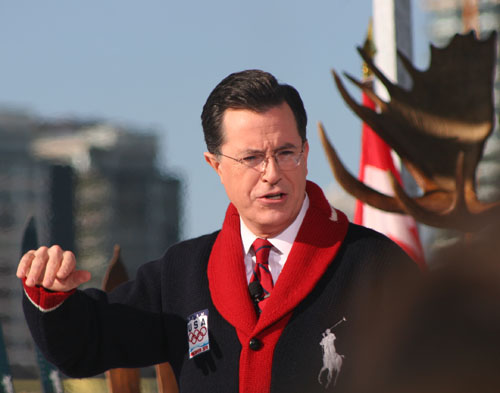
Stephen Colbert looked right at home sitting on a taxidermied moose, under a spray of fake white snow, waving a large Canadian flag. The crowd of about 6,000, gathered Feb. 18 at Vancouver’s Creekside Park to watch an outdoor taping of the Comedy Central show Colbert Report, made him do it. Sortof. A repeated chant of “Get on the moose” prompted the improv-loving comedian to give up metaphorically his bald-eagle mount, an image on the stage’s banner backdrop, and hop on the hoofed Canadian icon instead.

“If anything happens to me, it’ll be your fault,” he quipped to the audience packed around the stage, safely behind barriers.

low-res-flag-and-moose1

Colbert, in Vancouver to provide offbeat Olympic coverage and support the U.S. men’s speed skaters, clearly loved that Canadians can take a joke. After having called them “syrup-sucking iceholes” on his show, he confessed: “I take it all back.” He joked about needing an English-English dictionary to understand Canadian terms like “riding” for a political district. His stage manager and crew wore white T-shirts with a red maple leaf emblem that read on the front: “Icehole Crew.” The back of the shirt said: “Colbert Nation eh!”

colbert-close-up-low-res

(Colbert was reportedly delighted to receive a case of Iceholes Celebration lager beer, inspired by his Canuck putdown and specially brewed byVancouver’s R & B Brewing Company. R & B co-owner Barry Benson says on the company website: ” In celebration of our icehole-ish behaviour we have decided to get even rather than get mad.”)

brass-band-low-res

Before appearing, Colbert invited the Dutch oom-pah-pah group Klein pils onstage to warm up the fans with jovial, brass-band versions of songs from The Turtles’ Happy Together to Sweet Caroline, We Will Rock You, and Michael Rowed the Boat Ashore. He had discovered the boisterous musicians the night before while they performed rinkside at the Richmond Oval.

gold-medalllist-low-res

Colbert’s guests included Seth Wescott, two-time gold medal winner in snowboard cross, who picked up his latest gold this week in Olympic competition at Cypress Mountain. After Colbert asked to wear Westcott’s medal, he refused to give it back to the athlete, despite urgings to do so from the fans. Wescott, in turn, gave his host a team plaid jacket and autographed a specially made snowboard that bore Colbert’s image. (Colbert wore a navy Ralph Lauren cardigan and white 2010 track pants for the show, a nod to the designer of U.S. team uniforms in this year’s Winter Olympics.)

colbert-in-jacket

After his vocal support for the U.S. Olympic speed skaters and his team fundraising drive which brought in about $300,000 from fans, one would have expected Colbert to interview Shani Davis, who has appeared on his show in a satirical speed-skating challenge. But Davis was apparently offended by some of Colbert’s previous remarks and was not a guest. Colbert played a taped segment of his show onstage, which included a public apology to Davis. (That same day, Davis won a gold medal in the 1,000-metre men’s speed-skating in Richmond.)

aerialist-low-res
                                                                                                         Ryan St. Onge

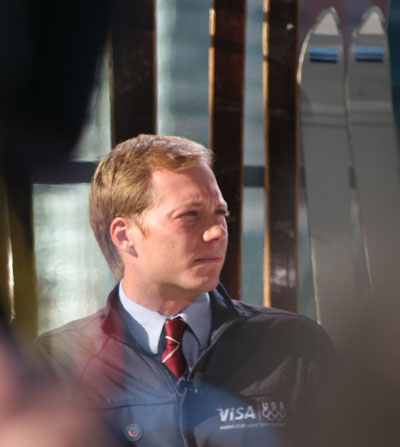
Other Olympic guests included U.S. freestyle aerialists Ryan St. Onge and Jeret “Speedy” Peterson. While Colbert teased St. Onge, who appeared shy in a conservative shirt and tie, about his name, Peterson appeared to hold his own with Colbert. When asked about getting kicked out of the  2006 Olympics in Turin, Italy for a drunken altercation, Peterson admitted his actions and told his host: “Sorry to steal your thunder.”

athlete-low-res
                                                                      Jeret Peterson

As if for required Canadian content, Colbert interviewed the Honourable Ujjal Dosanjh, Liberal Member of Parliament for Vancouver South. He teasingly asked Dosanjh what caste he was from and repeatedly mentioned India’s caste system. Dosanjh said that he didn’t believe in the caste system and stressed the equality of all. Yet, when Colbert continued trying to pin down the ultra-serious federal politician on this subject, Dosanjh appeared taken aback and possibly offended. I wondered if he even knew that such stances are part of Colbert’s shtick and on-camera persona.  

ujal-low-res

This show was the last of a two-day taping for Colbert at the park. Fans had waited since dawn for the 10:15 start time. I arrived at 7:45 a.m., joining a long line of people waiting patiently in front of Science World. A friendly female parks ranger warned us that the park had four inches of mud in places and was very slippery. She urged people not to run on the grass to avoid injury.  

colbert-with-skis-low-res

Yet, once the orderly queues received permission to move towards the stage,
 hundreds started running up the hill and charging through the mud. In such a free-for-all, someone who had arrived five minutes earlier could easily have gotten a much better viewing spot than someone who camped out overnight in wait. I ended up to the right of the stage close to the front.

colbert-crowd-low-res1

Following these fun shoots, Colbert toured a variety of Olympic pavilions in Vancouver, doing his usual campy and impromptu repartee, besides serving as an on-air NBC commentator and the U.S. speed-skating team’s assistant sports psychologist.

colbert-banner-low-res

Stephen Colbert will certainly never make the podium as an Olympic gold medalist, as portrayed on this banner made by a fan, but he has made phenomenal strides in bringing Canadian and U.S. psyches and spirits together through laughter. Maybe he deserves to keep Seth Westcott’s medal after all.

colbert-cheering-low-res1

Click here if you’d like to know more about my past film and TV writing.

February 21, 2010 at 2:03 pm Comments (11)

Newer Posts »