Heather Conn Blogs

spoutin’ about by the sea

Youth doc ReGENERATION fell short for me

At the recent Vancouver International Film Festival (VIFF), I saw the documentary ReGENERATION, about activism in today’s youth generation, and how to change apathy to hope.

I must have had high expectations for the film because it disappointed me. Sure, it had interviews with Amy Goodman, co-founder of Democracy Now, Vancouver’s Kalle Lasn, who started Adbusters, Noam Chomsky, and the late Howard Zinn, who wrote A People’s History of the United States. It emphasized the power of hope and how an individual’s choices and actions affect consumerism, the environment, media, and so on.

The film conveyed that we’re victims of mass media, “technological dependence, rampant materialism and the increasingly fractured relationship with the natural world,” as the VIFF program stated. I don’t disagree with any of that. But the film did not cover the Internet as a tool of empowerment and education, linking people around the globe and regionally in activism, awareness, and communication in ways not remotely possible decades ago.

I think of groups like Avaaz.org, who have used the Internet to remarkable advantage to educate thousands, if not millions, about sociopolitical issues around the world. Their online petitions have altered events and galvanized movements to stop destructive actions from environmental devastation to the sexual exploitation of children. The Internet has connected people to organize demonstrations and educational workshops on short notice with impressive results.

When I brought up this point in the question period after the film, director Phillip Montgomery dismissed my remarks, saying that he didn’t think that social media was the answer and it didn’t have the same powerful impact as a demonstration. I wasn’t talking about Facebook and Twitter. Sure, there is a lot of online crap out there, but I still think that activists and nonprofits can use the Internet to great advantage, whether through videos, blogs, or sending out info about an upcoming protest. Someone like filmmaker Velcrow Ripper certainly does.

I am happy that a film like ReGENERATION is out there to serve as a rallying cry, but it didn’t have the same inspiration and impact for me that a movie like The Corporation did. That is largely due to its story structure. It tries to cover too many areas without a clear presentation of distinct messages. For me, the last few minutes of the film, in which a female high school valedictorian speaks of the need for hope to her classmates, had the biggest punch. The doc needed more moments like that with an emotional edge.

Overall, the movie needed a list of simple, declarative statements, an informal manifesto, if you will, to anchor its message. It gave value solely to external action, not addressing how individuals can transform themselves and the world through deep inner, spiritual work. Look at Gandhi and Martin Luther King Jr. — that was a core element of their activism and look what global influence they had.

October 21, 2010 at 7:56 am Comments (0)

Quarotchety for Canada’s Governor-General

Mike Klassen, columnist for the Vancouver, BC tabloid 24 Hours, suggests that the 2010 Olympics mascot Quatchi should be Canada’s next Governor-General. Since the GG role is primarily for ceremonial purposes, he reasons that a stuffed toy could do just as well as a human. Besides, he adds, with Quatchi in place at the official GG residence, Rideau Hall, the Canadian government could turn it into a Disneyland-like attraction with theme rides based on the Olympic mascots. (Stephen Harper would be fighting to get into “It’s a small world.” He’s made being prime minister into enough of a game, he doesn’t need the rivalry.)


But I think that Quarochety, Quatchi’s twin sister (see my earlier posts), would make a far more effective Governor-General. First, she’s female, like our excellent Michaelle Jean, and unlike her shy brother, she’s not afraid to speak her mind. She’d make a great advocate for Canada and her ever-present smile would make the perfect addition at official functions.


Quite simply, Quarotchety will be around to take on the GG responsibilities; her brother Quatchi won’t. Quatchi and his fellow mascots, Sumi and Miga, were recently on death row, thanks to VANOC. The city’s Olympic organizing committee has essentially murdered its three innocent mascots as per IOC rules; symbols of Vancouver’s 2010 Olympic games aren’t allowed to exist. That’s life in today’s harsh, commercial world: one minute you’re a global media darling, the next you’re a targeted pariah slated for death.


I’m shedding no tears for this loss of corporate Olympic symbols, even though it might cause some grief for poor Quarotchety to lose her twin brother. My vote’s for you for GG, Quarotchety.

May 13, 2010 at 12:54 pm Comments (0)

Torts and retorts: a climate scientist strikes back

 A current lawsuit against Canada’s National Post newspaper and its publisher, editors, and three writers could have huge ramifications for both social media and online dissemination of news.


Andrew Weaver, a respected climate scientist and one of the world’s top climate modellers,  has sued the National Post  and related parties for “a series of unjustified libels based on grossly irresponsible falsehoods that have gone viral on the Internet.” (The suit includes both hard-copy content and information that appeared on the Post’s four related Internet sites, produced by Canwest Publishing. It acknowledges that electronic versions of the same content can appear in 11 different Canwest publications across Canada, which it names. These range from the Vancouver Sun and Province to the Montreal Gazette. The suit also names five electronic databases).


Weaver is a professor and Canada research chair  in climate modelling and analysis in the School of Earth and Ocean Sciences at the University of Victoria. He launched the suit this week (April 20) in the Supreme Court of B.C. via McConchie Law Corporation of North Vancouver.


Weaver’s 48-page statement of claim identifies a pattern by the conservative Post of reporting incorrect and critical material about him and refusing to provide corrections or retractions when he brought these to the paper’s attention. For example, the Post alleged that Weaver had, or was going to, quit his Nobel-winning role in the Intergovernmental Panel on Climate Change. He emphatically dismissed this as false.


I’m sure that the Post and others will scream “freedom of the press” on this issue, but that is a mere smokescreen. This matter addresses the widespread damage that “false, malicious and defamatory” words can make once they appear in multiple places on the Internet.


The suit includes numerous citations, including an article called “Weaver’s web” that identified the client scientist as “Canada’s warmist spinner-in-chief” and “climate alarmist.”  The piece said that Weaver “appears not to understand what solar climate theory actually involves” , makes “distinctly dodgy arguments” and ignores scientific skepticism. The suit charges, among many things, that the related media content suggested that Weaver “engages in willful manipulation and distortion of scientific data for the purpose of deceiving the public in order to promote a political agenda.”


If Weaver’s suit is successful, it will have a monumental impact on both online media and anyone who adds comments to an Internet forum. This will result from two elements contained within his suit. First, Weaver cites reader comments on the Post’s website as libellous.  He also asks for a court order, unprecedented in Canada, that requires the National Post  to find and remove its defamatory articles from the many other Internet sites where they were reposted.


Kudos to Weaver for having the guts to take on the global warming debunkers and put some legal punch behind his reputation to ensure that lies in print do not stand as truth. His suit has launched what could be a precedent-setting case in determining how media outlets disseminate news and public comment on the Internet. However, it’s notoriously difficult to make libel cases stick. Weaver will undoubtedly face a remarkable challenge in the process and the case could hang around for years. Regardless, he earns my praise.

For more information on this issue, please visit www.desmogblog.com, a site dedicated to “clearing the PR pollution that clouds climate science.”

April 24, 2010 at 8:33 pm Comments (0)

Mary Walsh is right

With a horned Viking hat, fake metal armour and scads of improv confrontation, actor/comedian Mary Walsh has challenged and discomfited some of Canada’s top politicians. Beyond her satirical Viking role as Marg Delahunty on CBC Television’s This Hour Has 22 Minutes (a show that Walsh created), she recently lashed out at the federal government for its indifference to child poverty.


If senior government had made the same financial commitment to abolish child poverty as it did to Olympic athletes, Canada would be a far different country, Walsh told the March 8 annual general meeting of the B.C. Teachers’ Federation at the Hyatt Hotel in Vancouver.


“We got the most gold ever won by a host country and they say that cost about $4.2 million per medal,” the keynote speaker said of Canada’s 14-gold-medal achievement. Walsh charged the federal government with failing to fulfill its commitment made decades ago to eliminate child poverty by 2000.


“If they had thrown money at that then, I think we could be looking at a different country today,” she said.


For the past six years, British Columbia has had the highest child poverty rate in Canada, with a shocking rate of 18.8 per cent in 2007, the last available annual measurement. Pitted against the $58.8 million spent to earn Canada’s gold medals, what does this say about our national priorities?!

March 14, 2010 at 6:33 pm Comment (1)

Glenn Beck hates me

The U.S. activist group Moveon.org has created a hilarious video satire of Glenn Beck’s rabid, illogical thought. You can receive a free personalized attack from him through Facebook. Watch and enjoy.

March 11, 2010 at 8:52 am Comment (1)

Colbert to Canadians: “I take it all back”

colbert-on-moose-low-res
                                                                                                                       — Heather Conn photos

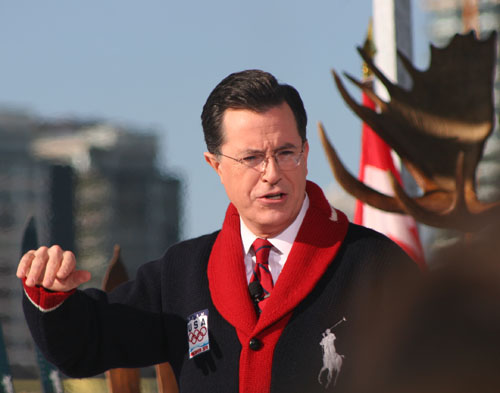
Stephen Colbert looked right at home sitting on a taxidermied moose, under a spray of fake white snow, waving a large Canadian flag. The crowd of about 6,000, gathered Feb. 18 at Vancouver’s Creekside Park to watch an outdoor taping of the Comedy Central show Colbert Report, made him do it. Sortof. A repeated chant of “Get on the moose” prompted the improv-loving comedian to give up metaphorically his bald-eagle mount, an image on the stage’s banner backdrop, and hop on the hoofed Canadian icon instead.

“If anything happens to me, it’ll be your fault,” he quipped to the audience packed around the stage, safely behind barriers.

low-res-flag-and-moose1

Colbert, in Vancouver to provide offbeat Olympic coverage and support the U.S. men’s speed skaters, clearly loved that Canadians can take a joke. After having called them “syrup-sucking iceholes” on his show, he confessed: “I take it all back.” He joked about needing an English-English dictionary to understand Canadian terms like “riding” for a political district. His stage manager and crew wore white T-shirts with a red maple leaf emblem that read on the front: “Icehole Crew.” The back of the shirt said: “Colbert Nation eh!”

colbert-close-up-low-res

(Colbert was reportedly delighted to receive a case of Iceholes Celebration lager beer, inspired by his Canuck putdown and specially brewed byVancouver’s R & B Brewing Company. R & B co-owner Barry Benson says on the company website: ” In celebration of our icehole-ish behaviour we have decided to get even rather than get mad.”)

brass-band-low-res

Before appearing, Colbert invited the Dutch oom-pah-pah group Klein pils onstage to warm up the fans with jovial, brass-band versions of songs from The Turtles’ Happy Together to Sweet Caroline, We Will Rock You, and Michael Rowed the Boat Ashore. He had discovered the boisterous musicians the night before while they performed rinkside at the Richmond Oval.

gold-medalllist-low-res

Colbert’s guests included Seth Wescott, two-time gold medal winner in snowboard cross, who picked up his latest gold this week in Olympic competition at Cypress Mountain. After Colbert asked to wear Westcott’s medal, he refused to give it back to the athlete, despite urgings to do so from the fans. Wescott, in turn, gave his host a team plaid jacket and autographed a specially made snowboard that bore Colbert’s image. (Colbert wore a navy Ralph Lauren cardigan and white 2010 track pants for the show, a nod to the designer of U.S. team uniforms in this year’s Winter Olympics.)

colbert-in-jacket

After his vocal support for the U.S. Olympic speed skaters and his team fundraising drive which brought in about $300,000 from fans, one would have expected Colbert to interview Shani Davis, who has appeared on his show in a satirical speed-skating challenge. But Davis was apparently offended by some of Colbert’s previous remarks and was not a guest. Colbert played a taped segment of his show onstage, which included a public apology to Davis. (That same day, Davis won a gold medal in the 1,000-metre men’s speed-skating in Richmond.)

aerialist-low-res
                                                                                                         Ryan St. Onge

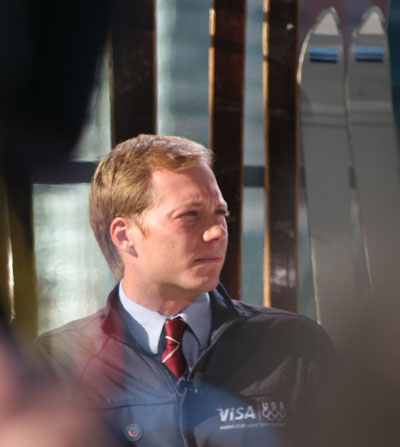
Other Olympic guests included U.S. freestyle aerialists Ryan St. Onge and Jeret “Speedy” Peterson. While Colbert teased St. Onge, who appeared shy in a conservative shirt and tie, about his name, Peterson appeared to hold his own with Colbert. When asked about getting kicked out of the  2006 Olympics in Turin, Italy for a drunken altercation, Peterson admitted his actions and told his host: “Sorry to steal your thunder.”

athlete-low-res
                                                                      Jeret Peterson

As if for required Canadian content, Colbert interviewed the Honourable Ujjal Dosanjh, Liberal Member of Parliament for Vancouver South. He teasingly asked Dosanjh what caste he was from and repeatedly mentioned India’s caste system. Dosanjh said that he didn’t believe in the caste system and stressed the equality of all. Yet, when Colbert continued trying to pin down the ultra-serious federal politician on this subject, Dosanjh appeared taken aback and possibly offended. I wondered if he even knew that such stances are part of Colbert’s shtick and on-camera persona.  

ujal-low-res

This show was the last of a two-day taping for Colbert at the park. Fans had waited since dawn for the 10:15 start time. I arrived at 7:45 a.m., joining a long line of people waiting patiently in front of Science World. A friendly female parks ranger warned us that the park had four inches of mud in places and was very slippery. She urged people not to run on the grass to avoid injury.  

colbert-with-skis-low-res

Yet, once the orderly queues received permission to move towards the stage,
 hundreds started running up the hill and charging through the mud. In such a free-for-all, someone who had arrived five minutes earlier could easily have gotten a much better viewing spot than someone who camped out overnight in wait. I ended up to the right of the stage close to the front.

colbert-crowd-low-res1

Following these fun shoots, Colbert toured a variety of Olympic pavilions in Vancouver, doing his usual campy and impromptu repartee, besides serving as an on-air NBC commentator and the U.S. speed-skating team’s assistant sports psychologist.

colbert-banner-low-res

Stephen Colbert will certainly never make the podium as an Olympic gold medalist, as portrayed on this banner made by a fan, but he has made phenomenal strides in bringing Canadian and U.S. psyches and spirits together through laughter. Maybe he deserves to keep Seth Westcott’s medal after all.

colbert-cheering-low-res1

Click here if you’d like to know more about my past film and TV writing.

February 21, 2010 at 2:03 pm Comments (11)

Haiti and Havana don’t mix in mainstream media

While watching news broadcasts of the international aid effort in post-earthquake Haiti, I kept wondering if Cubans had arrived to help. Their country is so close to Haiti and I know that they have highly skilled teams in emergency response, due to their many hurricanes. The newscasters mentioned aid groups from Red Cross to Unicef and various nonprofits active in Haiti, but I never heard if Cubans were on hand.


It was no surprise that U.S. media outlets didn’t mention Cuba, due to their decades-old embargo of this island nation and its inclusion on the U.S. list of “terrorist” countries.  But I figured that Canadian reporters would at least acknowledge Cuban aid efforts. Not so.


A friend of mine sent me the following article, which he found online via Al Jazeera’s English media service. This untold-by-the-media information makes me think of the “Health Care Olympics” episode that Michael Moore did on his show TV Nation. In that documentary segment, he had a person with a broken bone receive health care in three different countries (Canada, the U.S., and Cuba), then compared the service provided in each case. Cuba won: it gave the best care in the fastest time with no cost to the patient.


However, NBC censors stepped in, saying that politically, there was no way they could show Cuba as the winner on prime-time television. They insisted that the segment had to make Canada the winner, and although Moore argued on this point up to show time, Canada was announced the winner. Moore writes in his book Adventures in a TV Nation: “Did NBC think that a new missile crisis would erupt if we showed the commies winning? . . . It makes you wonder what else is ‘changed’ on TV if something this insignificant cannot even make it on the air in its original form.”


 Here are excerpts of the article my friend sent me:

Cuba’s aid ignored by the media?

By Tom Fawthrop in Havana

After the quake struck, Haiti’s first medical aid came from Cuba.

Among the many donor nations helping Haiti, Cuba and its medical teams have played a major role in treating earthquake victims.

Public health experts say the Cubans were the first to set up medical facilities among the debris and to revamp hospitals immediately after the earthquake struck.

However, their pivotal work in the health sector has received scant media coverage.

Special Report: Haiti earthquake

“It is striking that there has been virtually no mention in the media of the fact that Cuba had several hundred health personnel on the ground before any other country,” said David Sanders, a professor of public health from Western Cape University in South Africa.

The Cuban team coordinator in Haiti, Dr Carlos Alberto Garcia, says the Cuban doctors, nurses and other health personnel have been working non-stop, day and night, with operating rooms open 18 hours a day.

During a visit to La Paz hospital in the Haitian capital Port-au-Prince, Dr Mirta Roses, the director of the Pan American Health Organisation (PAHO) which is in charge of medical coordination between the Cuban doctors, the International Committee of the Red Cross (ICRC) and a host of health sector NGOs, described the aid provided by Cuban doctors as “excellent and marvellous”.

La Paz is one of five hospitals in Haiti that is largely staffed by health professionals from Havana. . .

Before the earthquake struck, 344 Cuban health professionals were already present in Haiti, providing primary care and obstetrical services as well as operating to restore the sight of Haitians blinded by eye diseases.

More doctors were flown in shortly after the earthquake, as part of the rapid response Henry Reeve Medical Brigade of disaster specialists. The brigade has extensive experience in dealing with the aftermath of earthquakes, having responded to such disasters in China, Indonesia and Pakistan.

“In the case of Cuban doctors, they are rapid responders to disasters, because disaster management is an integral part of their training,” explains Maria a Hamlin Zúniga, a public health specialist from Nicaragua.

“They are fully aware of the need to reduce risks by having people prepared to act in any disaster situation.”

Cuban doctors have been organising medical facilities in three revamped and five field hospitals, five diagnostic centres, with a total of 22 different care posts aided by financial support from Venezuela. They are also operating nine rehabilitation centres staffed by nearly 70 Cuban physical therapists and rehab specialists, in addition to the Haitian medical personnel.

The Cuban team has been assisted by 100 specialists from Venezuela, Chile, Spain, Mexico, Colombia and Canada and 17 nuns.

Havana has also sent 400,000 tetanus vaccines for the wounded. . .

Media silence

However, in reporting on the international aid effort, Western media have generally not ranked Cuba high on the list of donor nations.

One major international news agency’s list of donor nations credited Cuba with sending over 30 doctors to Haiti, whereas the real figure stands at more than 350, including 280 young Haitian doctors who graduated from Cuba. The final figure accounts for a combined total of 930 health professionals in all Cuban medical teams making it the largest medical contingent on the ground.

Another batch if 200 Cuban-trained doctors from 24 countries in Africa and Latin American, and a dozen American doctors who graduated from Havana are currently en route to Haiti and will provide reinforcement to existing Cuban medical teams.

By comparison the internationally-renowned Médecins Sans Frontières (MSF or Doctors without Borders) has approximately 269 health professionals working in Haiti. MSF is much better funded and has far more extensive medical supplies than the Cuban team. . .

Western NGOs employ media officers to ensure that the world knows what they are doing. . .

Cuban medical teams, however, are outside this predominantly Western humanitarian-media loop and are therefore only likely to receive attention from Latin American media and Spanish language broadcasters and print media.

There have, however, been notable exceptions to this reporting syndrome. On January 19, a CNN reporter broke the silence on the Cuban role in Haiti with a report on Cuban doctors at La Paz hospital.

Cuba/US cooperation

When the US requested that their military plans be allowed to fly through Cuban airspace for the purpose of evacuating Haitians to hospitals in Florida, Cuba immediately agreed despite almost 50 years of animosity between the two countries.

Cuban doctors received global praise for their humanitarian aid in Indonesia. Josefina Vidal, the director of the Cuban foreign ministry’s North America department, issued a statement declaring that: “Cuba is ready to cooperate with all the nations on the ground, including the US, to help the Haitian people and save more lives.”

This deal cut the flight time of medical evacuation flights from the US naval base at Guantanamo Bay on Cuba’s southern tip to Miami by 90 minutes.

According to Darby Holladay, the US state department’s spokesperson, the US has also communicated its readiness to make medical relief supplies available to Cuban doctors in Haiti.

“Potential US-Cuban cooperation could go a long way toward meeting Haiti’s needs,” says Dr Julie Feinsilver, the author of Healing the Masses – a book about Cuban health diplomacy, who argues that maximum cooperation is urgently needed. . . .

The Montreal summit, the first gathering of 20 donor nations, agreed to hold a major conference on Haiti’s future at the United Nations in March.

Some analysts see Haiti’s rehabilitation as a potential opportunity for the US and Cuba to bypass their ideological differences and combine their resources – the US has the logistics while Cuba has the human resources – to help Haiti. . .

But, will Haiti offer the US administration, which has Cuba on its list of nations that allegedly “support terrorism”, a “new dawn” in its relations with Cuba?

In late January, Hillary Clinton, the US secretary of state, thanked Cuba for its efforts in Haiti and welcomed further assistance and co-operation.

In Haiti’s grand reconstruction plan, Feinsilver argues, “there can be no imposition of systems from any country, agency or institution. The Haitian people themselves, through what remains of their government and NGOs, must provide the policy direction, and Cuba has been and should continue to be a key player in the health sector in Haiti.”


(For those of you who think “terrorist” when you hear “Al Jazeera,” consider this: the CRTC in Canada has agreed to broadcast Al-Jazeera English (AJE) to its cable and satellite providers. Started in 2006, AJE is the primary international news channel based in the Middle East that covers issues in the developing world. Hardly a terrorist sympathizer, AJE criticizes political repression and is banned in Iraq, Tunisia, Algeria and until last summer, Saudi Arabia. Ponder this media cred: former CBC News chief Tony Burman is AJE’s managing director. )  

February 16, 2010 at 7:33 pm Comments (0)

Media

Feature writing my favourite

Ever since learning to read and write, I knew that I wanted to live in the world of words. As a child, I wrote stories on my mother’s typewriter, kept a journal, made mini-newspapers, and loved to visit the library.


As a teen, I wrote newsletter blurbs and edited my high school yearbooks. At university, I co-edited the tri-weekly student newspaper and worked as a summer reporter at The Edmonton Journal and The Vancouver Sun.


 Today, I have published in more than 50 books, magazines and newspapers, including The Globe and Mail, The Georgia Straight, Sierra and BC Business magazine. Yet, as a reporter, I soon realized that “hard” news or daily reporting of events didn’t excite my heart. I preferred feature writing, which offered more depth and creative options as a writer.


 Early in my career, at age 21, one small reporting assignment shaped my future work decisions. While at The Edmonton Journal, I was supposed to do a story about a baseball coach who became paralyzed after a member of his peewee baseball team had thrown a bat in anger. The bat had bounced off the ground and hit the coach’s spine, leaving him permanently injured.


 When I phoned the coach for an interview, he selflessly pleaded with me not to pursue the story, insisting that the boy and his family had already suffered enough. His grace and consideration in crisis touched me.


I discussed the situation with my editor, who relented; he said just to include a short paragraph on the incident as a matter of record. I did so and in the process, learned that my priorities would never make me a hard-nosed reporter: I would always place the human factor above getting a story at any cost.


When interviewing people as a professional writer today, I have found myself more intrigued by their personal tales and inner struggles than just recording an external event.


I like to extend compassion and a soulful connection to the people I write about, rather than only find a story angle and maintain so-called objective, professional distance.

November 30, 2009 at 5:49 pm Comments (0)

Media

Whatever happened to free speech?

Detention and interrogation. A vehicle and laptop search. Riffling through reporter notebooks. I found Canadian border officials’ recent treatment of U.S. journalist Amy Goodman a disturbing threat to free speech. 

Host of Democracy Now, a public radio show in the States, Goodman was stopped in a vehicle with two assistants at the Washington-B.C. border on Nov. 25. Visiting Canada to promote her new book, she was en route to Victoria for a speaking engagement. Yet the border guards kept grilling her about the 2010 Winter Olympics, afraid that she was coming to Canada to criticize this world event. What if she was? Is freedom of speech the new contraband?

The guards  interrogated her for more than an hour, reportedly demanding to know the details of Goodman’s planned speech. They asked her at least six times if she was coming to Canada to speak about the Olympics. One border patrol agent looked through her book, Breaking the Sound Barrier, and made notes from it. Goodman said: “I was totally shocked . . .It sends a message that we’re being monitored, watched. . .It sends a message to other journalists to watch what they do.”

Fear of such reprisals might indeed result in unnecessary self-censorship on the part of reporters, both locally and those visiting from around the world. Are we heading for a Big Brother world of Government Think?

We’ve already seen the fallout in Vancouver from “free speech zones” designated for protesters during the Olympics. A gag order targeted for the three-week event prevents the display of any commercial signs that  might compete with the corporate logos and messages of official sponsors like Visa or Royal Bank. Whose interests are we protecting, anyway?

This makes me think of practices by companies like Coke and Pepsi that try to muzzle negative comments about their products. In many cases, they make any school or university that carries their bottled water sign an agreement saying that they will not publicly criticize their products.

November 30, 2009 at 5:01 pm Comments (0)

Newer Posts »