Heather Conn Blogs

spoutin’ about by the sea

The Northern Gateway Project: Which conversation of “facts” will you join?

This week, The Vancouver Sun ran in multiple papers a three-quarter-page ad from Enbridge, the U.S. corporation behind the Northern Gateway project. Enbridge plans to build 1,200 kilometres of pipeline across northern B.C. from Alberta’s Tar Sands project to Kitimat on the coast. This would end British Columbia’s current moratorium on related tanker traffic and open up a vast, pristine area, including the Great Bear Rainforest, to more than 200 oil tankers a year.

(For more background on this project, see my archived post “No oil tankers on B.C. coast,” Dec. 1, 2009 under Environment on this blog.)

These ads are a prelude to the public hearings about the Northern Gateway project, to be held from January to March 2012 in some of the northern communities situated along the suggested pipeline route.

I wrote a letter to The Sun in response to these ads, which I didn’t really expect them to publish, since it criticizes an advertiser. Here’s what I said:

“I wanted to point out how your repeat ad from Enbridge executive vice-president Janet Holder is a wonderful example of doublespeak. The most telling line is the following: ‘We fully accept the responsibility of earning your trust and confidence regarding the high standards and expectations of this project.’ This phrase implies that the go-ahead for the Northern Gateway oil pipeline is already a fait accompli. Therefore, the invitation to ‘join the conversation’ is really just another way of saying: ‘We want you to see it our way.’


“I applaud the initiative to host public hearings and have open dialogue. However, this so-called open letter by no means gives the impression that if enough people speak out against the Northern Gateway project at the hearings, Enbridge will not move forward with it. Sure, the company might have ‘a long tradition of listening to all opinions,’ but how many of those opinions made them stop their actions? Such use of language would make even Orwell blush, if he was still around. In response, I offer a simple saying learned in the schoolyard: ‘Say what you mean and mean what you say.’


The letter by Holder says: “I invite you to engage in the conversation based on informed, knowledge-based opinions, which are grounded in balanced facts and realities.” This means “facts” like those presented on the Northern Gateway Facts website, facts like “the chances of a marine mishap are very unlikely.”


Is that less or more unlikely than the Michigan oil spill caused by Enbridge  in July 2010? The rupture of a 30-inch piece of pipeline released 819,000 gallons into the Kalamazoo River and carried oil 30 miles downstream this Lake Michigan tributary.


For real facts on the Northern Gateway project, I recommend the book Tar Sands: Dirty Oil and the Future of a Continent by Andrew Nikiforuk and any of his related articles. To learn more about the impact of this pipeline project on marine life, fragile waterways, and First Nations livelihoods, please see the website for Pacific Wild.

, , , ,
December 23, 2011 at 4:35 pm Comments (0)

Occupy Vancouver: 3,000+ bring power to the people


“First they ignore you

Then they laugh at you

Then they fight you

Then you win” – Gandhi

(on a sign at Occupy Vancouver)


“In times of universal deceit,

Telling the truth is a revolutionary act”

— George Orwell

(on a sign at Occupy Vancouver)


Under the menacing glare of gargoyles perched high on the corners of Hotel Vancouver, across from looming RBC and HSBC buildings, we gathered downtown, 3,000+ strong on Oct. 15. This Occupy Vancouver movement, spawned by weeks of Occupy Wall Street activism in New York City, had set up a sprawling camp of tents, plus tents for food, first aid, public education, and a children’s area, in front of the art gallery.


                                                                                                               — photos by Heather Conn

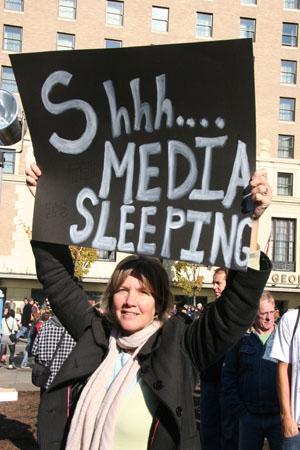
A handful of friends and I from British Columbia’s Sunshine Coast sat on the edge of the mosaic fountain in front of the Vancouver Art Gallery, surrounded by people of every age, ethnicity, and background: infants, white-haired grandmothers, laid-off workers, disgruntled professionals, business people in suits, women in high heels and fashionable dress, bohemians in masks and costumes . . .They were all a highly visible part of the 99 per cent of western society seeking to be heard and counted as banks, corporations, and governments have gained hugely skewed levels of power, making decisions with little accountability over issues that affect the earth, the public good, and livelihoods. As activist Naomi Klein said a week earlier as part of Occupy Wall Street: “Our system is crashing economically and ecologically.” As one of the dozens and dozens of homemade signs in Vancouver, held high among the throng, said on this day: “Another world is possible.”


I was heartened to see more than a thousand people gathered by 10 a.m., after premier Christy Clark and others had dismissively predicted that few would appear at the event. More and more people kept arriving, until at least 3,000 (some reports claimed 5,000) marched peacefully in a square along four downtown blocks, starting northward at Georgia and Howe. No one smashed windows, threw food at cops, or yelled verbal abuse at passersby. Cars honked in support of the moving crowd. A police officer wore an orange flower in his lapel. The sea of signs gave heart and meaning to what was a living, growing statement (not “a protest”) shared with others who were organizing publicly on the same day in 1,000 cities across the globe:


“One World, One Humanity, Share the World’s Resources”

“Serve the people”

“Close the gap”

“Vancouver wakes up”

“A fair taxation system is overdue”

“We’re the #1 Highest Child Poverty Rate in Canada – Way to go B.C.”

In the first general assembly that morning, various speakers, as part of a moderating team, stood on the art gallery steps and explained the proposed working model for consensus. As defined in the handout provided to the crowd: “A consensus is a decision-making process that attempts to be inclusive and accommodating of the desires and needs of an entire group.” Workers in Venezuela and other Latin American countries have used such models for decision-making in factories and collectives. As one of the moderators pointed out: “It’s not pretty.” It was slow, tedious, and the process bumbling. We were all new at this; our capitalist system had not created models for such forms of decision-making. People would holler out occasionally: “This is what democracy looks like.”


Eager for action and group-based agreements, I grew impatient as different speakers read through the consensus document, word for word, using the mike and then having people within the crowd repeat each phrase in a “human mike” format. Requests went out for translators in a host of languages, from Farsi to Spanish. Hand gestures were given as symbols for how each participant could indicate whether he or she agreed with a proposal, had reservations, would stand aside (“I cannot support this proposal and will not help implement it but do not want to stop the group or block the proposal”) or would block it (“I have a fundamental disagreement with the proposal that must be addressed and has not been resolved”). This repetitive process took an hour and a half.


I was soon growing bored and frustrated. I had to examine my own impatience and desire for a quick outcome, over the inclusion of all questions and requests for something to be repeated. Rather than feeling energized, hopeful, and excited, this process left me feeling deflated and in limbo. But the non-stop stream of informal speakers from the crowd, who took turns at the microphone, helped to draw me back to the power of a group assembly. (The maximum time allotment for each speaker, decided by the group as a whole, was five minutes.) A speaker asked: “Do you trust the system?”

“No,” the crowd roared back. If the group thought that someone was going on too long or the remarks were too self-serving, they hooted or called “Wrap it up” or made the accompanying hand signal. Here is a selection of those who spoke, besides David Eby of the B.C. Civil Liberties Association and Seth Klein (Naomi’s brother) of the Canadian Centre for Policy Alternatives:


  • Bob, a unionized meter reader for BC Hydro, who will be replaced by a smart meter within a year, after receiving only a 1% pay increase in a decade: “Gordo (former premier Gordon Campbell) exempted smart meters from due process”;


  • an artist from Montreal: “We’re losing our neighbourhoods”;


  • Paul Grignon, creator of animated films such as Money as Debt;


  • a representative from Zeitgeist Vancouver, part of the Zeitgeist world movement: “What are the root problems?”


  • Activist and grandmother Betty Krawczyk: “Our environment is going, our wild salmon are going. We won’t tolerate it. Their (government/corporate) power comes with our permission, from our acquiescence. True power is in our hands. The power belongs to us, always and forever.” That brought on loud cheers.


  • The Raging Grannies: “Your right is to be heard.”


Later that day, after meeting a client and some of his medical colleagues for lunch at upscale Shaughnessy Restaurant, I was heartened (again) to hear that one of them, a successful doctor, had wanted to join the Occupy Vancouver events himself. He said that he had felt like going down there and throwing something. I was surprised to hear such a remark in that context from such a professional; you never know where you’ll find someone of like mind.

The day’s events did not topple any existing structures or result in resounding changes. However, the simple act of people coming together in peace in a public space to voice discontent and seek more compassionate and inclusive alternatives was a powerful reminder that the power of the people lies innately with the people and in democratic process. We are the power of the majority and we control how much of that we choose to keep or give up.

After returning home just before the seven p.m. general assembly, my husband and I stopped to watch an astounding natural sight: thousands upon thousands of crows were flying, seemingly without end, through the sky. They kept coming and coming, a sprawling black flap of wings across blue, heading east above the Commercial Drive SkyTrain station. They appeared to be coming from downtown. I thought to myself: “Maybe they had their own gathering.” I had never seen such a massive group of crows in my life. I took it as a sign.


Click here for a Buddhist perspective on Occupy Wall Street, by Buddhist teacher and psychotherapist Michael Stone, author of Awake in the World: Teachings From Yoga and Buddhism for Living an Engaged Life.


Click here to watch U.S. news commentator Keith Olbermann outline what Wall Street protesters want (October 05, 2011)


, , , ,
October 18, 2011 at 12:50 pm Comments (5)

Social media: Have we forgotten the “real” world?

At a social media seminar I attended this week in Vancouver, one of the presenters said: “The real world is so key.” She was referring to live-blogging events. I had to laugh at the irony. We have to be reminded to participate in activities that occur beyond cyber-reality? How sad.

As a writer and communicator, I firmly acknowledge the value of the Internet and social media in connecting with others and sharing information. But if this activity ends up alienating and isolating us from the flesh-and-blood world, it’s ultimately substracting from, rather than adding to, our lives. Do we chat with a near-stranger online, or visit a real friend face-to-face in a cafe? Do we choose to email rather than phone someone? Are personal encounters diminishing, replaced by Tweets and cyber-dialogue?

I think of family trips we took when I was a child. While driving through spectacular scenery, from the Petrified Forest and Painted Desert in the U.S. to the orange-red canyons and mesas of Arizona, my mom had to repeatedly urge my sisters and I to look out the window and admire the view. We were often too engrossed in some card game or crossword puzzle in the back seat to even notice what was around us. Unwittingly, we were shutting out the world and our relationship to nature. (This was many decades before the term “nature deficit disorder” was coined.)

Social media can create the same real-life siloing. On the same night as the seminar, I attended a talk and reading by musician/author Sylvia Tyson at the Festival of the Written Arts in Sechelt, BC. She read from her new novel Joyner’s Dream, which reinforces one family’s connection to music through multi-generations. In the Q&A afterwards, someone asked Tyson if she was on Facebook.

“I’m one of the original Luddites,” she replied. (That was a no.) Applause followed from at least one-quarter of the sold-out audience of several hundred. I assumed that those who clapped were honouring the value of person-to-person sharing, the kind of connection that Tyson created that night through her spoken word and recorded music.

I don’t advocate shunning the digital world. Let’s just keep it in perspective. To me, nothing beats the unadulterated, non-enhanced connection, in person, with people and nature. Once we’ve stopped valuing that relationship, and making time for it, we might as well become heartless cyborgs.

, ,
August 6, 2011 at 10:49 am Comment (1)

Do your choices lead to social change?

Have you ever wondered if today’s overwhelming array of choices — whether it’s food products, sex partners, careers or reading material — disempower, rather than serve you? If so, then you’ll enjoy a 10.5-minute animated presentation narrated by sociologist and legal theorist Renata Salecl.

Her premise is that under capitalism, too many choices create anxiety for us. (Raised under Communism in the former Yugoslavia, Salecl challenges that form of ideology too.) As social beings, we’re inclined to choose what others choose, she says, and we worry about how others will regard our choice. Not clear on “What do I really want?”, we become frozen, pacified, and indecisive. (I agree, although many independent thinkers do disregard popular opinion and make choices that seem to serve themselves far better.) We try to make an ideal choice, but there never is one. Therefore, we experience loss (reaction to the choice(s) we didn’t make), which can provoke more anxiety. Sounds cheery, right?

Salecl mentions a lawyer friend of hers who gets anxious when he has to order a bottle of wine. If he gets one that’s too inexpensive, he worries that he’ll look cheap. If he buys something pricey, he figures his fellow diners will think he’s showing off. So, he buys a moderately priced bottle and then feels guilty and anxious for having others’ supposed opinion of him determine his choice.

That makes me think of a food line-up I was in years ago at Capers in Vancouver, BC. A man in a suit in front of me, whom I later learned was a judge, seemed to have untold difficulty deciding which juice to choose from the refrigerated shelves. I watched him, amazed, as he seemed to wrestle for about five minutes with the choice. Later, I thought: How on earth, while on the bench, does he choose people’s fate? Are those choices easier for him because they’re pre-determined, more or less, by the law?

I recognize how quickly I feel overwhelmed when shopping somewhere with too many choices; that’s one reason why I rarely go to Costco or ever shopped at Granville Island Market. Salecl says that too much choice precludes social change because people end up feeling so anxious and powerless, they don’t want to risk more vulnerability. Afraid to lose what they already have, they won’t join others to organize and confront authorities to seek change.

In Salecl’s view, the myriad of choices under capitalism reinforces the myth that “Everyone can make it.” If individuals don’t reach their dreams, they feel guilty for their perceived failures, or shame for being “poor”, however that’s defined. Unfortunately, instead of criticizing society for this, people too often turn their criticism inwards, railing at themselves for not measuring up and never feeling good enough. A variety of malaises can result, from anorexia and bulemia to workaholism and other addictions.

Overall, Salecl’s premise is that the ideology of choice prevents social change. Workers (what she calls “proletarian slaves”) end up believing that they are in charge and have control (as consumers) when someone else (a boss or company) determines their livelihood.

It sounds dismal but too true. Unfortunately, Salecl’s presentation doesn’t present solutions. I think that self-awareness and nurturance of an inner sense of self, beyond the socially created “ego”, is a huge first step. If you are aware of your true desires (not those imposed on you), you can mindfully make more choices that serve your real needs, not those that advertisers and the consumer world say are yours. If we could all internalize the belief “I’m okay exactly the way I am” rather than “I’ll never be good enough,” that would spawn a massive social revolution. External change, inspired by inner growth, makes for the greatest and most meaningful change, in my view.

, , ,
July 9, 2011 at 1:09 pm Comment (1)

Yippies in Love: truly a riot

yippies-in-love-lowres

A current celebration of Vancouver, B.C.’s radical early-70s era presents the delightful fun and conviction (in both senses of the word) of an activist spirit. My husband Frank and I saw Bob Sarti’s play Yippies in Love at The Cultch last night, and I came away so enthused, I couldn’t sleep for too many hours later. Frank, a former New Yorker, commented: “This was way better than a lot of off-Broadway stuff  I’ve seen.)

This campy musical romp, “borrowed from a true story” of Vancouver history and Sarti’s own anarchic actions, recreates key public protests of 1970-71, using the ideals of a fictional Yippee household as its thematic lens. The love story begins unwittingly, when Andy (Steve Maddock), a U.S. surfer dude avoiding the Vietnam draft, decides to try and cross the border at Blaine, WA on May 9, 1970 — the same day that hundreds of peaceniks and Yippies from Vancouver invaded Blaine to protest the Vietnam war and claim the Peace Arch as their own. (Sarti still retains a small chunk of the Arch as a souvenir of his involvement that day.)

Caught up in this raucous group action, Andy meets plucky protester Julie (Danielle St. Pierre), a feminist single mom who cherishes her independence. She later invites him to join her household of Yippee enthusiasts (actors Bing Jensen, Emily Rowed and Rebecca Shoichet), who each play a series of characters, ranging from local Yippie motivator “The Wizard” to Vancouver Judge Les Bewley and the city’s former notorious hippy-baiting-and-hating mayor, Tom “Terrific” Campbell. All of the actors are excellent; my only criticism is that Bing Jensen’s singing voice didn’t project loudly enough to we folk in the last row.

One might expect a Question Authority play, which mocks The Man and slams capitalist power, to lay on the heavy rhetoric, but Sarti keeps the tone entertaining and educational, in irreverent Yippee style. His pithy lyrics are hilarious and the choreography routines, especially Dancin’ Doobies, are great. His use of news footage of police violence at events like the Gastown riot (on Aug. 9 1971) enhances the injustices rampant at the time, as do the excerpts from court transcripts that Sarti weaves into dialogue.

A retired Vancouver Sun reporter, Sarti projects above the stage numerous media headlines, including ones from The Sun, which aptly captured the public hysteria over peaceful protest. (As a cub reporter one summer at The Sun too many decades ago, I  benefited from Sarti’s information-sharing and enjoyed his reporting of non-Establishment events.) In the program for Yippies in Love, he thanks the Newspaper Guild, his union at the time, “for protecting my job security while I juggled two careers — while collar worker by day, white collar Yipppie by night.”

The play runs until July 3 and I urge anyone with an iota of activism in their blood to see it. Its message of grassroots action seems especially a propos while people riot and die for democracy in the Middle East, and Vancouver reels from the yahoo riots by drunken Canuck fans. (After today’s performance, Sarti is hosting a panel “Yippies and Yahoos: What’s the Difference?”)

Yippies in Love is dedicated to the memory of Sarti’s father Paolino, who fought fascism in Spain. It’s directed and produced by Jay Hamburger, artistic director of Theatre in the Raw, which bills itself as “giving exposure to voices seldom heard” since 1994. Jay appeared onstage to introduce the play, and read Lawrence Ferlinghetti’s poem “The World is a Beautiful Place” to evoke the protest tone of the early 1970s. The third stanza reads:

Oh the world is a beautiful place
to be born into
if you don’t much mind
a few dead minds
in the higher places
or a bomb or two
now and then
in your upturned faces.

Noted pianist and arranger Bill Sample, the play’s music director and composer, joined guitarist Robbie Steininger to energize the whole show with great live keyboard action, from ballads to Hendrix. All ’round, a wonderful experience.

, , , , , , ,
June 26, 2011 at 4:12 pm Comments (2)

Offensive and absurd: recent ads hit an astounding new low

            There’s never any shortage of offensive advertising, but I found one recent  television ad so repulsive, I had to write about it.

            It has aired for a few months, seen by millions during the Stanley Cup playoffs. It’s the TV ad for Old Milwaukee beer, showing vintage-style pinup images of two buxom and leggy women, wearing tight and scant outfits from the 1940s-50s era. They appear, in close-up, on either side of an Old Milwaukee beer can, as if they’re about to cuddle it.

            That imagery alone astounded me. I thought that by 2011, many major advertisers have begrudgingly matured enough to portray women as more than just the usual male sex objects. Does Pabst Brewing Company, which brews and owns Old Milwaukee, have such little regard for female sports fans?

            Well, these caricatures weren’t the worst of it. At a rare time when my remote wasn’t muted for commercial breaks during the hockey playoffs, I was appalled to hear the accompanying narration: “A free girl with every can.” How outrageous! This likens women to nothing more than a disposal party favour, ready on demand to provide pleasure and satisfaction — at no cost. What a disgusting affront to females of every age.

            For pure tasteless exploitation, this ranks almost as high as the United Colors of Benetton’s former ads, which used scenes from real-life Third World suffering to grab interest and juxtapose against their luxury fashions.

            Part of me is shocked that the Canadian Broadcasting Corporation accepted this sexist piece of tripe, yet I know that the network is desperate for revenue. Ironically, decades ago, the CBC refused to run a short TV ad that portrayed logging companies, destroying B.C. forests, as bloated pigs. The ad was meant to present an alternative view  to the “Forests Forever” TV ads running on the network at the time. Outraged by the CBC decision, Vancouverite Kalle Lasn launched Adbusters, now an international magazine and media organization that slams consumer culture and mainstream advertising.

            I plan to write to both CBC and Pabst and let them know what I think about the Old Milwaukee ad. If you find this ad offensive, I encourage you to do the same.

 *                      *                      *                      *                      *                      *

            When my husband told me this week that he heard a radio ad for a product called Fresh Balls, I was dumbfounded. What will marketers think of next? Is there any part of the human form left that adertisers haven’t identified as badly needing to be fixed in some way? Some wily, creative ad agency type must have figured: “Hey, why not grab guys by the balls (metaphorically)? Here’s a whole untapped market we can focus on.”

            The cream is supposed to keep “your private area” dry, clean and fresh, instead of “sweaty, sticky and chafing”, which apparently “all men suffer from.” Daily application is recommended as part of a man’s regular “grooming routine”; frequency uses up more product, right?

June 12, 2011 at 6:26 pm Comments (4)

The Quaids in Hollywood North: How can you trust a guy who wears a fake dick?

When a filmmaker appears onstage at Vancouver, B.C.’s Rio Theatre and says: “The bullets are rubber, the penis is a prosthetic, and there’s a lot of nudity,” you can expect her upcoming flick to be, er, a tad unconventional. (I was only thinking: How can you trust a guy who wears a fake dick?)

When that filmmaker is Evi Quaid, wife of wacky Hollywood actor Randy Quaid, then you can expect the movie to be extremeo bizarro. Yes, indeed, this year’s April 22 world premiere of Star Whackers, featuring Randy as three ultra-strange characters plus a cast of several mangy-looking donkeys (the four-legged kind), was as woo-woo as they get. This grossly self-indulgent flick seemed akin to a bad student experimental film trying desperately to be clever and edgy, yet coming across as something influenced by alternating doses of downers and LSD.

(For backstory, it helps to know that Evi and Randy are on the lam after fleeing from California to Canada. In the U.S., they left behind a range of crimes from break-and-enter to unpaid hotel and restaurant bills. Randy believes that he’s targeted for death by Hollywood “star whackers” who seek to kill celebrities to boost their market value. He thinks that stars such as Heath Ledger and Chris Penn, among others, were victims of these professional assassins.)

Hence, his wife’s film focuses on a mostly naked Randy, clothed in a full-length fur coat, on the run from Randy the assassin, clad in black with sunglasses and a serious-looking assault rifle, interspersed with Randy as an unknown third character, who spouts off on a hilltop while wearing an animal skull and antlers on his head and a black, open-weave bag stretched across his face. Your usual run-of-the-mill stuff, right? (Randy’s penis prosthetic, by the way, is a forlorn, droopy-looking thing. Can’t guess, and don’t want to, what’s hiding underneath it.)


Randy’s penis prosthetic is a forlorn, droopy-looking thing.


I had expected Evi, who appeared in the Rio’s aisles wearing tight clothes, a wide-brimmed hat and a video camera, to screen a 10- or 15-minute excerpt, then ask for audience feedback. Instead, we were subjected — the theatre was about a third full — to an 88-minute screed of Randy reciting Shakespeare and repeating soliloquoys over and over and over without any identifiable plot or script. After about the eighth consecutive time of him spouting “To be or not to be,” even the curiosity-seekers in the crowd like me were groaning.

We saw frontally nude Randy rolling in dry grass in his long fur coat. We saw him bellowing Shakespeare while holding the same antlered animal skull that later ended up on his head. We saw him eating dried grass on all fours and putting  a white donkey in a head lock, presumably to get information out of him. Early in the movie, he grabs a clump of fur-looking hair and holds it to his head and his crotch. The audience roars. Extreme close-ups put his (Randy’s, not the donkey’s) nose hairs and bulging eyes a lot nearer than this viewer would have liked.

In the movie, Randy plays the fiddle while ranchers brand cattle. He stares down a camel in the middle of remote desert scrub. He drives down a dusty desert road as a killer in a white Mercedes jeep and takes pot shots at invisible enemies. (The film’s on-screen opening explained that Randy was obsessed with the spirit of Shakespeare’s character Falstaff. He later said that he performed the part in what was to be a Broadway musical that  never happened.)

Based on the opening sequence (a pink-toned underexposed effort with Randy on a Shakespearian rant in full-frontal nudity), Evi apparently didn’t use a boom mike on a windy day. Strutting in a field in his fur coat, Randy sounds like he’s trying to speak over a hurricane.

Throughout the whole film, audience-members laughed, even at parts that the couple might have deemed serious. I actually felt compassion for the Quaids then: who wants their creative effort laughed at? (After four hours, I couldn’t bear to sit through a second 15-minute intermission for the Q&A to hear the couple’s view of their process and product.)

In my view, the scenery and wardrobe were the best part of the movie. The open desert setting looked like it could have been California, Mexico, Arizona or New Mexico.  The suits Randy wore in the film were unquestionably expensive and well tailored. I couldn’t help thinking: This movie is how this wealthy couple spends their money? What a waste. (The pair has sought refugee status in Canada and has made Vancouver their adoptive home. Evi is now here legally because her dad was born in Canada, but Randy’s application is still pending. The two donated the night’s proceeds to the Canadian Council of Refugees.)

Admittedly, I think that Randy is a gifted character actor who’s gone seriously askew. The evening opened with a screening of the Canadian movie Real Time, in which Randy plays, coincidentally enough, a hired assassin of a young, compulsive gambler whose unpaid debts are too high. In the role, he appears to channel Michael Caine, and won the 2009 Vancouver Film Critic’s Circle Award for his portrayal.

I confess that it was voyeuristic of me to attend An Evening with the Quaids, after hearing about Randy’s conspiracy theory and reading about the couple in the January 2011 issue of Vanity Fair. That publication calls them “Hollywood’s craziest couple ” and points out “that’s a high bar.” I agree, and yet, at least, Randy and Evi have been married since 1989, which is a helluva lot longer than most Hollywood couples, including Randy’s younger brother Dennis.


This movie is how this wealthy couple spends their money? What a waste.


I also confess to enjoying the lyrics in Randy’s two rockabilly songs Star Whackers (“They’ll sell your vital organs on ebay”) and Mr. DA Man (“a little bureaucrat in a chintzy suit”), which he performed as lead singer with local band The Fugitives. A handful of people in the audience, including the guy in front of me, were videotaping this portion of the show. (Sure enough, you can see and hear Randy singing Star Whackers from that night on YouTube.) About a half-dozen young women in tight black clothes danced in the aisles, then ran 0nstage and gyrated with Randy as he sang.

Yes, even in Vancouver, Randy has his groupies. They were hollering “We love you, Randy” outside the theatre at the front of the line on Broadway before the show. I was surprised at the media presence then. Global, CBC, CNN and Fox were doing on-camera interviews with some of those waiting and Jack FM reps were hoisting around life-size cutouts of several of their DJs. When Randy and Evi arrived, gleeful cheers went up and people clamoured for autographs.

Randy and Evi recently told Vancouver magazine WE that they love Canada and “want to give back in every way possible.” Why not use your money to build a shelter for the homeless in Vancouver, for people who already live here legally?

May 8, 2011 at 1:26 pm Comments (0)

What’s in a head? A typo of privilege

As an editor, I find it hard to turn off the part of me that zooms in on a typo in anything from a menu to a marquee. Well, I spotted a whopper a few weeks ago in a full-page ad in The Vancouver Sun, which left me shocked at its size and brazen irony.

The four-colour advertisement, by Polygon Homes, featured a sexy young couple, dressed in black attire, as if for an upscale soiree. They stood poised between two fancy, black, wrought-iron gates, which opened onto an immaculate lawn, trimmed hedges and trees, suggesting the entrance to a palatial estate.

The ad was promoting a new real estate development, Mayfair Place, in Richmond, BC as “a collection of Georgian-inspired apartment homes.” The ad copy read that these new homes were “evoking the sophistication of London’s prestigious Mayfair district, in a sought-after location that’s just minutes from hundreds of popular shops and services.”

Okay, I get the message: these places are supposed to be classy, trendy, and full of status power. Well, guess what? Having money and a position doesn’t mean that you’re literate.  (Just ask George W. Bush.) The ad’s bold headline, which appears in at least 48-point type (about a half-inch high), reads “A Priviledged Place.”

When I first read the head, I thought that maybe they were doing a deliberate play on words but no, it’s one giant — and expensive — boo-boo. How many people looked at that ad before it went to print and never spotted this large spelling mistake, exposed in three words on a single line? So much for the power of suave images. The two models in the photo might as well have eggs dripping off their chins onto their polished attire. 

We all make mistakes, I know, but some are bigger, and more public, than others. I wonder what Michael Audain, the boss of Polygon Homes and an art collector who sits on the board of the Vancouver Art Gallery, thought when he saw this all-too-obvious error.

I love the irony of this goof, because it reduces the impact of the ad almost to a spoof, making a complete mockery of its attempt to promote wealth and success.

April 3, 2011 at 6:00 pm Comment (1)

Help save Canada’s public radio and television

There’s talk in Parliament about killing our public broadcaster, the Canadian Broadcasting Corporation (CBC). That’s like taking a knife to the flag and snubbing hockey and maple syrup.
We’ve known for awhile that Stephen Harper has no fondness for the CBC. Last month, Dean Del Mastro, Parliamentary Secretary to the Minister of Canadian Heritage, said publicly: “Maybe it’s time we get out of the broadcasting business.” Since all such public messaging must receive prior approval from the Prime Minister’s Office, we know that this reflects Harper’s sentiment.
On Dec. 6, during Parliamentary debate, Heritage Minister Moore twice refused to dismiss the idea that the government should kill public broadcasting.
We need to show our support for our public broadcaster. Please sign the petition below and forward it to others. Thank you.

December 14, 2010 at 1:54 pm Comments (0)

A hacker attack: they got me

When I tried to open this blog and my two other websites this past weekend, I was horrified to discover that a hacker had invaded and taken over all three. Instead of seeing my home page, a giant phoenix-like character with folded wings on a black background appeared, complete with music and a  blinking message in all caps: ACCESS DENIED. Whoever the culprit was, he/she was displaying obvious pride and glee over this computer coup.


Talk about feeling like a vulnerable victim. It was as if someone had changed the locks on my home and I had no idea if the contents of my house still existed. I couldn’t imagine trying to recreate all of the data and images on my sites.


Since my mind too often searches for cause-and-effect connections, I wondered if this was a retaliation for my criticism of a recent youth-activist film. Ironically, a computer consultant had just installed Spybot Search and Destroy software (I love that name) and beefed up my online security.


I immediately notified the woman who set up my sites, who then informed my web server. She responded with “Holy cow!! I’ve never seen such a blatant attack before!” It turns out that this cyber-hoodlum had hacked in at the server level, and affected a number of other sites using the same server. At least I don’t depend on my sites for mail-order businesses and the like.


Thankfully, the web server remedied the situation the next morning and all of my site content was restored. No blog posts were missing and nothing in my writing had been tampered with. What a relief.


Beware of online menaces. Make sure that your web server has filled any potential gaps at the server level. Keep as much protective security on your site as possible. Such incidents are unwanted reminders of how dependent we are on technology and how every communication medium has its great benefits — and malevolence.

October 25, 2010 at 5:38 pm Comments (2)

« Older PostsNewer Posts »